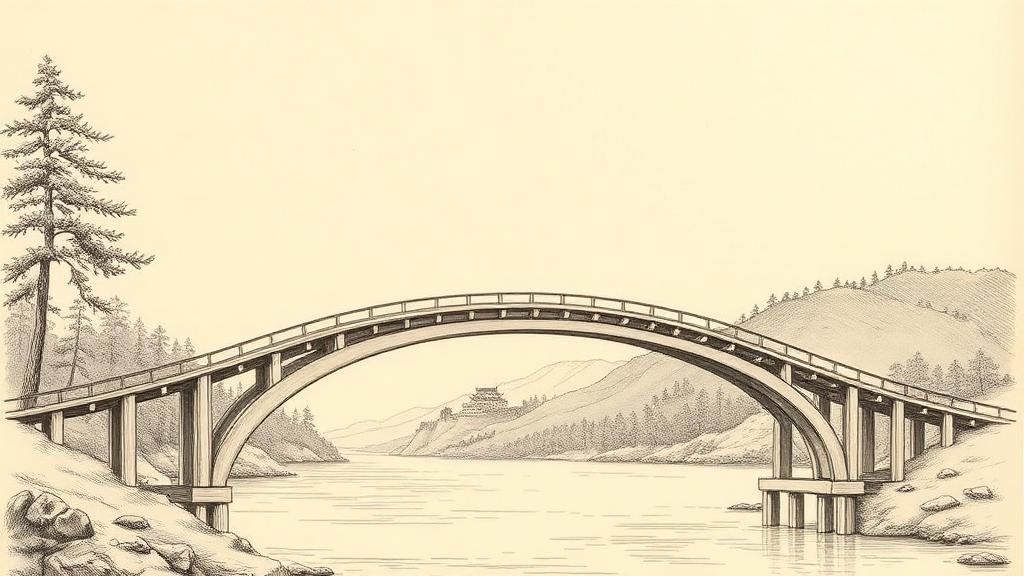
Kintai-kyō: the five wooden arches of Iwakuni
Sometime around 1672, a Chinese Buddhist priest living in Japan unrolled a painting for Kikkawa Hiroyoshi, the third lord of Iwakuni Domain. The painting showed West Lake in Hangzhou — and crossing it, a five-arched bridge stepping from islet to islet with nothing but air beneath its spans (Nippon.com). Hiroyoshi had spent years trying to keep a bridge across the Nishiki River. He looked at the painting and saw the answer.
The Nishiki runs fast out of the Chugoku Mountains through what is now Yamaguchi Prefecture, and every wooden crossing the Kikkawa lords had thrown across it had sooner or later been taken by the floods. The castle stood on the western bank; the castle town — retainers, merchants, craftsmen — lay to the east. A bridge was not an amenity. It was governance.
Hiroyoshi’s solution was to replace the Hangzhou islets with four stone piers set into the riverbed, place three tall arches between them, and anchor each bank end with a shorter flat span. The result, completed in 1673, was a structure 193 meters long and 5 meters wide — five connected bridges stepping across the Nishiki in sequence.
The engineering is what keeps modern bridge scholars interested. Each arch rib is assembled from eleven wooden members in a specific overlapping sequence: each piece protrudes roughly one-third of its length beyond the piece beneath it, and a wedge inserted at each joint bends the whole chain into a curve. The main structural binding is iron belt-straps clamped around bundles of girders; the arches rest on their piers with no trestles supporting them from below. The structure finds its rigidity through geometry alone. Analysis of the arches under load has found a non-linear structural response — the bridge stiffens differently under small deformations than large ones — that helps explain why the original stood as long as it did.
The bridge lasted roughly a year. The flood of 1674 took it (Wikipedia). Hiroyoshi rebuilt it with reinforced stone piers, and that version stood — through wars, earthquakes, two and a half centuries of typhoon seasons — until September 1950, when Typhoon Kezia ran the Nishiki so high that even the improved bridge went under. Three of the five arches were gone by morning.
Iwakuni rebuilt it a third time, finishing in 1953. The old pier stones were retrieved from the riverbed; the arch proportions were taken from a 1699 technical drawing that had survived in the castle archive.
What Kintai-kyō demonstrated was that wood, correctly assembled, could out-think stone. Roman and medieval bridge-builders answered the problem of flood with mass — thick stone arches heavy enough to stay put. Hiroyoshi’s carpenters built something light enough to be rebuilt entirely, sophisticated enough to stand for centuries when left alone, and structurally inventive in ways that Western engineering theory would not catch up to for another two hundred years. The arches are still there. The floods come every year.
Sources
- Kintai Bridge — Wikipedia — construction date, builder, the 1674 and 1950 destruction events, flooding history
- Kintaikyo Bridge Architecture — Iwakuni City — voussoir arch assembly, eleven-member girder sequence, iron belt-strap binding, structural analysis
- Kintaikyō: Iwakuni’s Historic Arched Bridge — Nippon.com — the Chinese painting inspiration, West Lake connection, social role of the bridge