Latin alphabet: how a borrowed script conquered the world
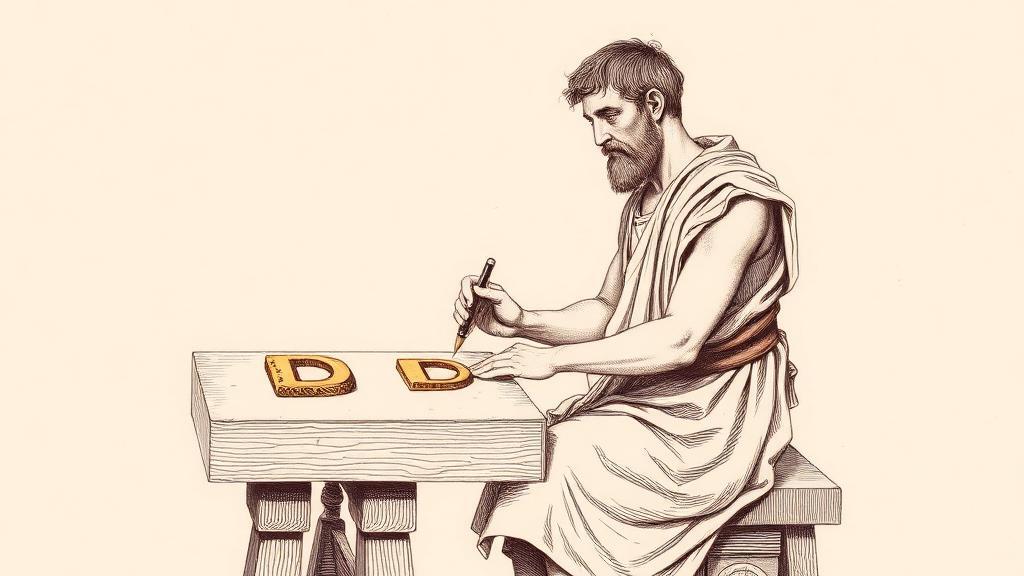
Somewhere in Latium around 670 BCE, a craftsman named Manius finished work on a fibula — a D-shaped brooch of hammered gold, about as long as a child’s hand — and scratched seven words into its surface before handing it to a man named Numerius. MANIOS MED FHEFHAKED NVMASIOI. Manius made me for Numerius. It is the oldest surviving sentence in the Latin alphabet, and it spent the next two-and-a-half millennia buried somewhere near the town of Palestrina, twenty-five miles southeast of Rome.
The script Manius cut into the gold was not Latin’s own invention. It came from the Etruscans, who had borrowed it from Greek settlers at Cumae, the first Greek colony on the Italian peninsula, founded around 740 BCE on the bay of Naples. Those colonists brought a Western variant of the Greek alphabet, which had its own ancestry running back through Phoenician and ultimately to the same North Semitic inscriptions that gave rise to Hebrew and Arabic (Britannica). The Latins, farming the hills above the Tiber, adopted 21 of the 26 Etruscan letters and went to work.
That initial set had rough edges. The letter C handled double duty, representing both the /k/ and /g/ sounds because Etruscan hadn’t distinguished them. For at least two centuries, Latin speakers got along fine with this ambiguity. Then around 230 BCE, a schoolteacher and former slave named Spurius Carvilius Ruga — reportedly the first Roman to charge tuition — solved the problem by adding a small horizontal bar to the C, producing G (Wikipedia). He slotted it into the seventh position, the spot left empty when Z had been dropped as unnecessary. Rome had gone from 21 letters back to 21 letters, but now they actually matched the sounds.
The Praeneste fibula, meanwhile, spent the late 19th century at the center of a forgery scandal. The brooch was announced to scholars in 1887 by archaeologist Wolfgang Helbig, who said it had turned up in a burial near Palestrina. In 1980, epigraphist Margherita Guarducci published a careful case that the inscription was a modern plant, arranged by Helbig and an art dealer named Francesco Martinetti. For thirty years the debate ran. Then in 2011, Edilberto Formigli’s team subjected the gold to scanning electron microscopy and found micro-crystallization in the surface — a natural process that takes centuries to develop and cannot be faked (Wikipedia: Praeneste fibula). Manius was vindicated. Guarducci was not.
After Rome absorbed Greece in the 1st century BCE, the alphabet took on two Greek letters, Y and Z, placed at the end to handle Greek loanwords — giving Classical Latin its canonical 23-letter set. Medieval scribes finished the job: I split into I and J, V into U, V, and W, producing the 26-letter alphabet used today by roughly 70% of the world’s population across more than 3,000 languages (Wikipedia).
Manius scratched seven words onto a gold pin in provincial Latium. The script outlasted the city, the republic, the empire, and the language — and kept going.
Sources
- Latin alphabet — Wikipedia — Etruscan origins, letter count and evolution, global reach statistics.
- Latin alphabet — Encyclopaedia Britannica — Ancestry from Etruscan via Cumaean Greek via Phoenician; earliest inscriptions; medieval letter additions.
- Praeneste fibula — Wikipedia — Inscription text and translation, discovery by Helbig (1887), Guarducci forgery argument (1980), and Formigli’s 2011 electron microscopy vindication.
- History of the Latin script — Wikipedia — Spurius Carvilius Ruga and the invention of G; early letter ambiguities and adaptations.