The pentathlon at Olympia, and a jump no one has explained
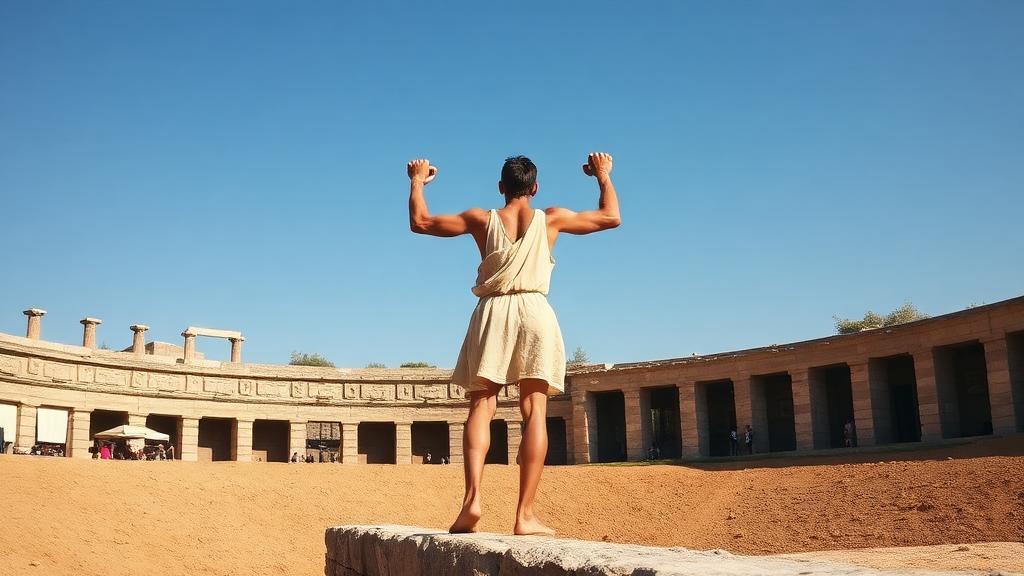
In the summer of 708 BCE, an athlete at Olympia stood at the edge of a long-jump pit — a trench of freshly raked earth — holding a pair of stone weights, one in each hand. He swung them behind him, leaned forward, and jumped. The weights swung forward as he flew, adding rotation, gaining distance. He was competing in one of five events that, for the first time in Olympic history, would be judged as a whole. The pentathlon had arrived.
This was the 18th Olympiad. The Games had run for sixty-eight years on a programme of running events and little else. The stadion — a sprint of roughly 192 metres — had been the founding event in 776 BCE, and the schedule had grown cautiously since. In 708 BCE the organisers added two events at once: wrestling as a standalone contest, and the pentathlon, which folded wrestling in as its final act.
The five events — stadion, discus, javelin, long jump, and wrestling — were not chosen by accident. Each had a battlefield application. A Greek soldier who could sprint, hurl a javelin, throw a heavy disc, leap a ditch, and grapple an opponent to the ground was, in the language of the age, useful. The pentathlon was a fitness examination staged as a festival.
The jumping weights — halteres, typically 1.5 to 2 kilograms each, made of stone or lead — are the event’s most counterintuitive detail. Modern biomechanical research suggests that a standing long jumper using them correctly gains roughly five percent of distance by thrusting them forward at the jump’s peak. Ancient athletes had worked this out centuries before anyone named the principle.
Determining the winner was, by modern standards, a mess. The most credible reconstruction — drawn from Aristotle’s Nicomachean Ethics and various ancient commentaries — holds that a competitor who won three events outright took the title immediately; if no one managed that, the field narrowed after the first four events and the survivors wrestled for the championship. Wrestling always closed the day. Either way, you had to be good at everything.
What the format produced, over two centuries of competition, is the stranger achievement. Pentathletes ranked below pure specialists in their individual events — the sprinter was faster, the wrestler stronger — yet Aristotle praised the pentathlete as the most beautiful athlete in the Games: developed everywhere, excess nowhere. The kalokagathia, the Greek ideal of beautiful goodness, was most purely expressed in the person who could not be beaten at any single thing.
Then there is Phayllos of Croton. A fifth-century pentathlete from southern Italy, Phayllos left behind an inscription claiming a long jump of fifty-five feet — just under seventeen metres. The current world record is 8.95 metres. Scholars have argued for a century that the figure must represent either five consecutive bounds or a copyist’s error. No one has settled it. What history does confirm is that in 480 BCE, Phayllos outfitted a warship at his own expense and commanded it at the Battle of Salamis — the only Greek athlete from the western colonies to do so. The five events, it turned out, had been useful after all.
The pentathlon survived in its ancient form until the Games were suppressed in 393 CE. Its descendants — the modern decathlon and heptathlon — have cleaned up the scoring ambiguity considerably. The idea underneath them has not changed: that a person who can do five things well tells you something a person who can do one thing brilliantly cannot.
Sources
- Ancient Olympic pentathlon — Wikipedia — five events, introduction at the 18th Olympiad (708 BCE), winner determination theories, wrestling as the deciding final event.
- Greek Pentathlon — Health and Fitness History — halteres biomechanics, Phayllos’s 55-foot jump, prestige of the all-around athlete.
- Phayllos of Croton — Wikipedia — Pythian Games victories, outfitting a ship for the Battle of Salamis, Herodotus’s account.
- Ancient Olympic Games — World History Encyclopedia — event sequence, jumping pit, scoring ambiguity.