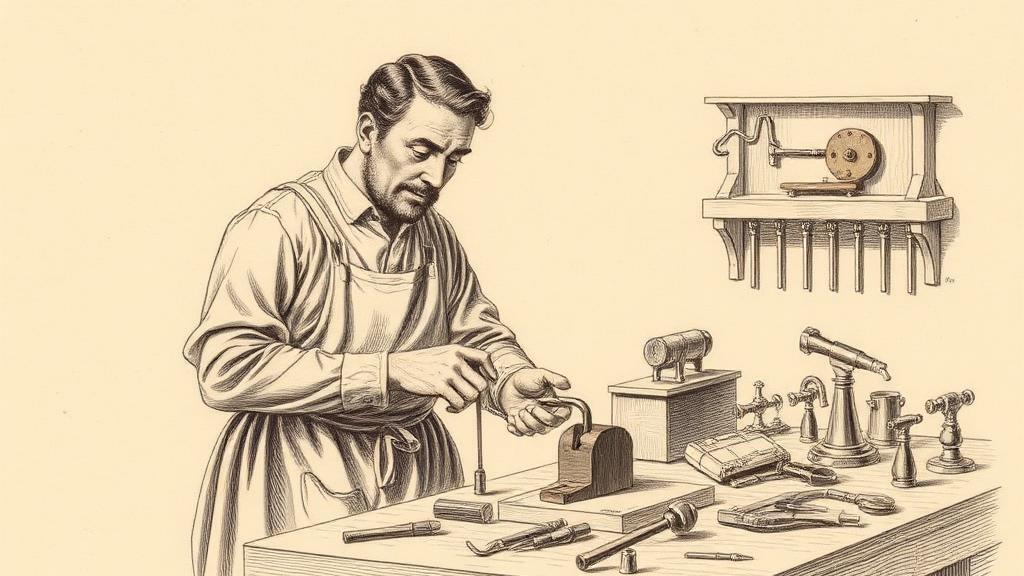
Linus Yale Sr.'s bank lock, or the pin-tumbler's American debut
The Newport lock shop opened around 1840 in a town that barely warranted the name. Newport, New York sat in the Mohawk Valley, about sixty miles west of Albany, in the grip of a long agricultural quiet, and Linus Yale Sr. had spent his forties building the wrong things: millstones, threshing machines, a horse-powered mechanism for farms that were slowly losing interest in horse power. In June 1844, he sent a different kind of drawing to Washington. U.S. Patent 3,630 was for a pin-tumbler safe lock, and it described, in the dry language of government filings, a mechanism that had last appeared on Earth around 4000 BCE.
Yale was 47, born in Middletown, Connecticut in 1797, trained on farm machinery and entirely self-taught in locks. What he understood — from somewhere in that practical education — was that the ancient Egyptian pin-tumbler lock, the spring-loaded wooden pegs and wooden key used to bolt granary doors along the Nile, worked on a sound principle that nobody had bothered to translate into metal. The Egyptians had the right idea and the wrong material. Yale rebuilt it in brass and iron.
The mechanism was simple in principle: a stack of spring-loaded pins, each a slightly different length, blocking a plug from rotating. The correct key lifts each pin to a precise height — the shear line — at which point all the pins align, the plug turns, the bolt retracts. The wrong key leaves even one pin high or low, and the whole assembly stays put. Wood warps; metal does not. Yale’s version was also machined tight enough that drilling the bolt mechanism would cause the lock to seize before it opened. For a bank vault in 1844, that combination of pick resistance, drill resistance, and metal durability was exactly what a frontier savings institution needed to sleep at night.
Context made Yale’s timing fortunate. New York’s Free Banking Act of 1838 had touched off a multiplication of state-chartered banks across America; within a decade there were roughly five times as many as there had been in the 1820s. Every new bank needed a vault, and every vault needed a lock, and the warded locks that had served for centuries — iron plates with fixed obstacles that blocked the wrong key — were proving inadequate against a determined driller or a lockpick with patience. Yale’s metal pin-tumbler offered something different: a lock whose security depended on precision tolerances rather than brute obstruction.
What followed was steady. He filed bank lock patents in 1853, 1854, and 1855, then a vault-door bolt mechanism in 1856. He became, in the compact world of American bank security, the man to call — and in Newport itself, he became the town’s first elected mayor in 1857. By the time he died in August 1858, his shop had obtained a government contract to serve as the sole supplier of all new bank locks for the United States Treasury — every mint, every sub-treasury, every custom house in the country. Not bad for a man who had started out dressing millstones.
His son Linus Yale Jr. had joined the Newport operation in 1850, while the elder Yale was still alive and working. What the father had designed for vaults, the son would spend the next fifteen years adapting for front doors — shrinking the mechanism, reshaping the key, filing the 1865 patent that turned the pin-tumbler into a residential standard used by hundreds of millions of people. The distance between the two designs was less than twenty miles and one generation.
Ancient Egypt had the right idea in palm wood. It just needed Newport, New York and four thousand more years to find the right material.
Sources
- Linus Yale Sr. — Wikipedia — Life dates, birthplace, Newport lock shop, patent timeline (1843–1857), US Treasury contract.
- Linus Yale Sr. — Lockwiki — Patent list, pin-tumbler safe lock details, son’s involvement in the business.
- Pin tumbler lock — Wikipedia — Egyptian origins circa 4000 BCE, mechanism description, and how Yale’s metal redesign differed from wooden predecessors.