Morse code, or the first writing system designed by data
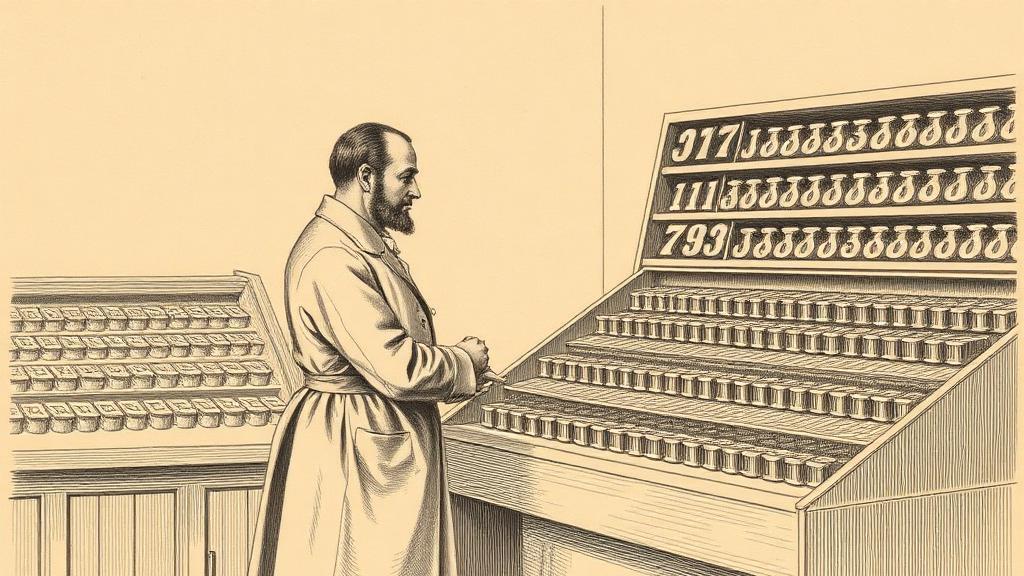
The typesetter in Morristown, New Jersey had no reason to remember the afternoon in 1837 when Alfred Vail walked into his shop and started counting movable type. Vail wasn’t there to set anything. He was counting which letters the printer kept in the largest piles — the ones the English language consumed fastest. E and T topped every case. Q and Z were nearly empty. He walked out with the architecture of a new alphabet.
Vail was the engineering half of an unlikely partnership. Samuel Morse, better known as a portrait painter turned professor at New York University, had the concept — transmit messages as electrical pulses over wire — but his original design was a codebook cipher, numbers that referenced words in a printed dictionary, which the receiver would look up by hand. Cumbersome. Slow. Vail, who joined the project in 1837 with his family’s money and his own machinist’s skill, threw out the dictionary. He expanded the system to cover every letter and punctuation mark, then assigned each one a pattern of short and long pulses — dots and dashes — calibrated by frequency (Wikipedia).
The key insight was that not all letters are equal. E, the most frequent in English, became a single dot. T became a single dash. Together they account for roughly a fifth of everyday text, so compressing each to one symbol saves an enormous amount of transmission time. Q, which a writer might not use all week, got four symbols: dash-dash-dot-dash. It was, in modern terms, a variable-length binary encoding — the same principle that underlies every Huffman-compressed file ever created (Wikipedia).
The formal public test came on May 24, 1844, over 40 miles of wire strung between Washington, D.C., and Baltimore. Morse sat in the chamber of the U.S. Supreme Court; Vail waited at the B&O Railroad’s Pratt Street Station. The message Morse tapped out had been suggested to him by Annie Ellsworth, the 19-year-old daughter of the Commissioner of Patents, who drew it from the Book of Numbers: “What hath God wrought.” Vail received it, transcribed it, and sent the same words back as confirmation (National Magnet Lab).
No writing system before Morse code had been designed from scratch around a performance constraint. Every alphabet before it had evolved — letterforms drifting across centuries, borrowed, compressed, adapted by use and accident. This one was engineered, which also made it the first writing system to treat language as a data-compression problem. Claude Shannon would formalize that same intuition as information theory a century later.
Maritime distress services retired Morse code’s last formal obligation in 1999. But the logic it embedded — short codes for common things, long ones for rare ones — still runs inside every compressed image, audio file, and ZIP archive. The dots and dashes have gone quiet. The idea never did.
Sources
- Morse code — Wikipedia — development timeline, Vail’s Morristown type-case method for determining letter frequency, the dot-dash encoding system.
- Alfred Vail — Wikipedia — Vail’s role expanding Morse’s original numeric cipher to a full alphabet, the frequency-based code assignment, and his departure from the project in 1848.
- Morse Telegraph, 1844 — National High Magnetic Field Laboratory — the May 24, 1844 demonstration, Vail’s role at the Baltimore end, and the Western Union expansion that followed.