One lutetium ion, nineteen decimal places
A single atom of lutetium — element 71, a dense silvery rare-earth metal that most clockmakers have never thought to use — hangs in a vacuum chamber in Singapore, held in place by oscillating electric fields. It is smaller than a virus. A laser interrogates it, and the frequency at which it responds has now been measured to nineteen decimal places. It is the most accurate clock in the world.
The results appeared in Nature on September 23, 2026, by a team led by Murray Barrett, Associate Professor in the Department of Physics at the National University of Singapore and a Principal Investigator at the Centre for Quantum Technologies. Senior Research Scientist Kyle Arnold and PhD student Michael Lee are the paper’s joint first authors. The team had been working with lutetium since the mid-2010s — the only research group in the world doing so — on a hunch, grounded in theoretical predictions, that the element had properties no other clockmaker had fully appreciated.
What they found is that lutetium-176 (¹⁷⁶Lu⁺) has three distinct clock transitions, each with exceptionally low sensitivity to the electric and magnetic field fluctuations that drag down every other optical clock. Strontium, ytterbium, and aluminum — the previous record-holders — all require careful temperature control and magnetic shielding. The lutetium clock, Barrett says, would hold its accuracy across the full range of temperatures from Death Valley to the Antarctic plateau. The ion carries its own environmental immunity.
The team measured the absolute frequency of the lutetium transition with a systematic uncertainty of 1×10⁻¹⁹ — the lowest ever reported for any optical atomic clock. To put that in terms with some gravity: the clock would gain or lose one second in approximately 300 billion years. The universe has been running for 13.8 billion years. In all that time, Barrett’s clock would have accumulated less than a twentieth of a second of error.
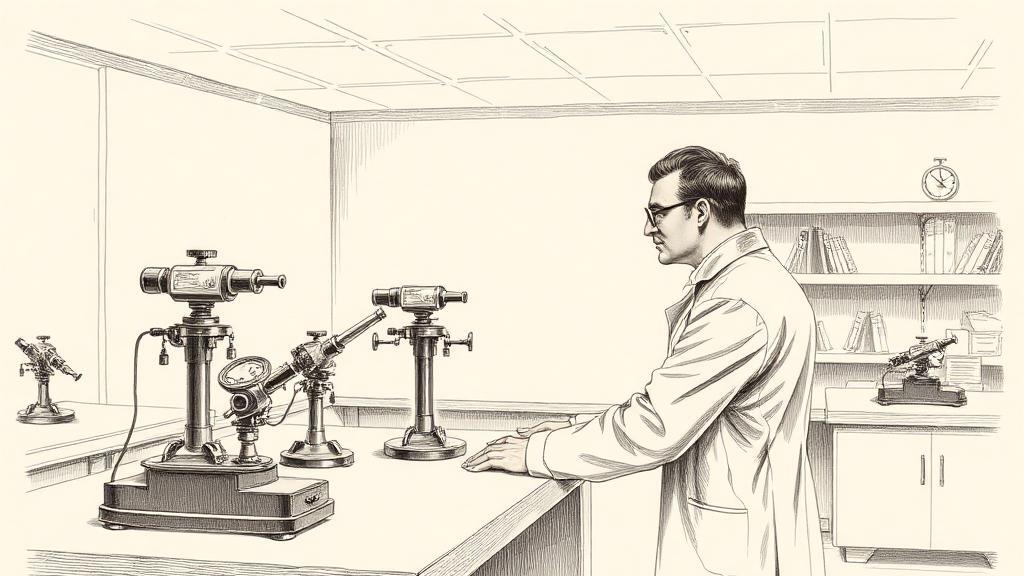
The number that settles the argument is the comparison. To verify the absolute claim, the team built two independent lutetium clocks and ran them side by side for 200 hours. They agreed to within 5.7×10⁻¹⁹ — the most precise clock comparison ever made. Kyle Arnold reached for the old watchmaker’s quandary: “A man with a watch knows what time it is. A man with two watches is never sure.” The Singapore team built two watches. They are very sure.
That same-species comparison matters past the headline. The BIPM’s roadmap toward redefining the SI second — still anchored to the cesium hyperfine transition that has served since 1955 — requires, among other criteria, same-species comparisons between independent groups. Barrett’s is still the only lutetium group in the world, so an external comparison must wait for others to build lutetium clocks of their own. But the methodology and the accuracy threshold are now demonstrated. In two weeks, delegates at the 28th General Conference on Weights and Measures will gather in Versailles to vote on the formal roadmap toward a new definition of the second, expected around 2030. The Singapore result arrived at the right moment.
The cesium second has been ticking since Louis Essen set it at Teddington in 1955. One lutetium ion in Singapore is getting ready to take the job.
Sources
- K. J. Arnold et al., “Lu⁺ optical frequency references with accuracy verified at the 19th digit,” Nature, 23 September 2026 — primary paper; 1×10⁻¹⁹ uncertainty, 200-hour comparison result, hyperfine averaging technique
- Singapore scientists build world’s most accurate atomic clock — CQT/NUS — Barrett and Arnold quotes, history of lutetium research, three-transition advantage, environmental robustness
- Scientists build world’s most accurate atomic clock — phys.org — 300-billion-year accuracy figure, comparison with ytterbium, strontium, and aluminum predecessors