The Mackinac Bridge, or how Michigan became one state
On Labor Day weekend in 1953, the ferry lines at the Straits of Mackinac stretched sixteen miles. Drivers waited up to five hours for a three-mile crossing. The state of Michigan was, functionally, two states.
The Straits separate Michigan’s Lower Peninsula — densely populated, heavily industrialized — from its Upper Peninsula, a stretch of forest and copper country connected to the rest of the world since 1837 only by boats and ferries. The idea of bridging the five-mile gap was not new. A St. Ignace shopkeeper had advertised a proposed bridge across the Straits as far back as 1884, illustrated with a woodcut of the Brooklyn Bridge. Between 1920 and 1950, serious proposals included a floating tunnel and an elaborate series of causeways. None got built. The ferries kept running, and on summer weekends the lines stretched past reason.
In January 1953, Dr. David B. Steinman — one of the most prolific suspension bridge engineers of his era, and the man who had spent the years after 1940 publishing theoretical analyses of why bridges twist in wind — took the commission as chief engineer. His first problem wasn’t the length of the crossing. It was Galloping Gertie.
The Tacoma Narrows Bridge had opened in July 1940 in Washington State. It was a beautiful, slender structure, and on November 7 of that year, in a 42-mile-per-hour wind, it shook itself apart. Its designers had calculated it could withstand winds ten times that strong. What they had not modeled was aerodynamic flutter — not the force of the wind, but the resonance it could set up in a structure too rigid to move and too light to resist. Steinman had been writing about exactly this for thirteen years.
His counter-measures for the Mackinac were specific and architectural. Instead of solid plate girders along the deck edges — the same design feature that had doomed Tacoma — he installed open stiffening trusses forty feet deep, roughly one-eighty-fifth of the main span. The center two lanes of the roadway were laid in open steel grating, not concrete, so wind could pass through rather than press against the deck. Double lateral trusses ran the full length of the center span for torsional rigidity. Steinman calculated the theoretical critical wind velocity at 642 miles per hour. The worst winds ever recorded on the bridge have been around 78.
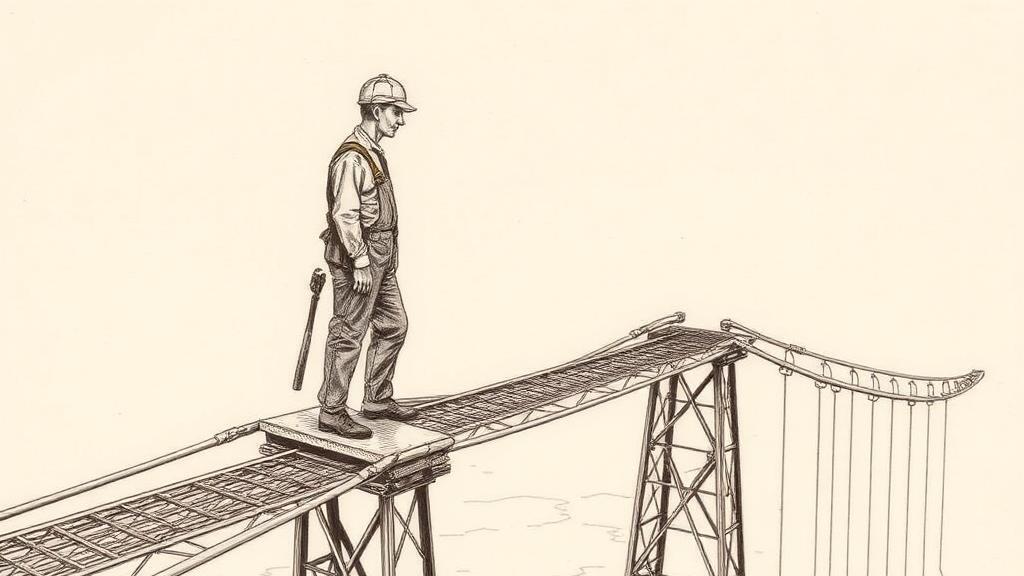
Construction began May 7, 1954, peaking at nearly 3,500 workers across four summers — no winter construction, given what Lake Michigan becomes in January. Five men died: Frank Pepper in a diving accident, James LeSarge and Albert Abbott in separate falls, and Jack Baker and Robert Koppen on June 6, 1956, when a section of temporary catwalk near the top of the north tower gave way. A persistent legend holds that workers’ bodies were entombed in the concrete piers. It isn’t true, and it probably endures because it feels right — a structure that big should have cost something that personal.
The bridge opened November 1, 1957, on schedule and within its $100 million budget — bonds that had only sold after the Michigan legislature pledged $417,000 annually from gasoline taxes to guarantee investor returns. Its total suspended length made it the longest suspension bridge between cable anchorages in the world. Nine state ferries were retired. Michigan’s two halves were, after seventy-three years of proposals, finally one.
Every long-span suspension bridge built since the Mackinac carries a version of Steinman’s open trusses and his aerodynamic arithmetic — not as a tribute, but because flutter is still a problem and the math still works.
Sources
- Mackinac Bridge — Wikipedia — Dimensions, construction timeline, five deaths by name and date, pre-bridge ferry situation.
- History of the Bridge — Mackinac Bridge Authority — 1884 early proposals, ferry era, financing difficulties, world record designation, opening details.
- Michigan’s Mackinac Bridge Tames the Wind — ASCE Civil Engineering — Steinman’s aerodynamic innovations: stiffening truss depth, open-grid roadway, torsional rigidity, 642 mph critical wind velocity.