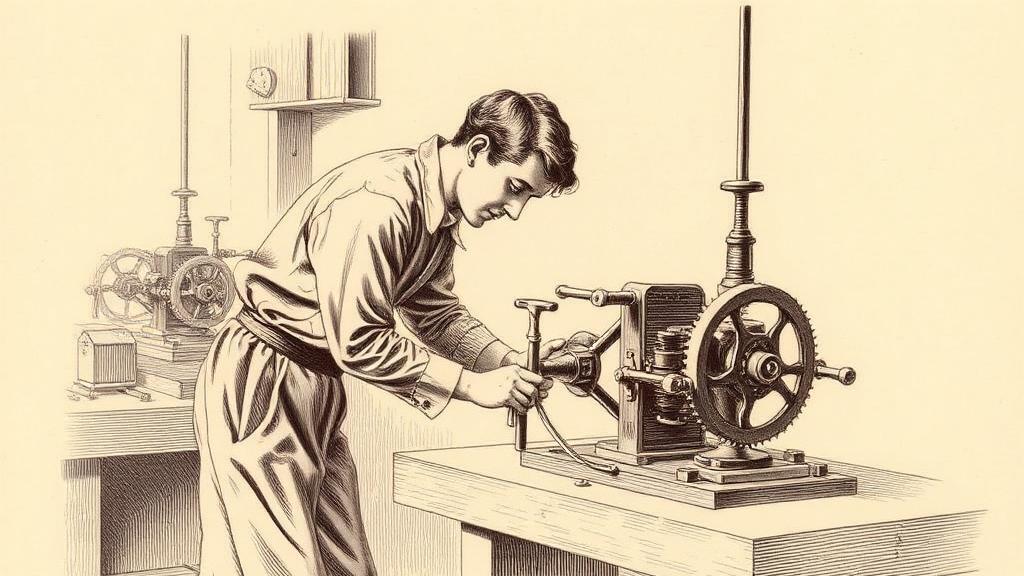
Jan Matzeliger's lasting machine, or the grammar of a craftsman's hands
In 1882, after two years of working alone at night on a machine assembled from cigar boxes, wire, and elastic, Jan Matzeliger filed for a patent. The United States Patent Office, finding the claims too remarkable to evaluate from drawings, sent a special examiner to Lynn, Massachusetts, to watch the machine operate in person before they would sign anything. The examiner watched. On March 20, 1883, they signed.
Matzeliger was thirty years old and had arrived in Lynn from Paramaribo, Suriname — via merchant ships and a brief stay in Philadelphia — in 1877. He worked at the Harney Brothers Shoe factory and taught himself English at evening classes. The problem he was working on was called lasting, and it had blocked every prior attempt to fully industrialize shoe production. Every part of a shoe could be cut and stitched by machine. The final step — pulling the leather uppers tightly over a wooden last, tacking the edges underneath to meet the sole, attending to the toe and heel with the precision that only years of practice produced — required the hands of a craftsman. A skilled hand laster could produce fifty pairs per day. There were never quite enough of them, and the lasters knew it.
Matzeliger spent years studying their movements, watching their hands before he translated them into iron. His first prototype was built from cigar boxes, wire, and elastic; he rebuilt it in metal. The mechanism that emerged gripped the shoe’s last, pulled the leather down over the toe, set and drove the tacks around the perimeter, and discharged a finished shoe. An early version produced 150 pairs per day. An improved model reached 700. Either figure against a hand laster’s fifty made the arithmetic obvious.
Lynn’s shoe prices fell by roughly half. Lynn itself, already a manufacturing center, became known as the Shoe Capital of the World. The Consolidated Lasting Machine Company that took on Matzeliger’s patents later merged into the United Shoe Machinery Corporation, which dominated American shoemaking for most of the following century. More than 99 percent of the shoes made in the world today are produced by machines derived from his design.
Matzeliger died on August 24, 1889, at thirty-six, from tuberculosis. He had never profited from the invention. He left what remained of his estate to the North Congregational Church of Lynn — the only congregation in the city that had admitted him as a member.
The hand lasters went on strike. The machine kept running. What Matzeliger had understood, and reproduced in iron, was that even a complex hand skill has a grammar — a repeatable sequence of moves, a logic that can be studied and specified. Once you could write that grammar down, you could give it to a machine. That was the lesson, and it ran well past shoes.
Sources
- Jan Ernst Matzeliger — Wikipedia — Biography, background, arrival in Lynn 1877, lasting machine development, patent date (March 20, 1883, US Patent 274,207), death, estate bequest to North Congregational Church.
- Matzeliger Demonstrates Revolutionary Machine — Mass Moments — Cigar box prototype, patent examiner’s visit to Lynn, production rates (150 and 700 pairs/day), shoe price impact, 99% legacy figure.