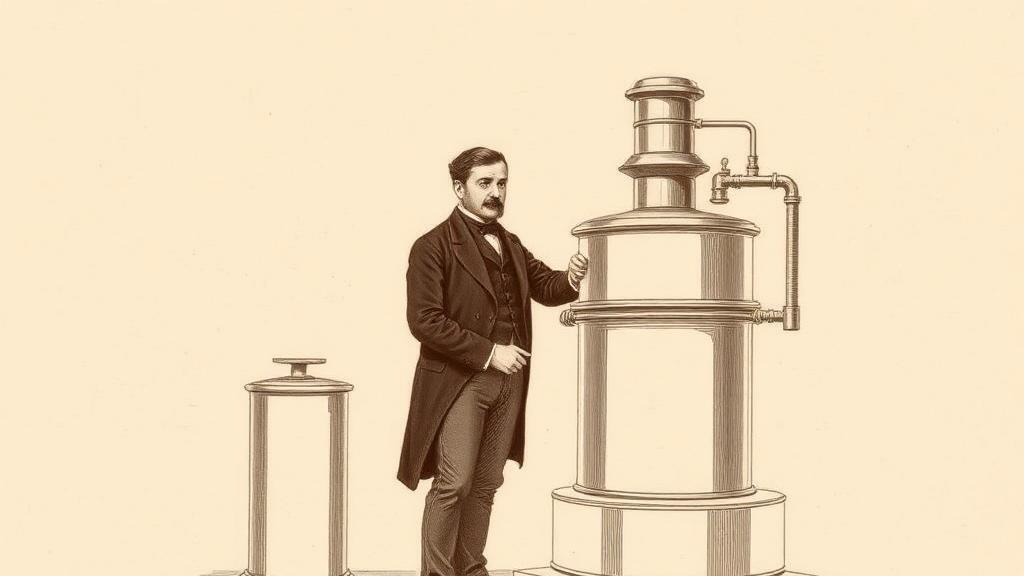
The espresso machine Moriondo kept to himself
In May 1884, at Turin’s Esposizione Generale Italiana — a vast exhibition staged to show what the newly unified nation could build — a hotelier named Angelo Moriondo set up a machine and brewed coffee under steam pressure while the judges watched. They awarded him a bronze medal. He took it home, installed the machine behind the bar of his hotel, and more or less never spoke of it publicly again.
Moriondo was thirty-two years old and already comfortable. His grandfather had founded a liqueur company; his father had co-founded the Moriondo and Gariglio chocolate works. Angelo himself ran two fashionable addresses: the Grand-Hotel Ligure on Piazza Carlo Felice and the American Bar in the Galleria Nazionale on Via Roma, where Turin’s prosperous classes came to be seen. He was not a man who needed to make his name on a patent.
His machine, built under his supervision by a mechanic named Martina, was registered in Turin on 16 May 1884 under the title “New steam machinery for the economic and instantaneous confection of coffee beverage, method ‘A. Moriondo.’” The device used two boilers working in sequence: the first, pressurized to 1.5 bars, pushed hot water through a large bed of ground coffee; the second produced a flash of steam to complete the extraction. The historian Ian Bersten later described it as “the first Italian bar machine that controlled the supply of steam and water separately through the coffee” — a distinction that sounds minor until you realize it describes every commercial espresso machine built since. Moriondo continued improving it, filing an updated registration in November 1884 and an international patent in Paris in October 1885, and then, more or less, stopped.
He built a handful of machines by hand and kept them in his own establishments. Later scholarship describes the arrangement as a “powerful marketing tool” — which is perhaps generous. He did not sell the design, license it, or approach manufacturers. There are no surviving Moriondo machines. There were no Moriondo cafés.
It fell to Luigi Bezzera, a Milanese engineer who appears to have had no knowledge of Moriondo’s work, to file his own patent in 1901 for the single-shot portafilter — the mechanism that made espresso a per-cup event rather than a batch proposition. Desiderio Pavoni bought Bezzera’s patent, added safety pressure valves, and launched the first mass-produced commercial machine in 1903. The espresso machine entered the world’s cafés bearing other men’s names.
What Moriondo had proved, even if only to his hotel guests on Piazza Carlo Felice, was the underlying claim of every espresso machine since: that water forced through packed coffee grounds under mechanical pressure produces a faster, more concentrated cup than gravity alone can manage. The modern shot, pulled at 9 bars through a portafilter, is a direct descendant; only the pressure rose and the batch size shrank. The crema, the twenty-six-second extraction, the ritual of the stand-up bar — all of that was still half a century away when Moriondo filed his papers.
He died at his country estate in Marentino, outside Turin, in May 1914. His machine had already escaped him, travelling forward under other names.
Sources
- Angelo Moriondo — Wikipedia — birth and death dates, family background (Moriondo and Gariglio), patent title and registration date, the mechanic Martina, Ian Bersten’s assessment, international Paris patent October 1885.
- Angelo Moriondo: The Godfather of the Espresso Machine — Coffeeness — machine mechanics (dual boilers, 1.5 bars), why he didn’t commercialize (“powerful marketing tool”), succession through Bezzera and Pavoni.
- The Long History of the Espresso Machine — Smithsonian Magazine — context of the 1884 General Expo, machine design, absence of surviving Moriondo machines.