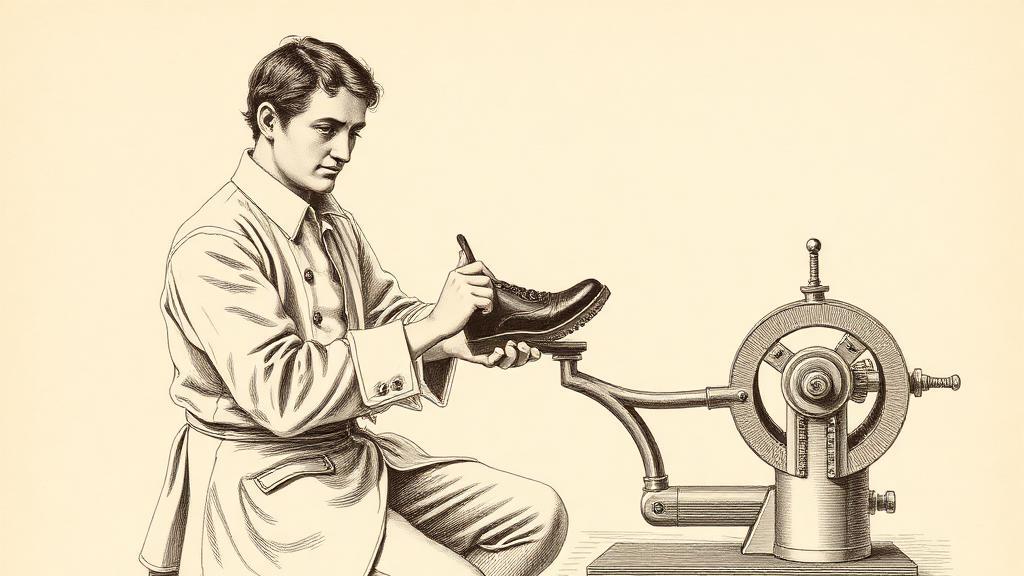
The McKay stitcher, or how a hollow needle ended the age of the hand-sewn shoe
Between July 1862 and July 1876, exactly 177,665,135 pairs of shoes were stitched by machine in the mills of Massachusetts — at a saving, calculated by McKay’s accountants, of eighteen cents per pair, or nearly fourteen million dollars in total. Every one of them was produced by the same mechanical act: a hollow curved arm slid inside the shell of a half-built shoe, driving waxed thread through insole, upper, and outsole in a single continuous pass. The machine bore the name of Gordon McKay. The man who invented it was a 23-year-old cobbler named Lyman Reed Blake.
Blake had grown up in the shoe trade in South Abington, Massachusetts, and by 1856 had become a partner in a small shoemaking firm. He also worked for Isaac Singer’s company, setting up sewing machines in shoe factories, which meant he understood exactly why Singer’s general-purpose machines couldn’t solve the problem: the stitch had to happen inside the shoe, on the curved last, with thread strong enough to hold a sole under daily wear. On July 6, 1858, Blake received a U.S. patent for a machine that threaded a curved hollow arm through all three layers — insole, upper, outsole — in the time it took to count to three.
He sold the patent the following year to Gordon McKay, a Scottish-born engineer who had made his reputation managing machinery works in New England. The price was $8,000 in cash and a share of future profits — ultimately worth $62,000. McKay improved the mechanism, submitted an enhanced patent in 1862, and built a business on an unusual model: rather than selling machines outright, he leased them to manufacturers at a per-pair royalty. Every pair of shoes produced on a McKay stitcher paid him a fraction of a cent. It was a subscription model for footwear, a century before the phrase existed.
The timing was not accidental. In April 1861 the Civil War began, and the shoemaking towns of Massachusetts promptly lost half their skilled workers to enlistment. The Confederacy, relying on handcraft, went chronically short of decent footwear — by the third year of the war, Confederate infantrymen were campaigning in Virginia without shoes. The Union had McKay’s factories running multiple machines per floor, producing army-grade shoes faster than men could be issued them. The stitcher is often credited with giving the North a measurable material advantage in a war decided, as most wars are, partly by logistics.
What it did to the workers is a more complicated account. The machine drew craftsmen out of the independent backyard “ten-footer” shops — where skilled cordwainers had controlled their own hours — and into factory floors. Standing at a machine in a ventilated mill proved healthier than hunching over a curved needle in a ten-footer thick with leather dust; tuberculosis rates among shoemakers dropped. Factory wages rose. Hours fell. The craft was diminished; the craftsmen, on balance, lived longer.
The McKay stitcher dominated American and British shoe production for twenty-one years, until Charles Goodyear Jr.'s welt construction — resoleable, favored by quality bootmakers — began drawing the high end of the market away. Blake died in 1883, the same year Goodyear introduced his competing method. McKay died in 1903, leaving the bulk of his fortune to Harvard.
The stitch moved from the craftsman’s hand to the machine on July 6, 1858, and it has not moved back.
Sources
- Lyman Reed Blake — Wikipedia — biography, the 1858 patent, sale to McKay, career timeline.
- The McKay Stitcher — Massachusetts Historical Society Beehive — production totals July 1862–1876, Civil War context, the per-pair leasing model, per-pair savings figures.
- Blake-McKay Stitching Machine — CT Williams — technical description of the curved hollow arm and chain stitch, worker displacement, tuberculosis mortality data.