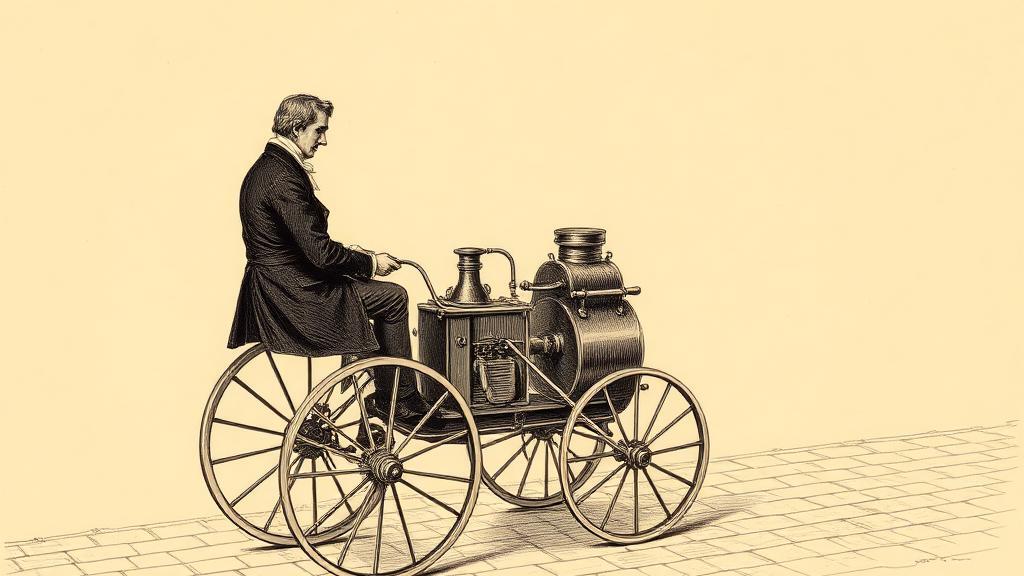
Lenoir's Hippomobile: eleven kilometres on a coal-gas engine
On an unrecorded day in 1863, a three-wheeled carriage rolled east out of Paris along the road to Joinville-le-Pont, eleven kilometres away. No horse pulled it. No steam boiler drove it. Beneath the seat a single-cylinder coal-gas engine fired on jumping sparks, turning a crankshaft at roughly walking pace, and the vehicle — if it could yet be called that — reached Joinville-le-Pont in about ninety minutes, then turned around and came back. The gasoline automobile was still twenty-two years from being invented. What Jean Joseph Étienne Lenoir had just demonstrated, at a pace a fit pedestrian could match, was that an internal combustion engine could propel a vehicle down a road.
Lenoir was born on January 12, 1822, in Mussy-la-Ville — then the Austrian Netherlands, now Belgium — and arrived in Paris at sixteen with no engineering credentials beyond a talent for electroplating and a curiosity about electricity. By 1859 he had adapted a double-acting steam cylinder into something qualitatively new: an engine that ignited a mixture of coal gas and air by electric spark, rather than by an external furnace. He demonstrated it on January 23, 1860, to twenty guests, and patented it the same day. The design was two-stroke and not especially efficient, but it ran reliably on its own compressed charge without the ton of coal and the boiler attendant that steam required. By 1865, 143 Lenoir engines were running in Paris alone, powering printing presses, lathes, and pumps. London began manufacturing them too. It was the first commercially successful internal combustion engine in history.
The carriage followed three years later. The Hippomobile mounted a 1.5-horsepower version of the Lenoir engine on a three-wheeled frame and set off, one afternoon, from Paris to Joinville-le-Pont and back. No passengers. No freight. Just the machine going somewhere under its own power and returning intact — slower than a horse, though the horse was not there to ask.
The same year Lenoir made that drive, Jules Verne was writing Paris in the Twentieth Century across the city — a novel set a hundred years forward, in which the boulevards of Paris are crowded with gas-engine cabs he called “Lenoir machines.” Verne’s publisher thought the book too bleak to print, and it sat in a locked safe until 1994, by which point Verne had been proved almost entirely right. He was simply early.
Lenoir, meanwhile, watched the industry he had started overtake him. By 1865, Nikolaus Otto in Germany was already working on a four-stroke refinement of the two-stroke cycle; by 1876 Otto’s engine had rendered Lenoir’s obsolete. Fewer than 500 Lenoir engines were ever built. He returned to electrical work, grew steadily poorer, and on July 16, 1900, received a certificate from the Automobile Club of France naming him “inventor of the gas engine and builder of the first car in the world.” He died nineteen days later, on August 4, 1900, largely forgotten.
The Benz Patent-Motorwagen came in 1885 and got the credit — faster, more reliable, commercially viable in a way Lenoir’s carriage never was. But there is always a prior question: not how to build a good automobile, but whether a fuel-burning engine can move a vehicle at all. That was settled on a road heading east out of Paris, at roughly walking pace, on a slow afternoon in 1863.
Sources
- Étienne Lenoir — Wikipedia — birth, 1860 patent, jumping-spark ignition, commercial success (143 Paris units by 1865), impoverishment, death date.
- Hippomobile — Wikipedia — vehicle configuration, Paris–Joinville-le-Pont journey distance and duration.
- Lenoir, internal combustion engine inventor, born — Automotive History — Jules Verne Paris in the Twentieth Century reference, Automobile Club of France recognition July 1900.
- A pioneering developer of the internal combustion engine — Transportation History — Lenoir’s death, late-life recognition.