The Millau Viaduct: a motorway taller than the Eiffel Tower
On certain mornings in the Tarn gorge, drivers on the A75 autoroute find themselves moving through cloud. Not toward it — through it. Below, the valley floor is invisible; above, seven slender white piers emerge from the mist carrying a strip of road at 268 meters above the ground. The tallest pier, P2, clears 244.96 meters — thirteen meters more than the Eiffel Tower, though nobody in Paris particularly likes to dwell on that.
The Millau Viaduct exists because of August. For decades, the fastest route from Paris to Barcelona stalled in the medieval market town of Millau, where the A75 dropped into the Tarn valley and laboriously climbed out the other side. The summer bottleneck had become a French institution of suffering, and by the 1980s the government had decided the only cure was to bridge the gorge entirely rather than widen through it.
French structural engineer Michel Virlogeux sketched the first proposal in 1991 — a cable-stayed viaduct with multiple spans across the gorge — but local authorities initially dismissed it as unfeasible. A formal competition launched in the early 1990s, and in July 1996 the jury selected a consortium led by Virlogeux and British architect Norman Foster (Wikipedia). Virlogeux supplied the structural logic: seven piers, six central spans of 342 meters each, 154 stay cables. Foster shaped the silhouette — slightly curved in plan, so that drivers would see the road unspooling ahead of them rather than vanishing into a point. Before final approval in late 1998, the team spent months in wind tunnels modifying the deck’s cross-section; the lesson of Tacoma Narrows was not forgotten. Construction began October 16, 2001.
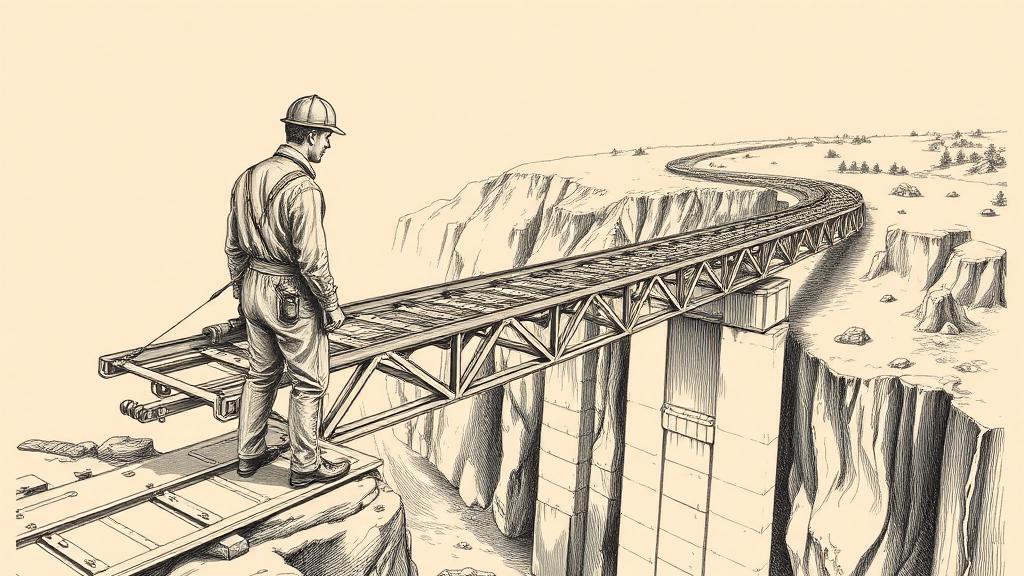
The deck was prefabricated at the Eiffel company’s factory in Lauterbourg, Alsace — a descendant of Gustave Eiffel’s own steel firm — in sections requiring over two thousand truck deliveries and a regional road-improvement program just to reach site. With the gorge 270 meters deep and conventional scaffolding impossible, both halves of the 36,000-tonne steel deck were pushed outward from the plateaus on each side, advancing 600 millimeters every four minutes on hydraulic skids mounted atop each finished pier. Freyssinet’s stay cables were installed at approximately 20 percent tension — far below the standard 30 percent — and adjusted in six-hour overnight windows as the deck’s geometry shifted with each launch cycle (Freyssinet). When the two halves met in May 2004, they were aligned within one centimeter.
Jacques Chirac inaugurated the bridge on December 14, 2004, as French fighter jets drew contrails overhead. It opened to traffic two days later, three months ahead of schedule and on budget, with no serious accidents across three years of construction.
Within months, the speed limit had been cut from 130 km/h to 110 km/h. Not for safety. Drivers kept slowing to photograph. The spillover extended farther: visitor numbers at the Roquefort cheese caves twenty kilometers south rose 28 percent in the viaduct’s first year, and the abbey at Sylvanès — previously known mainly to medieval-music enthusiasts — was up 18 percent (Designing Buildings).
Foster described the collaboration as the pursuit of a bridge “at one with its landscape.” What came out of it was something civil engineering had not often produced before: a structure people traveled specifically to see. The Tarn gorge was already dramatic; the viaduct made it famous.
The Tarn valley now has a dedicated viewpoint with parking, built specifically to give tourists somewhere to stop before they blocked the road. Every bridge designed at landmark scale since 2004 has had to reckon with Millau — not just structurally, but aesthetically.
Sources
- Millau Viaduct — Wikipedia — design competition history, construction timeline, deck-launching operation, measurements, opening ceremony.
- Millau Viaduct construction — Freyssinet — cable installation at 20 percent tension, six-hour adjustment windows, deck-launching engineering detail.
- The Millau Viaduct — Designing Buildings — speed limit reduction, tourist spillover to Roquefort caves and Sylvanès Abbey.