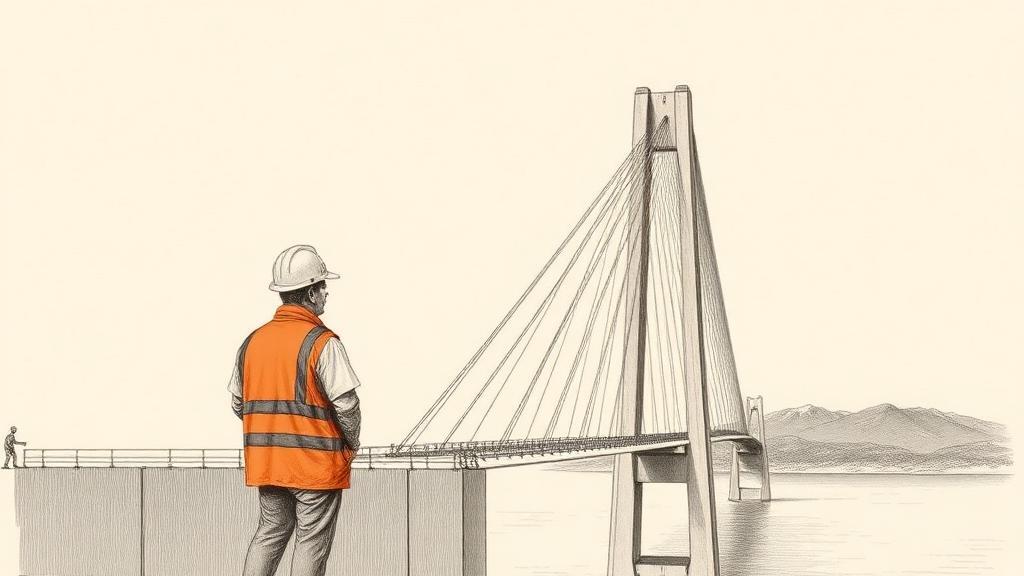
The Rion-Antirrion Bridge: built to slide
The engineers drilling test bores off the Peloponnese coast in the mid-1990s hit a hundred metres and stopped — not because they had reached bedrock, but because there wasn’t any. Below the Gulf of Corinth lay more than half a kilometre of alluvial sediment: soft clay, silt, fine sand, with nothing solid to drive a pile into. Building a cable-stayed bridge across a 65-metre-deep, seismically hyperactive rift on soil that wasn’t really soil was, by almost every textbook measure, not a serious engineering proposition.
They built it anyway.
The idea was more than a century old by then. Charilaos Trikoupis, a reforming prime minister who served seven terms between 1875 and 1895, had proposed spanning the Gulf of Corinth sometime in the early 1880s. He also, in a moment of devastating parliamentary candor, rose to announce in 1893: “Unfortunately, we are bankrupt.” Greece entered financial collapse, the bridge stayed a sketch, and Trikoupis died in 1896 without seeing either problem resolved. It would take 110 years and a fundamentally different approach to structural engineering to finish what he had started.
The problem with the Gulf of Corinth is that it is not merely deep — it is also alive. The rift widens at roughly 1.6 centimetres a year, one of Europe’s most seismically active zones. An earthquake of magnitude 7 is not a planning scenario; it is a planning assumption. The consortium led by Vinci Construction Grands Projets designed the Rion-Antirrion Bridge not to resist seismic forces but to accommodate them.
Each of the four pylons — 220 metres from seafloor to tip — rests on a concrete caisson 90 metres across, not anchored to the seabed but sitting on it. Beneath each caisson, roughly 200 hollow steel pipes two metres in diameter were driven into the soft sediment to stiffen it; a 3.6-metre layer of compacted gravel was spread over the top. During an earthquake, the caissons are designed to slide across that gravel bed while viscous dampers and built-in fuse links — mechanical fuses that snap before the deck does — absorb whatever the pylons cannot. The system was engineered to tolerate two to five metres of total lateral movement over 125 years. It is a bridge that works by yielding.
It was inaugurated on 7 August 2004, with Olympic torchbearers the first to cross. Among them was Otto Rehhagel, the German manager who had just steered Greece to its improbable Euro 2004 football championship — a detail so fitting it might have been arranged. The bridge opened to traffic on 12 August, the day before the Athens Games began. For the western Peloponnese, the alternative had always been the ferry or the long eastern detour through Corinth; now there was a road and, at 2,252 metres, the world’s longest fully continuous cable-stayed deck.
Named for the man who first imagined it, the Charilaos Trikoupis Bridge carried its century of delay quietly. The caissons shift whenever the rift exhales. The engineers expected it. The lesson — that you cannot fight geology, only negotiate with it — is now written into the design codes for every major seismic crossing built since.
Sources
- Rio–Antirrio Bridge — Wikipedia — dimensions, opening dates, Olympic torch connection, Trikoupis naming, and cable-stayed deck record.
- Rion-Antirrio Bridge: An Engineering Marvel — drgeorgepc.com — seabed conditions (no bedrock to 100m, sediment exceeding 500m deep), caisson diameter (90m), steel pipe inclusions (200 pipes, 2m diameter), gravel layer (3.6m), tectonic drift rate (1.6cm/year), total displacement tolerance (2–5m over 125 years), seismic specification (0.48g peak ground acceleration).