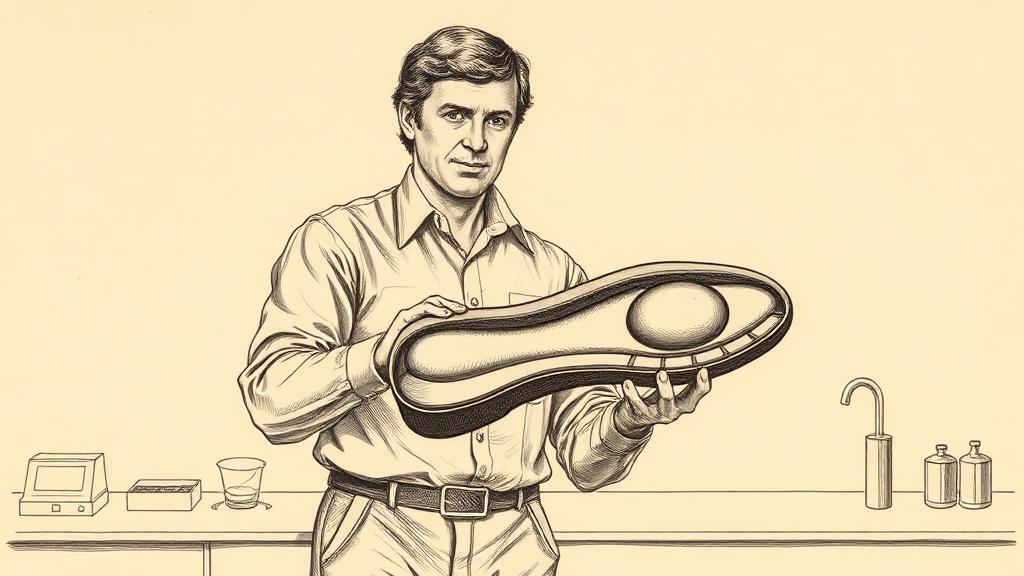
The Nike Air sole: Frank Rudy's twenty-fourth pitch
In March 1977, an aeronautical engineer named Marion Frank Rudy walked into Nike’s headquarters in Beaverton, Oregon, drew equations on a blackboard that nobody in the room fully understood, and proposed selling Phil Knight a shoe filled with air. Knight listened, then told Rudy the idea sounded like “comic book stuff” — something that belonged next to jet packs and moving sidewalks. It was the most encouraging response Rudy had received in two years. He had pitched twenty-three other shoe companies first.
Rudy (1925–2009) had trained as an aeronautical engineer at what is now Case Western Reserve University and spent his early career at NASA working on Saturn and Apollo rocket engines (Case Western Reserve). The technology he was proposing borrowed directly from aerospace manufacturing: polyurethane pouches filled with pressurized inert gas, sealed using the same blow-rubber-molding technique used to make astronaut helmets for the Apollo program. Under a runner’s heel strike, the pouches would compress and rebound, cushioning the impact without wearing out the way foam does under repeated loading. Rudy would accumulate more than 250 patents in his lifetime. He was not a man who ran short of ideas.
What changed Knight’s mind was not the equations. It was Adidas. When Knight hesitated, Rudy mentioned that he had another meeting lined up — with Nike’s most formidable rival. Knight’s competitive instincts, which had built the company on exactly this kind of urgency, did the rest (Sneaker Freaker). Rob Strasser, Nike’s deal-maker, settled on a royalty somewhere between Rudy’s requested twenty cents per pair and Strasser’s opening offer of ten. Jeff Johnson, Nike’s very first employee, added one key refinement: the air bladder should sit in the midsole, not the outsole, which kept the edges of the polyurethane sac away from the foot.
The debut came at the Honolulu Marathon in December 1978. Nike shipped 230 pairs of the Air Tailwind to six stores in Hawaii, using the race as a live test market. All 230 pairs sold out within twenty-four hours. Then the bad news arrived: metallic particles in the silver dye had been abrading and tearing the nylon upper. Nike recalled the entire run, redesigned the shoe, and brought it back to broader release in 1979 — this time without the recall.
What began as a dismissed curiosity became the structural premise of Nike’s identity. The Air Max 1 in 1987 turned the technology into a spectacle — a window cut into the midsole that let you see the gas bladder directly, a feature that had no precedent in footwear. The Air Jordan line, launched three years before the Air Max, built an entire cultural mythology around the same air pocket. Every modern performance shoe with a foam-and-gas midsole traces some part of its lineage to those 230 recalled Tailwinds from a race in Honolulu.
Knight had tested the prototype himself, running six miles on a shoe he had almost refused to make. He said they were unstable. He also said they were “one heck of a ride.” Nike would spend the next four decades building the rest of the industry’s vocabulary on top of that air pocket.
Sources
- M. Frank Rudy — Wikipedia — Rudy’s background, the 1977 Nike pitch, the Air Tailwind launch, his patent portfolio.
- Nike’s Nutty Professor — Sneaker Freaker — Knight’s “comic book stuff” response, the Adidas gambit, Strasser’s royalty negotiation, Jeff Johnson’s midsole suggestion, and the Honolulu Marathon recall.
- M. Frank Rudy (CIT '50) — Case Western Reserve University — Rudy’s engineering background and NASA career.