Nüshu: the script women kept
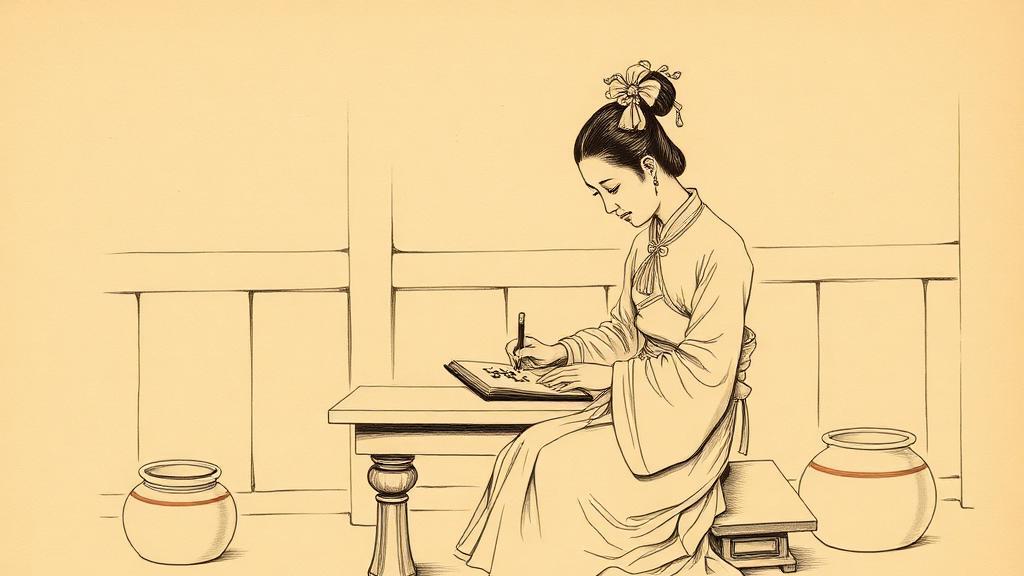
Three days after a wedding in Jiangyong County, Hunan, the guests had gone home — but the real gift was still being made. A group of women would spend those three days filling a small cloth book with careful, slanted characters: poetry, songs, the kind of words that cannot be said aloud in a stranger’s household. On the third morning they handed it to the bride. She could read it. Her new husband could not. He had never been taught.
The script is Nüshu — 女书, “women’s writing” — and it is, as far as scholars can determine, the only writing system in recorded history created and used exclusively by women. For centuries it circulated in a cluster of villages along the Xiao River in southern Hunan, passed between mothers and daughters, shared among sworn sisters called jiebai, embroidered onto fans and handkerchiefs and the soles of cloth shoes. The men who lived in those households could not read a word of it.
Nüshu is a syllabic script of roughly 396 characters, derived from Chinese but compressed and stylized beyond recognition: thin elongated strokes, rhombus-shaped dots, each symbol standing for a syllable of the local Tuhua dialect rather than a meaning. This gave women a tool to record any spoken thought without borrowing the official written Chinese their husbands had access to. The earliest known artifact is a bronze coin from the Taiping Heavenly Kingdom, struck between 1851 and 1864, stamped with eight Nüshu characters that translate as: all the women in the world are members of the same family.
The third-day books — sanzhaoshu — were the script’s defining form. When a woman left her birth village to marry into a stranger’s household, her sworn sisters composed a cloth booklet filled with poetry, laments, and encouragement, then presented it at the wedding. The books were not meant to outlast their owners: most were burned on a woman’s death, to accompany her. That custom is partly why so few survive. It is also, when you consider it, a practice that made confiscation pointless.
Nüshu outlasted the Qing dynasty’s indifference, the Japanese occupation of Hunan in the 1930s and 1940s, and the Cultural Revolution — which briefly classified it as occult. What it could not outlast was time. By the 1980s, only a handful of elderly women still wrote fluently. Yang Huanyi, widely considered the last proficient native writer, died on September 20, 2004, at 98. Most surviving manuscripts were dictated from memory in her final decades.
In June 2017, Unicode 10.0 encoded all 396 Nüshu syllabograms in the block U+1B170 to U+1B2FF. The proposal had been moving through the Unicode Consortium’s review process since 2007, with contributions from Deborah Anderson at UC Berkeley and type designer Michael Everson. Three digital fonts now support the block. A museum in Jiangyong holds the surviving manuscripts. Revival programs at Tsinghua University are training a new generation.
The sanzhaoshu were burned on their owners’ deaths because there was no need for them to last. They had already done what they were made to do. The Unicode block has a different idea about permanence.
Sources
- Nüshu — Wikipedia — History, origin legends, jiebai and sanzhaoshu practices, the Cultural Revolution suppression, and Yang Huanyi’s death in 2004.
- Nushu (Unicode block) — Wikipedia — Unicode 10.0 encoding (June 2017), block range U+1B170–U+1B2FF, proposal history since 2007, font support.
- Nüshu: from tears to sunshine — UNESCO Courier — Cultural context of sworn sisterhoods, Taiping Heavenly Kingdom bronze coin inscription, ISO standardization 2015.