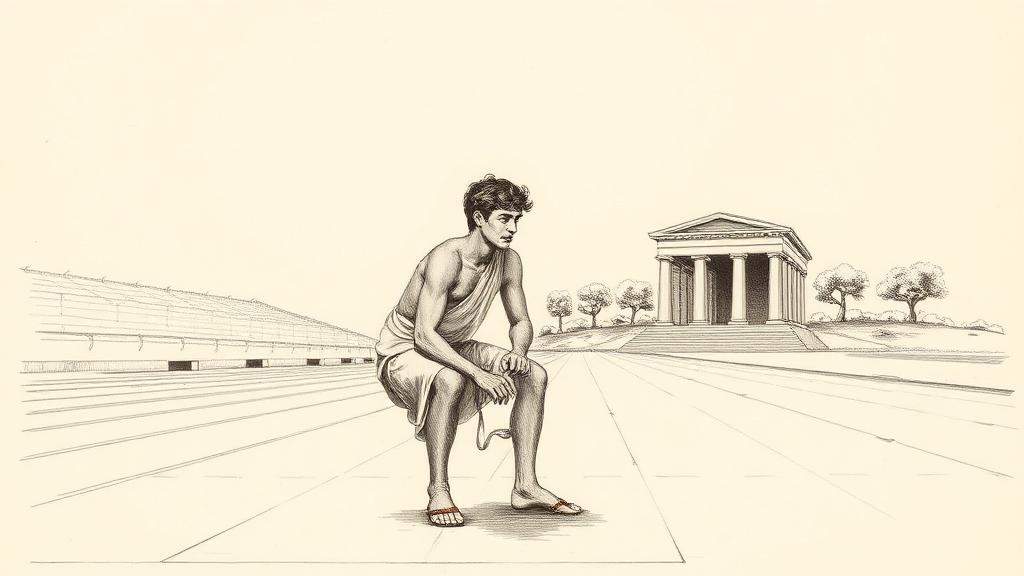
The first Olympic footrace, and the cook who won it
The altar of Zeus at Olympia was, by the time these games were held, already a monument to habit. Pausanias would describe it as a mound nearly seven metres tall, built from the compressed ash of centuries of burnt offerings — each layer the residue of the last sacrifice, tamped down and grown taller with every passing year. Athletes on that late-summer day in 776 BCE were not inaugurating a tradition. They thought they were continuing one.
Olympia is not and never was a city. It is a sanctuary in the western Peloponnese where the Alpheus and Kladeos rivers come close together, enclosed within a walled grove called the Altis. The games there honoured Zeus — not as a polite gesture toward religion but as the entire point. Midway through them, a hundred oxen were offered to the god; the athletes were the prelude.
What made 776 BCE historically legible was the truce. Three months before the games, three heralds — spondophoroi, truce-bearers — left Elis on foot to announce the ekecheiria: no arms in Elian territory, no wars in the approach. City-states that spent most of the year at each other’s throats briefly agreed to stand down and send their fastest men to run instead.
The single event was the stadion: one sprint the length of the stadium track, approximately 192 metres. The winner, recorded first in a list that would run unbroken for over a thousand years, was Coroebus of Elis. He received a wreath of wild olive, cut from a sacred tree in the Altis that tradition claimed had been planted by Heracles. No money, no territory, no political preferment — just the crown and the name.
Coroebus was a cook. His occupation survives through Pausanias, who also noted that his tomb stood at the border of Elian territory — the edge, in effect, of the world that had produced him. He was not a soldier or an aristocrat. He was a man from Elis who could run 192 metres faster than everyone else present. And because his name was written down and the Olympiad named for him, he became the fixed point from which the ancient Greek world calculated time. The historian Hippias of Elis standardised the victor list in the fifth century BCE; before that, Greek chronology was a patchwork of local reckonings. Coroebus’s win gave it a spine.
The games grew quickly from that single sprint. The pentathlon was added in 708 BCE, boxing in 688 BCE, the brutal pankration in 648 BCE. By the time the event list was full, Olympia had become the closest thing the fragmented Greek world had to a shared calendar, a shared stage, and a shared scorecard. Every four years, enemies stood down, heralds walked the roads, and the fastest man got a wreath of olive leaves. The interval between games — the Olympiad — became the unit by which Greek historians measured everything.
Coroebus’s olive crown did not survive the journey home. The crowns never did — they were meant to wither. What survived was the list with his name at the top and, beneath it, 293 more Olympiads, one every four years, until the Emperor Theodosius put an end to the whole business in 393 CE. By then the interval had been running for longer than the distance between us and the Norman Conquest. The cook from Elis had started something that took an imperial decree to stop.
Sources
- Ancient Olympic Games — World History Encyclopedia — the Altis sanctuary, the hecatomb of a hundred oxen, the ekecheiria truce, the spondophoroi heralds, the olive crown.
- Ancient Olympic Games — Wikipedia — the stadion race, the truce mechanics, the expansion of events (pentathlon 708 BCE, boxing 688 BCE, pankration 648 BCE), 293 Olympiads.
- Coroebus of Elis — Wikipedia — his occupation as cook, his victory, his tomb recorded by Pausanias, Hippias’s standardisation of the victor list.