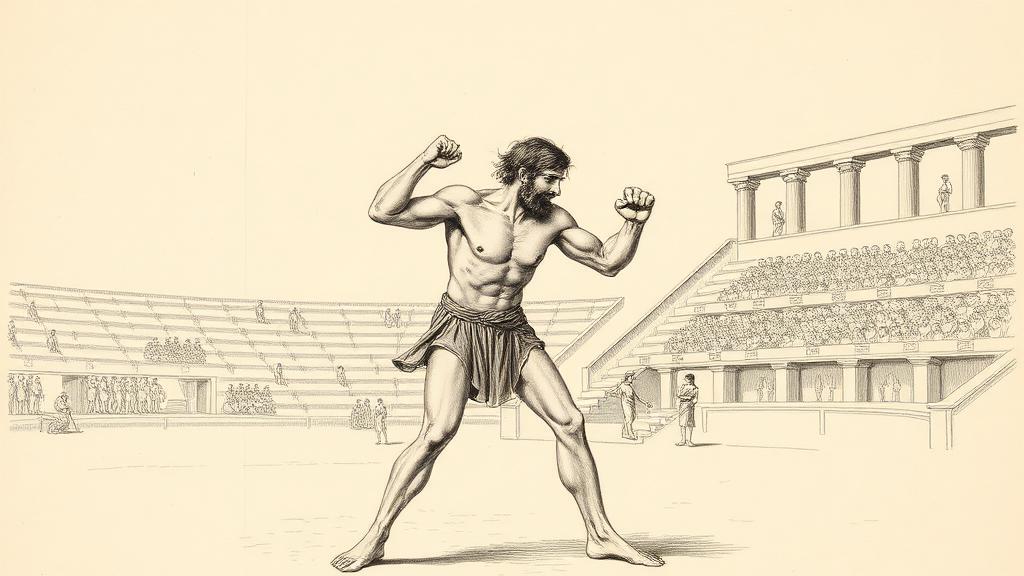
Pankration: the sport with one rule (well, two)
At Olympia in 648 BCE, two athletes oiled their bodies, stepped into the sand, and proceeded to do things to each other that boxing and wrestling explicitly forbade. The Greeks, watching from tiered banks of earth under the Peloponnesian sun, had a name for this: pankration, “all strength,” and they loved it immediately.
The 33rd Olympiad added pankration to the “heavy events” category alongside boxing and wrestling. Lygdamis of Syracuse won the first crown — his name survives in the victor lists — and whatever he did to earn it, the crowd approved without reservation. Pankration quickly became the most anticipated event at the festival.
The rules, such as they were, fit in a sentence: no biting, no eye-gouging. The Spartans, in their characteristic way, quietly disregarded both. Everything else — kicks to the groin, joint locks, strangulation, slamming a man’s face into the sand — was not only legal but expected. There were no weight divisions, no time limits, no rounds. Matches ended when a fighter raised an index finger to signal submission, or when he could no longer do so. The sport moved through two informal phases: ano pankration, the upright exchange of strikes and throws, and kato pankration, the ground phase, where chokeholds and broken joints settled matters.
The anecdote that defines pankration belongs to Arrhichion of Phigalia, who came to the 54th Olympiad in 564 BCE as the reigning two-time champion. An unnamed opponent caught him in a chokehold and squeezed. Arrhichion, rather than raise his finger, found the man’s toe with his own foot and twisted until the joint gave. The opponent’s hand shot up: the submission signal. The judges awarded the match to Arrhichion. Then they noticed he was dead — strangled in the same moment he forced the tap-out. The Eleans debated and reached the only logical conclusion: they crowned the corpse. Arrhichion went home to Phigalia undefeated, in the care of his fellow citizens.
Pankration mattered beyond the festival because the Greeks were a civilization at war behind the marble temples. The Spartans at Thermopylae in 480 BCE, according to later accounts, fought with bare hands once their weapons broke. Alexander the Great actively recruited pankratiasts to his Macedonian campaigns, finding that men trained to subdue resisting opponents at close range were worth keeping. More durably, the sport crossed the division between striking and grappling — two categories that boxing and wrestling had kept separate — and in doing so arrived at what turned out to be the most complete model of unarmed combat anyone would define for the next two thousand years.
The ancient Olympics ended in 393 CE. What pankration had worked out — that a fight is won on the ground as much as on the feet, that grappling and striking belong to the same contest — was rediscovered, sport by sport, across the 20th century. The cage, the submission holds, the ground-and-pound: Arrhichion would have understood the chokehold at a glance.
Sources
- Pankration — World History Encyclopedia — introduction at 648 BCE Olympics, two-phase structure (ano and kato), military significance, Alexander the Great’s use of pankratiasts.
- Pankration — Wikipedia — first champion Lygdamis of Syracuse, full rules, Spartan exemptions, Arrhichion story.
- Arrhichion — Wikipedia — detailed account of the 564 BCE posthumous victory, drawn from Pausanias.