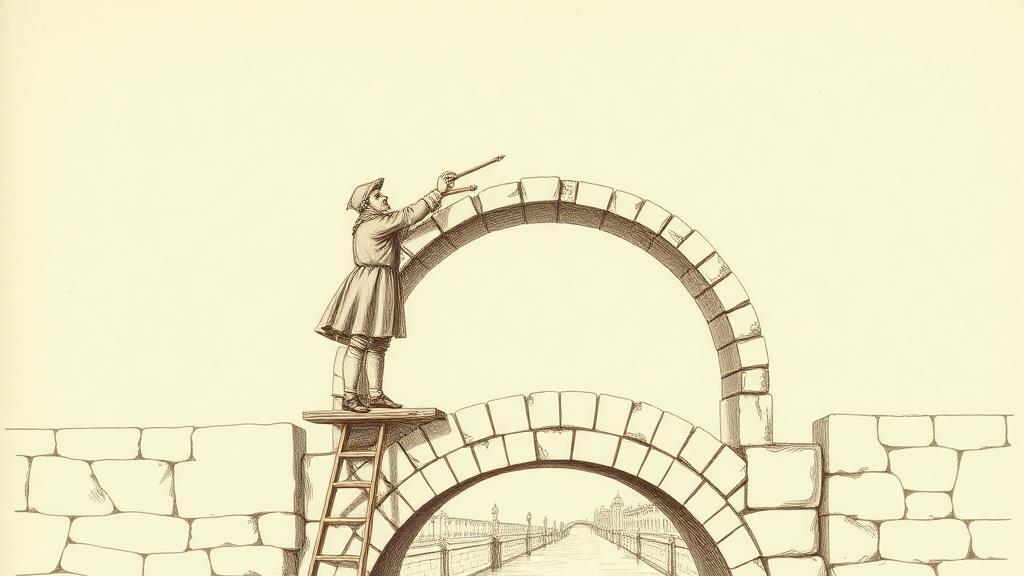
The Rialto Bridge, or how Venice bet on a single arch
In the summer of 1444, the wooden drawbridge crossing Venice’s Grand Canal collapsed under the weight of a crowd gathered to watch the wedding procession of the Marquis of Ferrara. People fell into the canal. The bridge had already been partially burned in the 1310 Tiepolo revolt; it was rebuilt, served its purpose for another century, and then in 1524 it fell again.
Venice had been crossing the Grand Canal on timber for three hundred years by that point, and the timber kept losing.
The Rialto was the only fixed crossing on the Canal, which here runs about forty metres wide and connects the administrative centre at San Marco with the marketplace of San Polo. A first pontoon bridge had gone up in 1181 — built by one Nicolò Barattieri, who is otherwise unknown to history — and successive wooden structures had served the city through its years as the dominant maritime power in the Mediterranean. Practical, cheap, flammable. The Venetian Senate had long wanted stone, but stone meant a decision, and Venice’s government was not built for speed. By 1551, when the Senate opened a formal competition for a permanent stone bridge, the plans that came back were classical multi-arch designs from names that read like a Renaissance honour roll: Andrea Palladio, Jacopo Sansovino, Vincenzo Scamozzi, Jacopo Vignola. All proposed several arches with piers sunk into the canal floor. Venice’s harbour officials looked at those pier-studded designs and noted that gondolas, trading boats, and everything else that used this stretch of canal would no longer pass freely. The competition stalled.
It took another generation. In 1587, under Doge Pasquale Cicogna, the city finally authorised a design by Antonio da Ponte — a Venetian architect and engineer then in his mid-seventies. His solution was a single stone arch, 31.8 metres wide and rising 7.3 metres above the water, with no support in the middle of the canal at all. Construction began in 1588.
The site first required 12,000 wooden pilings driven into the lagoon mud on each bank to anchor the abutments that would carry the arch’s thrust. On those abutments, courses of cut stone were fitted into a curve, each piece locked in place by compression — the arch holds itself up because every stone is being squeezed by its neighbours, and there is nowhere for the force to go except down and outward into the foundations. Vincenzo Scamozzi, who had lost the competition, publicly predicted that the structure would collapse. When it opened in 1591, he insisted the arch was too flat to last. He was not alone: contemporary critics considered da Ponte’s design reckless. Scamozzi’s prediction did not survive the century. The bridge did.
Da Ponte also lined both sides of the deck with covered rows of shops and a central portico open to the canal on both sides. The shop rents funded maintenance and security for decades. It was a bridge that paid for itself, which in Venice was considered perfectly sensible.
What the Rialto settled was a question that every major river-crossing since has had to answer: how much structure can you leave out while leaving all the strength in? Da Ponte’s single arch let the canal stay open to traffic and concentrated every force through stone and into foundations below the waterline. The arch has carried the same thirty-one metres ever since — still resting on those 12,000 wooden pilings, still sealed from rot by the airless lagoon mud, the same wet darkness that has held Venice up for a thousand years.
Sources
- Rialto Bridge — Wikipedia — construction timeline 1588–1591, earlier bridge collapses in 1310/1444/1524, dimensions, Nicolò Barattieri pontoon bridge 1181, competition history with Palladio and Sansovino.
- Rialto Bridge — EBSCO Research Starters — engineering approach, twelve thousand wooden pilings, Scamozzi’s prediction, role in connecting Venice’s commercial districts.