Ring's first smart lock, or how the key became optional
The Schlage Encode ships with two keys. The Yale Assure 2 ships with two keys. The Kwikset Halo ships with two. Every major smart lock on the market in 2026 includes physical keys in the box, because everyone who has designed a smart lock knows the battery will die one day and someone will be standing outside.
The industry’s standard answer, for anyone whose battery actually did die, was a troubleshooting tip: press a 9-volt battery against two terminals on the exterior face of the lock, draw just enough charge to open the door, then go inside and sort out the problem. The tip worked. It required carrying a 9-volt battery. It became a running joke.
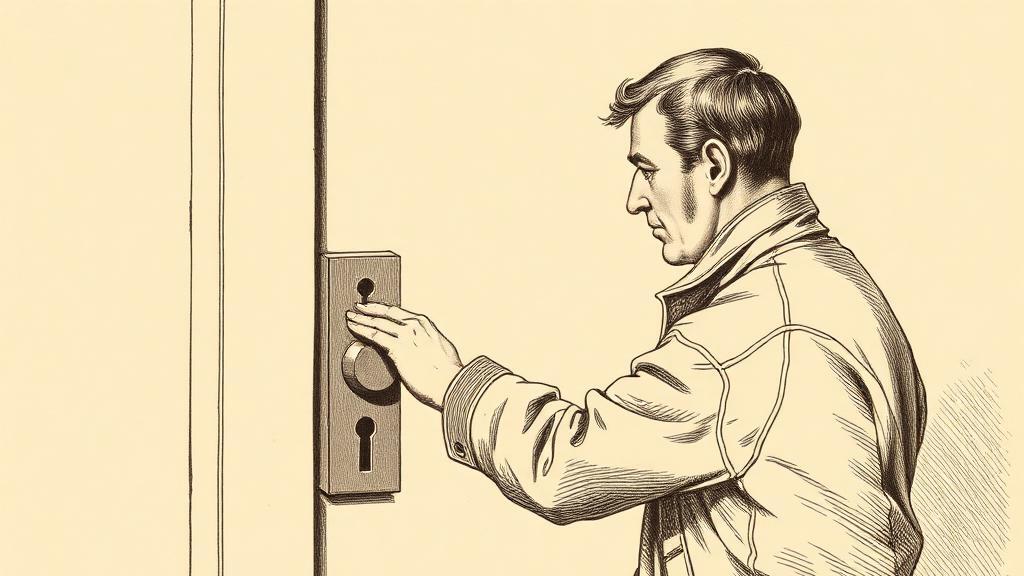
On October 7, 2026, Ring — best known for video doorbells, which founder Jamie Siminoff had started building in his garage in 2013 — announced its first lock. It did not come with keys. It did not have a keyhole. Where the keyhole would normally sit, it had a dial.
The dial was the answer to the 9-volt battery problem. If the battery died while you were outside, you turned the dial — five to ten rotations, depending on how fast you moved — until a light turned green. The turning drove a small generator inside the lock, producing enough current to wake the mechanism and draw the bolt. You went inside. You recharged the battery — Ring’s removable Quick Release Ultra Battery Pack, rated at roughly a year per charge. You didn’t have to carry a 9-volt.
Ring’s four ways to unlock, in the conditions where the battery was cooperative: fingerprint reader, backlit touchscreen keypad, Ring app, Alexa voice command. Price: $249. Three finishes: black, silver, brass. Available in early 2027, pending FCC authorization.
“If you have to have a key,” Siminoff told GeekWire, “it’s like, well, why have a smart lock?” The question had a point. Smart locks had been a niche product since August and Kwikset first introduced Bluetooth-enabled deadbolts in 2013. Thirteen years on, adoption remained modest — against nearly universal ownership of the smartphone that was supposed to be the key. The sticking point was not the price or the app or the fingerprint reader. It was the fallback: every smart lock owner either carried a physical key anyway, or privately acknowledged that they should.
Siminoff said he worked out the power-dial concept at night, using Amazon’s AI tools to model the mechanism. The parts, he noted, were mostly off-the-shelf; the invention was in how they were put together.
For six thousand years, every answer to the question of what opens a lock has been some variation of metal and shape. Ring’s first lock answers with five turns of a dial.
Sources
- Ring’s first smart lock — 9to5Mac — announcement date October 7, 2026, price, access methods, Q1 2027 availability.
- Ring Smart Lock — About Amazon — power dial mechanism, Quick Release Ultra Battery Pack details, Jamie Siminoff’s design rationale.
- Ring’s first smart lock — GeekWire — Siminoff quote, five-to-ten rotations specification, AI-assisted development.