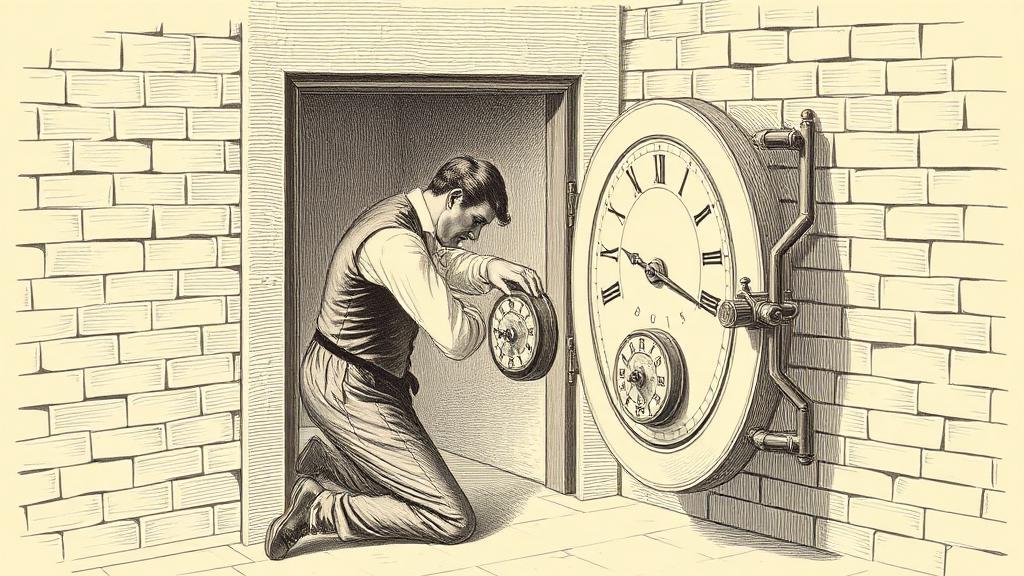
Sargent's time lock, or how a Rochester locksmith made coercion useless
In May 1875, eight men broke into the home of Frederick Deland, cashier of the National Mahaiwe Bank in Great Barrington, Massachusetts, and told him, politely at first, that he would open the vault. Deland explained that he could not. The vault was fitted with a new mechanism — a Sargent & Greenleaf double chronometer time lock — and even with the correct combination in hand, the bolts would not retract until a preset hour. The leader tried the combination himself to confirm. The vault stayed shut. The gang departed, empty-handed and eventually arrested, defeated not by any act of human courage but by two small clockwork movements ticking inside a steel housing made in Rochester, New York.
The time lock was barely a year old.
James Sargent had been thinking about the problem since the mid-1860s, when a wave of bank robberies began exploiting the simplest flaw in any combination vault: the person who knew the combination. Safe-cracking required skill. Kidnapping a cashier required neither. By 1873, Sargent — co-founder of Sargent & Greenleaf, already a supplier of combination locks to the U.S. Treasury — had built a prototype from lock components and two kitchen clocks. The principle was simple enough to be cruel: regardless of the combination dialed, the bolt remained physically blocked until a pair of independent clock movements, running in parallel, reached a preset hour. No combination, no key, no leverage moved it before its time. He filed a patent on June 11, 1873 — granted as Patent No. 186,369 in January 1877 — and personally installed the first production unit at the First National Bank of Morrison, Illinois, on May 26, 1874. That lock stayed in service for nearly forty years.
Two movements rather than one was not decorative redundancy. If one clock ran fast, broke, or was tampered with, the second continued and the vault waited. Sargent designed in failure modes from the beginning, which is a different instinct from most lock inventors.
The Great Barrington incident circulated quickly through the trade press, and it did something no patent certificate could: it made the time lock into a moral argument. The Berkshire Courier had announced the Mahaiwe Bank’s new installation in February 1875, three months before the robbery. The robbers apparently hadn’t read the paper. A vault secured by time was a vault secured against every leverage a criminal could apply to a human being — and bankers who had read one too many accounts of colleagues tied to parlor chairs understood the proposition immediately.
By the 1880s, time locks were standard equipment across American bank vaults. Sargent & Greenleaf sold them by the thousands. Competitors appeared, lawsuits followed, and Sargent prevailed at the U.S. Supreme Court in Sargent v. Hall Safe & Lock Co. The logic spread: jail cells, post office boxes, ATM withdrawal limits, the software prompt that asks you to wait twenty-four hours before closing your account.
The problem Sargent solved in 1873 was not really a lock problem. It was a coercion problem. Every timed access-control mechanism since has borrowed the same premise: security, sometimes, is the ability to say honestly that you cannot comply, even if you wanted to.
Sources
- The Origins of the S&G Time Lock — Safeguard Safes Australasia — installation at First National Bank, Morrison, Illinois (May 26, 1874); patent number and grant date; mechanism details.
- Sargent & Greenleaf Company History — founding of S&G (1865), U.S. Treasury contract, time lock invention date, product line history.
- Frederick Deland and the bungling bank robbers — The Berkshire Edge — the May 1875 Great Barrington robbery attempt and how the time lock thwarted it.
- Sargent v. Hall Safe Lock Company — Wikisource — Supreme Court opinion enforcing Sargent’s time lock patent against imitators.