The welt that made shoes worth keeping
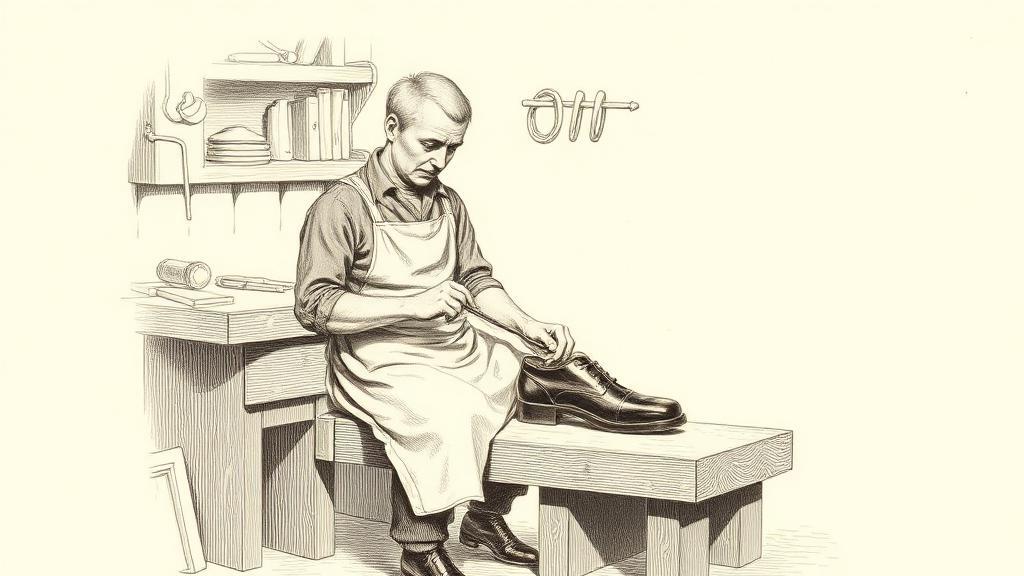
A skilled cordwainer in the 1860s could hand-welt a shoe in roughly twenty minutes — curved awl, waxed thread, twelve stitches to the inch, each one drawn tight through three layers of leather by feel. A machine patented in 1875 did the same stitch in under twenty seconds.
The machine came out of an unlikely chain of hands. In 1862, a French mechanic named Auguste Destouy patented a device built around a curved needle — the critical innovation being that a curved needle could loop inside the narrow cavity between the shoe’s upper and its insole without punching out through the bottom. Destouy lacked the capital to develop it. Seven years later, Charles Goodyear Jr. — son of the man who had discovered vulcanized rubber and, unlike his father, at ease with money — acquired a related patent from a Brooklyn shoe producer named James Hanan, then hired Destouy and a mechanic named Daniel Mills to resolve the machine’s remaining problems at his American Shoe Tip Company in New York.
Between 1869 and 1876, Destouy and Mills filed seven patents in Goodyear’s name, each addressing a different shortcoming — threading a curved needle in and out of a narrow groove while the shoe was still on the last, without stitching through the insole. The famous patent, U.S. Patent No. 96,944, arrived in 1875. The machine reached the market the following year.
The credit arrangement was slightly awkward. Goodyear Jr. had not invented anything in a mechanical sense. He had bought the patent, employed the inventor, and replicated the model his father had used — securing benefit from a discovery not by making it, but by exploiting it systematically. Destouy and Mills did the engineering. The machine went to market under the name Goodyear. Industrial history contains no shortage of such arrangements, but this one is unusually legible.
In a Goodyear-welted shoe, the upper leather is stitched to the welt; the welt is stitched to the outsole; and the insole sits between the two seams, untouched by either. The cavity above the outsole fills with cork, which molds over time to the exact shape of the wearer’s foot. When the outsole eventually wears through, a cobbler unstitches it, sews on a new one, and the shoe is good for another decade. The McKay stitch — the mass-market alternative of the same era, which Gordon McKay had been licensing since the Civil War — punched through the insole directly: faster to make, cheaper to buy, impossible to properly resole.
That difference in construction became a difference in commerce. The Northampton workshops that adopted Goodyear’s machine — Church’s, Crockett & Jones — built their businesses on the premise that a well-made shoe was something a customer would return to resole rather than replace. Welting by machine cost about one-fifth what hand-welting cost; you could offer durability at a price the middling classes could reach. By the 1880s, the machine had spread to workshops across England and America, and the hand-welters who remained did so by specializing in bespoke work — the machine had made their craft expensive, not redundant.
The sole wore out; the shoe didn’t have to. Somewhere in Northampton, the same stitch is still being set.
Sources
- Goodyear welt — Wikipedia — overview of welt construction, the roles of Goodyear Jr. and Auguste Destouy, and the machine’s multi-inventor development.
- History of the Goodyear welted shoe construction — Shoegazing — the patent chain from Destouy to Goodyear, the 1875 machine, production time reduction from roughly twenty minutes to under twenty seconds, and cost reduction.
- History of the Goodyear welting machine — goodyearweltedshoes.pt — James Hanan’s role, Patent No. 96,944, the seven patents filed 1869–1876.