Seiko Astron: the wristwatch that rewrote time
On Christmas morning 1969, a clerk at a Tokyo jeweller laid out a tray of 18-karat solid gold wristwatches and priced each at 450,000 yen — roughly what a new Toyota Corolla cost that year. The watch was called the Astron. Within a week, the initial run of one hundred had sold. The Swiss watch industry, which at that point held most of the world’s wrists, had not been warned to worry.
It should have been.
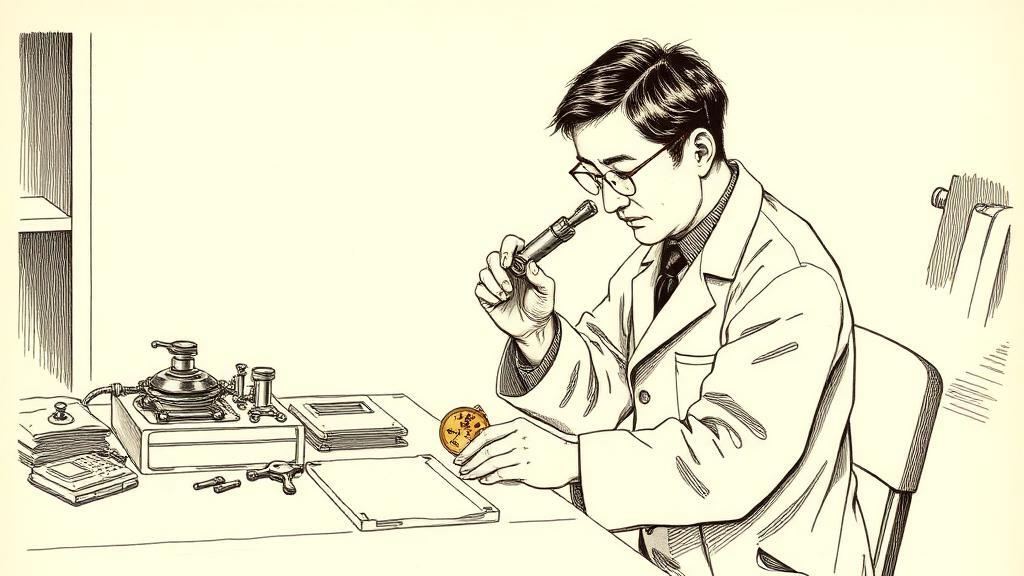
The Astron grew out of a project Seiko’s Suwa Seikosha division launched in 1959, called internally the 59A Project, with the modest aim of building a wristwatch accurate enough to time athletes at the 1964 Tokyo Olympics. A team of engineers under Tsuneya Nakamura — who had joined Seiko in 1944 as Japan was rebuilding from the war — spent a decade on three core problems: how to machine a quartz crystal small enough to fit a wrist, how to protect it from daily shocks, and how to drive the hands without draining the battery in a week. The solution to that last problem was a six-pole stepping motor, its copper wire wound 20,000 times, drawing just 18 microamps. It became the blueprint for essentially every quartz watch made since (Seiko Watch Corp.).
In 1968, with the team within reach of the finish line, Seiko president Shoji Hattori issued an ultimatum: cancel the competing tuning-fork project and have a commercial quartz watch on sale within one year. Nakamura’s team produced twenty working prototypes by December. On December 25, 1969, the Seiko Quartz-Astron 35SQ went on sale — the world’s first commercially available quartz wristwatch, gold-cased, hand-finished, accurate to within five seconds per month (Wikipedia).
The best Swiss chronometers of the same year managed five seconds per day on a good day. The Astron was one hundred times more accurate.
The Swiss had not been idle. The Centre Électronique Horloger in Neuchâtel had working quartz prototypes as early as 1967, one of which achieved a chronometer classification that August — accuracy the best mechanical watches could not match (ETHW). But Swiss manufacturers, locked into existing supply chains and unwilling to cannibalize their own output, did not bring a commercial quartz movement to market until April 1970. Four months after the Astron. By then, the January 5, 1970 issue of the New York Times was already reporting Seiko’s plans to bring the watch to the American market.
What followed is still called the Quartz Crisis. The number of Swiss watchmaking companies fell from over 1,600 in 1970 to under 600 by the mid-1980s. Employment in the industry shrank from 90,000 workers to 33,000 in fourteen years (Wikipedia). The mechanism Nakamura’s team had locked in — quartz oscillator, stepping motor — was cheap enough to put in a child’s toy by the end of the decade.
Tsuneya Nakamura, born in 1923, spent fifty years at Seiko before retiring in 1994. He lived to see mechanical watches repositioned as luxury objects rather than precision instruments — bought for craft and sentiment, not accuracy. The stepping motor his team wound from scratch, copper wire looped 20,000 times, now runs in roughly ninety percent of the world’s watches. It costs about a cent to make.
Sources
- Astron (wristwatch) — Wikipedia — development timeline, technical specifications, pricing, initial sales figures, IEEE milestone.
- Quartz crisis — Wikipedia — Swiss industry data: company count and employment 1970–1984.
- The Story of the 1969 Quartz Astron — Seiko Watch Corp. — 59A Project origins, Shoji Hattori’s 1968 ultimatum, Nakamura’s team, stepper motor specifications.
- First-Hand: The First Quartz Wrist Watch — ETHW — CEH prototype timeline, 1967 chronometer classification.