Soref's laminated padlock, or how a Milwaukee workshop closed the security gap
Harry Soref had already been turned away. By 1921, he had pitched his laminated-steel lock design to every major American manufacturer he could reach, and they had all told him the same thing: stacking metal plates and riveting them together was a crazy way to build a padlock.
Soref was thirty-four years old, Russian-born, and had spent years as a traveling locksmith working circuits through the United States, Canada, and Mexico. He understood the market well enough to know exactly what was wrong with it. Premium padlocks — solid brass or machined steel, precision-fitted — were nearly impossible to destroy but cost the equivalent of more than a hundred dollars in today’s money. Their cheaper cousins were affordable and useless: one swing of a hammer finished them. The gap between those two options was wide enough to drive a freight car through, and almost no one was doing anything about it.
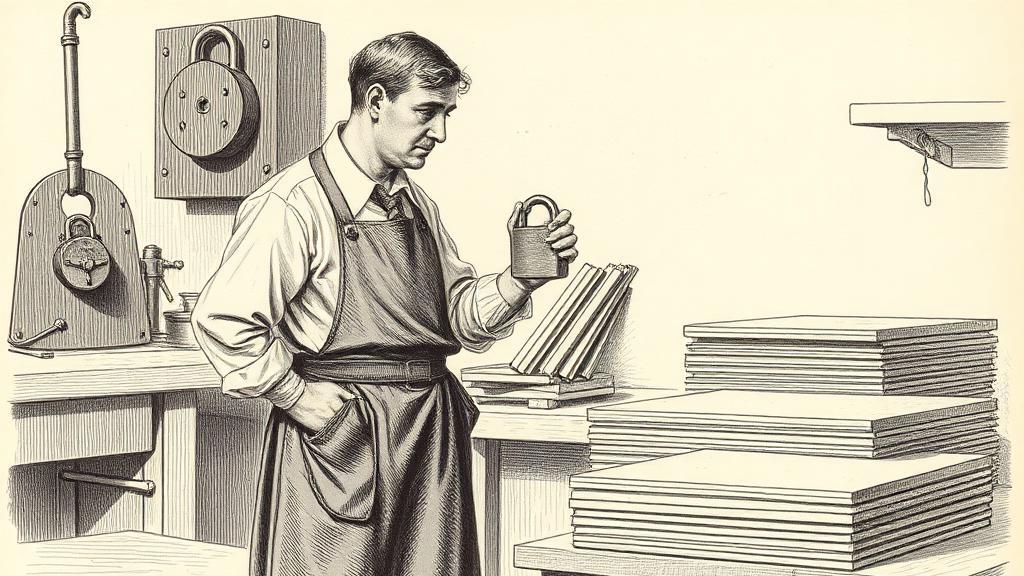
His solution came from a different industry. Armored warships and bank vaults had long achieved their strength not from single thick slabs of metal but from layers — plates bonded under pressure, each adding to a laminated whole that was denser and harder to breach than any individual sheet. Soref applied the same logic to a padlock body. Thin steel plates, stampable on ordinary punch presses, were squeezed together under intense pressure and riveted fast. The result absorbed blows like armor at a fraction of what solid-machined alternatives cost to produce. He founded Master Lock Company in Milwaukee in 1921 with partners Philip Yolles and Samuel Stahl and five employees. The patent came through in 1924.
The first landmark order followed in 1928. Federal agents needed to close the raided speakeasies, warehouses, and nightclubs of Broadway during Prohibition, and they placed a $65,000 order for 147,600 Master padlocks to do it. When the government decides a door needs to stay shut, it turns out it wants a lock that cannot be hammered off. Business never looked back.
Soref himself was not what you would picture. Small, soft-spoken, he worked from five in the morning until ten at night, six days a week, and refused to install time clocks in his factory or set production quotas. “There is no Sunday, no Monday, no Tuesday for me,” he told the Milwaukee Journal in 1955. “The days are too short and nights too long.” He also confessed, without apparent embarrassment, that he dreamed about padlocks. By the mid-1950s the plant was turning out eighty thousand locks a day. He died in 1957 holding eighty patents.
What Soref had actually built was a solution to a class problem as much as an engineering one. Before his design, a padlock that resisted real force was a luxury purchase. After it, the same protection hung from bicycle wheels, garden sheds, storage units, and school lockers across the country. The padlock became invisible — and eventually a generation of designers would replace it not by making a stronger padlock but by asking a different question, which turned out to be whether you needed the key at all.
Sources
- Master Lock — Wikipedia — founding date, Harry Soref’s background, laminated steel design, 1924 patent.
- Master Lock Has Had a Hold on the Industry for 100 Years — Smithsonian Magazine — premium/cheap market gap, the 1928 Prohibition government order for Broadway nightclubs.
- The Man Who Dreamed of Locks — Milwaukee Notebook — Soref’s personal biography, Milwaukee Journal quotes, production figures.