Swatch, 1983: the paper-towel sketch that saved Swiss watchmaking
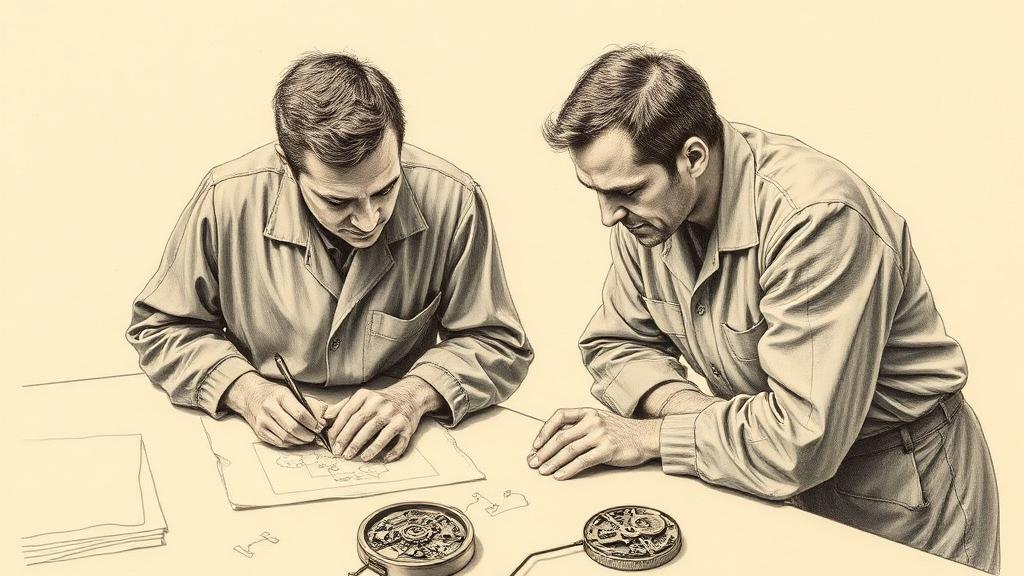
On March 27, 1980, two engineers at ETA SA’s research lab in Grenchen, Switzerland, spread out a paper towel on a workbench and started sketching. Elmar Mock and Jacques Müller had been handed a task their boss, ETA chief executive Ernst Thomke, considered urgent: design a Swiss quartz watch cheap enough to undercut the Japanese. The concept they roughed out that morning — titled Vulgaris, meaning common — was presented to Thomke before lunch (First Versions). Three years later, it would go on sale for CHF 39.90.
By 1980, the Swiss watch industry was in a state of collapse that would have seemed preposterous to anyone who remembered the 1950s. Swiss exports had dominated world watchmaking for generations, but the quartz movement — pioneered in Japan and mass-produced with ruthless efficiency — had changed the arithmetic entirely. Between 1974 and 1983, Swiss watch production fell from a record 96 million units to roughly 45 million, a halving in less than a decade (Crown & Caliber). By 1977, Seiko had become the largest watchmaker in the world by volume. Switzerland’s two largest conglomerates, ASUAG and SSIH, were so financially distressed that their banks were quietly exploring liquidation. Swiss watchmaking, as an industry, was considering the option of simply not existing.
Mock and Müller’s key insight was structural. A conventional quartz watch of the era had around 90 to 100 components. Their Vulgaris concept — later called “Revolution 51” inside the project — eliminated nearly half of them. The essential move was using the plastic case itself as the bottom plate of the movement: the case and the mechanism shared the same architecture, collapsing two separate objects into one. The result was a watch with 51 components, assembled entirely by machine, with no human hand touching the movement between injection molding and finished article (Wikipedia). Because the assembly was automated, production costs dropped roughly 80 percent compared with traditional Swiss methods.
The first twelve models launched on March 1, 1983, in Zürich, priced between CHF 39.90 and CHF 49.90 — standardized to CHF 50 flat by autumn. They were sold not as precision instruments but as fashion accessories, a second watch (the name Swatch collapses “Swiss” and “watch,” though “second watch” was the stated positioning). Marketing consultant Franz Sprecher pushed the brand toward color, pop-art dials, and the logic of the impulse purchase — away from the kind of horological dignity that had helped Swiss watchmakers pretend the crisis wasn’t happening.
The results were not subtle. Twenty million Swatches sold in the first three years. By 1988 the cumulative total passed 50 million; by 1991, 100 million (Wikipedia). Swiss production, which had bottomed at 45 million units in 1983, recovered to 60 million by 1985 — two years after Swatch launched (Crown & Caliber). Nicolas Hayek, brought in by the banks to assess whether the industry was worth saving, merged ASUAG and SSIH into what became the Swatch Group, then used the cash from the cheap plastic watch to acquire, over the following decade, Omega, Longines, Blancpain, and Breguet.
The paper towel Mock and Müller sketched on that morning in 1980 is, presumably, long gone. What they drew on it is still in the display case at every airport duty-free in the world.
Sources
- Swatch — Wikipedia — launch date and pricing, 51-component innovation, sales figures (20M, 50M, 100M), and the “second watch” name origin.
- The Quartz Crisis — Crown & Caliber — Swiss production decline from 96M to 45M units (1974–1983), Seiko’s 1977 ascendancy, and the rebound to 60M units by 1985.
- First Versions: Swatch — the March 27, 1980 Vulgaris sketch, the paper-towel design session, Thomke/Mock/Müller’s roles at ETA SA, and the “Revolution 51” engineering concept.