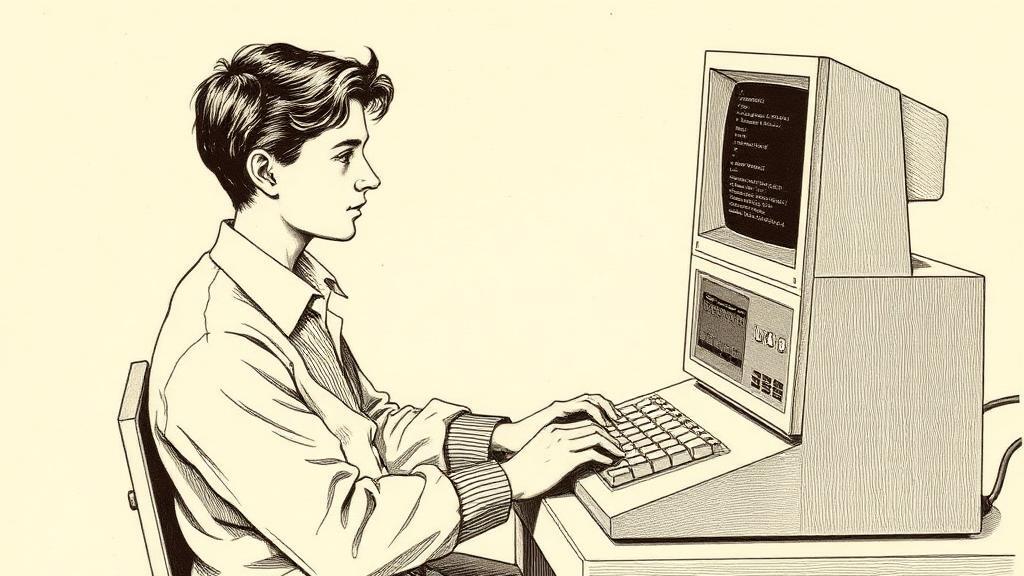
Turbo Pascal, or the compiler that never touched the disk
In 1984, Byte magazine reviewer Bruce F. Webster called Turbo Pascal “probably the best value for money in the history of microcomputers.” He wrote that after Borland had sold 250,000 copies — in a market Byte estimated at only 30,000 potential buyers (Wikipedia). Someone’s arithmetic was off, and it wasn’t Borland’s.
Turbo Pascal launched on November 20, 1983, at $49.95, sold by direct mail and bypassing retail entirely. The dominant Pascal environments of the day — UCSD Pascal, Microsoft Pascal — cost several hundred dollars, required separate editors, compilers, and linkers, and produced workflows that could turn a one-line fix into a ten-minute ceremony of floppy swapping and waiting.
The compiler at the center of all this was originally called PolyPascal. Its author was a twenty-three-year-old Dane named Anders Hejlsberg, working out of Copenhagen through a company he called Poly Data. Hejlsberg had been writing Pascal compilers since 1980, beginning on a Nascom microcomputer, and the version he brought to market in 1983 was exceptional: a one-pass compiler written in hand-tuned assembly language, running entirely in RAM, requiring no disk access during compilation. Philippe Kahn, the French-born founder of Borland International in Scotts Valley, California, licensed it, wrapped it in a screen editor and a menu shell, and turned it into Turbo Pascal. Hejlsberg joined the company shortly after and became architect for every version that followed (Wikipedia).
The name was honest. Where contemporary compilers ground through multi-pass pipelines — reading source from disk, writing intermediate files, reading them back — Turbo Pascal held everything in memory and compiled in a single pass. You pressed Ctrl-F9; an executable appeared in seconds. The editor was not packaging around the compiler: it was the same program, managing the source buffer that the compiler read directly. The edit-compile-run cycle, which had required coffee-break scheduling, became something a programmer could do impulsively.
Kahn’s pricing was not charity. He had concluded that setting the price below the cost of copying a floppy was the only way to beat piracy in the hobbyist market. He was right: Borland eventually sold over 400,000 copies (The Register), and Turbo Pascal became the standard teaching tool in computer science departments through the late 1980s. Students across the US and Europe wrote their first sorting algorithms, their first recursive functions, their first data structures inside it — in an environment where errors appeared underlined at the offending line, immediately, before the thought that caused them had finished fading.
Hejlsberg left Borland for Microsoft in 1996. At Microsoft he designed C#, then TypeScript. The instincts he carried from those tight assembly loops in Copenhagen — fast feedback, immediate results, never make the programmer wait for the machine — run through both. Every IDE that followed Turbo Pascal, from Visual Studio to Eclipse to VS Code, inherited the same premise: the editor, the compiler, and the programmer belong in the same room.
In 1983, Hejlsberg proved that room could fit on a single floppy.
Sources
- Turbo Pascal — Wikipedia — Release date (November 20, 1983), price, Hejlsberg’s PolyPascal origins at Poly Data, Bruce Webster’s Byte reviewer quote, sales figures of 250,000 within two years in a market estimated at 30,000.
- 40 years of Turbo Pascal — The Register — Market context, 400,000 total copies, Borland’s pricing-versus-piracy strategy, legacy in developer tooling.