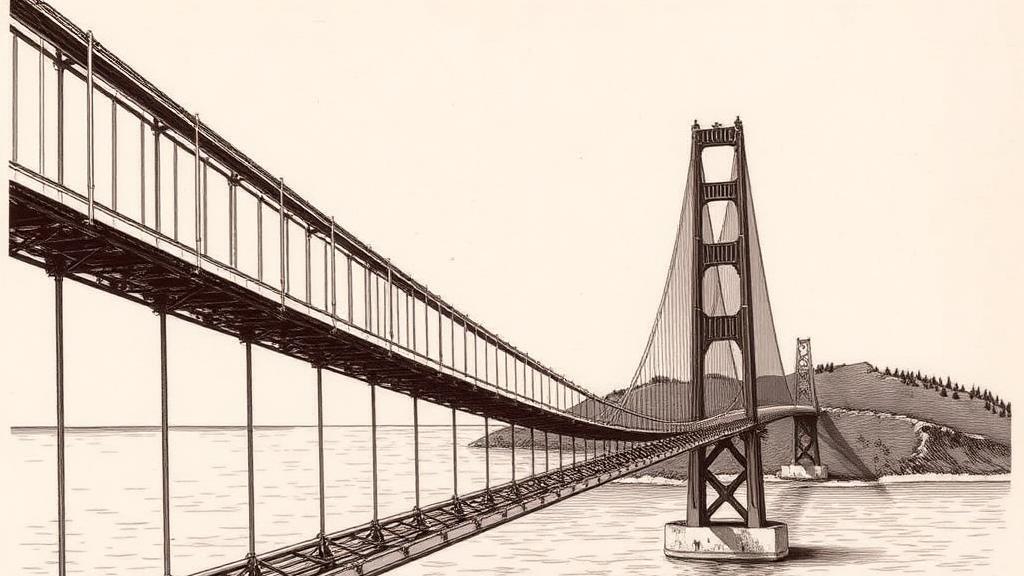
Galloping Gertie, or what the wind does to an airfoil
On the morning of November 7, 1940, a newspaper editor named Leonard Coatsworth drove onto the Tacoma Narrows Bridge in Washington State and realized he had made a mistake. The road was moving — not a gentle shimmy but a visible, nauseating oscillation, the entire 2,800-foot deck twisting in the November wind. Coatsworth stopped his car, got out, and crawled on hands and knees toward the nearest tower. His car went into Puget Sound. His three-legged Cocker Spaniel, Tubby, was inside it. The bridge had been open for four months.
The man responsible was Leon Moisseiff, a New York engineer whose mathematical contributions had helped make the Golden Gate possible. For the Narrows crossing, Moisseiff proposed a shallow, solid plate girder deck just 8 feet deep — barely a third of what the original engineering contract had specified — in place of the open-lattice through-trusses an earlier generation would have used. It was sleeker, cheaper, and wrong. Construction workers had nicknamed it “Galloping Gertie” before the bridge even opened on July 1, 1940, because the deck rose and fell several feet in moderate winds while crews were still laying the road surface. Engineers filed reports. The reports were noted.
What destroyed it was not the simple resonance that textbooks described for decades afterward. It was aeroelastic flutter: a feedback loop in which the bridge’s own motion reshapes the airflow around it, and the altered airflow amplifies the motion further, without limit. At 42 miles per hour — not a storm, just a stiff Puget Sound breeze — the solid deck began to twist. Each twist changed the pressure above and below the girder. The air pushed harder. By 10:30 a.m. the center span was tilting twenty-eight feet, side to side, in a motion that looked more like a flag than a road. At 11:02 a.m. it tore apart and fell 200 feet.
A camera shop owner named Barney Elliott drove to the bridge and filmed the whole thing. The footage — the deck writhing, cables snapping, forty-foot panels of road tilting vertical before they drop — became one of engineering history’s most-studied films and was added to the National Film Registry in 1998. Most copies played today run about fifty percent faster than real time. At actual speed it is four deliberate minutes of a road destroying itself, calmly and methodically.
Moisseiff did not recover professionally. He died in 1943. His colleagues absorbed what Galloping Gertie proved: a bridge deck is an airfoil, and airfoils have aerodynamics that pure load calculations cannot capture. Wind tunnel testing became a mandatory step in the design of every major suspension bridge built after 1940. The Humber, the Akashi Kaikyō, the Çanakkale — all carry the lesson in the geometry of their decks.
The replacement bridge opened in 1950 with an open-grated deck designed to let wind pass through. Galloping Gertie rests 200 feet below it — a national historic site and an artificial reef. The wind still blows through the Narrows. Now the bridge gets out of its way.
Sources
- Tacoma Narrows Bridge (1940) — Wikipedia — Moisseiff’s design philosophy, 8-foot girder depth, Leonard Coatsworth and Tubby, Barney Elliott’s film, National Film Registry, the replacement bridge.
- November 7, 1940: Collapse of the Tacoma Narrows Bridge — APS News — aeroelastic flutter mechanism (distinct from resonance), 42 mph wind speed, timeline of the collapse, engineering legacy and mandatory wind tunnel testing.
- Aeroelastic Flutter and the Tacoma Narrows — Bridge Masters Inc. — the feedback loop mechanism in detail, how flutter differs from resonance, and why the shallow solid-girder deck was vulnerable.