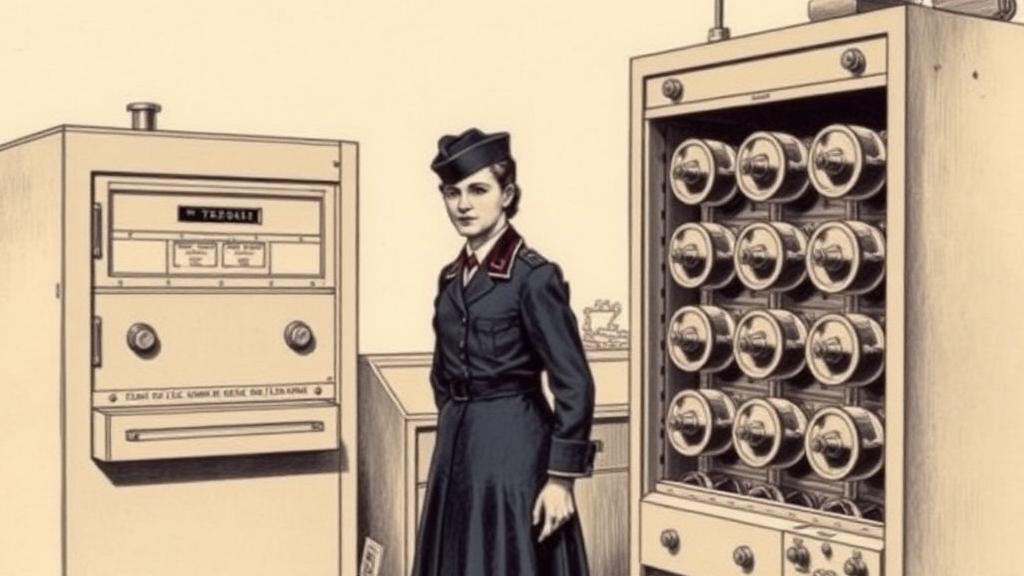
Turing's Bombe: the machine that solved by elimination
On 18 March 1940, a cabinet seven feet wide, six and a half feet tall, and weighing roughly a ton was delivered to a wooden hut at Bletchley Park in Buckinghamshire. It was named Victory, and it was Alan Turing’s answer to the problem Marian Rejewski had framed: how do you break Enigma when the Germans have already fixed the flaw Rejewski exploited?
Victory contained 36 Enigma-equivalent drums arranged in triplets, each triplet wired to represent a crib — a stretch of plaintext Bletchley expected to find somewhere in a message. The drums spun at 50 rpm. When a hypothesis about the day’s plugboard settings proved false — this letter cannot pair with that one — the contradiction cascaded electrically through the circuit, triggering further contradictions until the chain collapsed. Only the correct settings produced no contradiction. The machine stopped. That stop was the key.
The method was Turing’s. After the Polish Cipher Bureau handed over Rejewski’s work at the Pyry meeting in July 1939, Turing needed a new lever: the message-indicator repetitions that had given Poland its footing were gone, eliminated by a German procedure change. Turing found his lever in predictable plaintext. German military radio traffic was formulaic — weather reports in identical formats each morning, routine station returns that ended the same way every day. If you knew a few words of a ciphertext — a “crib” — you could deduce the plugboard pairings those words implied and feed them to the machine.
Victory alone produced too many false stops to be useful. The improvement came from Gordon Welchman, a Cambridge mathematician assigned to traffic analysis at Bletchley. Welchman noticed that the Enigma’s plugboard was symmetric: if it wired W to Q, it necessarily wired Q to W. He designed a “diagonal board” — 325 permanently connected wires — to propagate that symmetry automatically, eliminating whole classes of false stops at once. The second Bombe, Agnus Dei, arrived in August 1940 with the board installed. Decryption times that had taken days fell to hours.
The human story of that spring was John Herivel, a 23-year-old Cambridge undergraduate who arrived at Bletchley in January 1940. One February evening, dozing by his landlady’s fire, he reasoned through what a lazy German operator might do: rather than randomizing rotor positions before the first message of the day, the operator might simply leave the wheels where the previous session had ended, letting starting positions cluster near the ring settings. Herivel mentioned it. Nothing happened for months. Then, in May 1940 — during Dunkirk — the clustering appeared in the intercepts, and the “Herivel tip” gave Bletchley its grip on Luftwaffe Enigma. Turing’s machine ran on operator laziness as much as on electricity.
By May 1945, 211 Bombes were in service at Bletchley and out-stations at Stanmore and Eastcote, staffed mainly by WRNS personnel, processing three to five thousand intercepted messages a day. The intelligence they produced was codenamed Ultra and remained classified until 1974 — long enough that Turing, who died in 1954, received no public recognition for work historians broadly accept shortened the European war by two to four years.
Two hundred and eleven Bombes ran until Germany surrendered, and every one was then destroyed. The idea they ran on was not.
Sources
- Bombe — Wikipedia — Victory’s delivery date, technical specifications (36 drums, seven feet wide, roughly one ton), Agnus Dei in August 1940, and the wartime machine count.
- The Turing-Welchman Bombe — National Museum of Computing — Welchman’s diagonal board, WRNS staffing, out-stations at Stanmore and Eastcote, and daily message volumes.
- John Herivel — Wikipedia — the February 1940 fireside insight, the Herivel tip, and its role in Luftwaffe Enigma decryption from May 1940.
- The Turing Bombe in Bletchley Park — Rutherford Journal — Turing’s crib-based method, Welchman’s diagonal board mechanics, and contrast with the Polish bomba.