The Great Lock Controversy of 1851
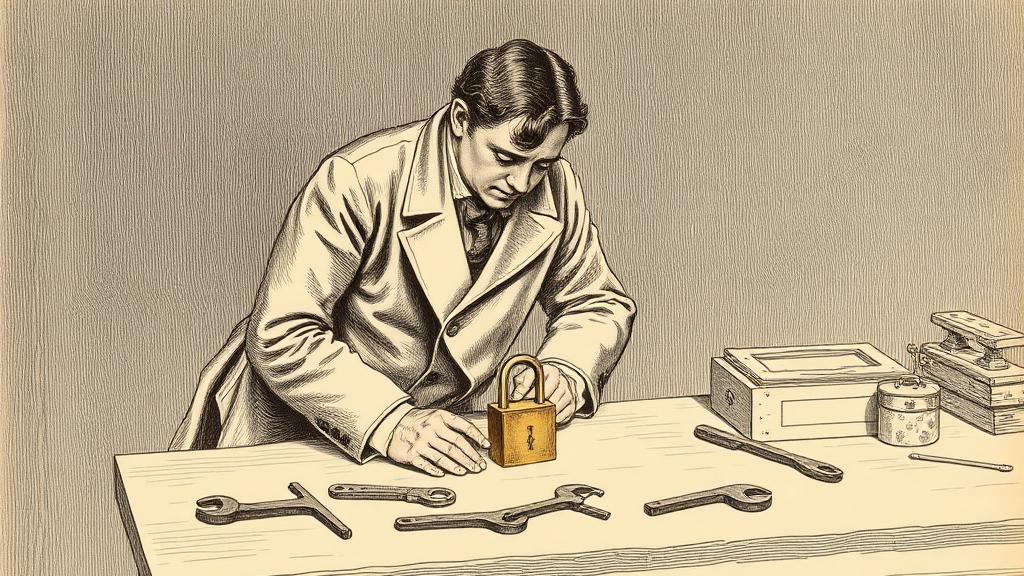
On the morning of 22 July 1851, a small group of gentlemen gathered at a Westminster vault to watch an American pick a British lock. The vault door was secured by a Chubb Detector — the kind of lock that British merchants trusted with their fortunes, that the trade called impregnable. The American, Alfred Charles Hobbs, had a trunk of custom tools and twenty-five minutes to prove otherwise.
He took exactly twenty-five minutes. Then he locked the door again, and picked it a second time in seven.
Hobbs was thirty-eight, from Boston, and had arrived in London as a representative of Day & Newell, a New York lock company exhibiting at the Crystal Palace that summer. He was there to sell American locks, which meant demonstrating that the British competition was worth replacing. He had been at this for years — travelling with a letter from New York’s police chief vouching for his character, and a small trunk of picks, wrenches, and improvised tools whose existence he declined to publicize. In Perth Amboy in 1848, a merchant wagered his safe couldn’t be opened. Hobbs opened it and told him: “Your lock won’t keep the door shut.”
The Chubb was the warm-up. The main event had been sitting in a Piccadilly shop window since 1790: Joseph Bramah’s Challenge Lock, a small padlock with a notice offering two hundred guineas to anyone who could open it without the original key. The lock’s mechanism — a barrel with dozens of interlocking sliders, each requiring precise alignment — had defeated every challenger for sixty-one years. Bramah’s sons had inherited the business. The prize was still there.
Hobbs accepted in August. The conditions: he could bring whatever tools he liked, but could work only on Bramah’s premises, and the lock had to emerge undamaged. He needed sixteen days and fifty-one hours of cumulative effort. At the end, he produced a hand-cut key and opened it in front of witnesses. When a judge called it a fluke, Hobbs locked it, unlocked it, and locked it again.
The British response arrived on cue. The Times lamented wounded national pride. Bramah disputed the terms; the Bankers’ Magazine suggested the circumstances were so contrived they “practically could never exist.” The Bank of England quietly replaced its Chubb locks with Day & Newell models.
What Hobbs had demonstrated was the thing the industry had preferred not to think about: a lock’s reputation is not the same as its strength. Security by obscurity is not security. Once someone with the skill and the incentive sits down with the right tools, the only thing that matters is the mechanism. Both Chubb and Bramah redesigned in the aftermath — Chubb added new boltwork, Bramah’s successors began improving the internal geometry. The next generation of designers — among them a young Linus Yale Jr. in Connecticut — was already working on the principle that the lock must assume a capable adversary.
The notice came down from the window in Piccadilly after sixty-one years. Its replacement, in time, was a design philosophy: build as though the pick is already in the keyhole.
Sources
- Alfred Charles Hobbs — Wikipedia — biographical details, the Great Exhibition context, and Hobbs’s founding of Hobbs Hart & Co. in London.
- Alfred C. Hobbs — Slate — the Perth Amboy anecdote, the police-chief letter, timing details for both locks, British press reaction, and the Bank of England switch.
- Alfred Charles Hobbs and the Great Lock Controversy — History of Safes — conditions of the Bramah challenge, Chubb and Bramah design improvements that followed.