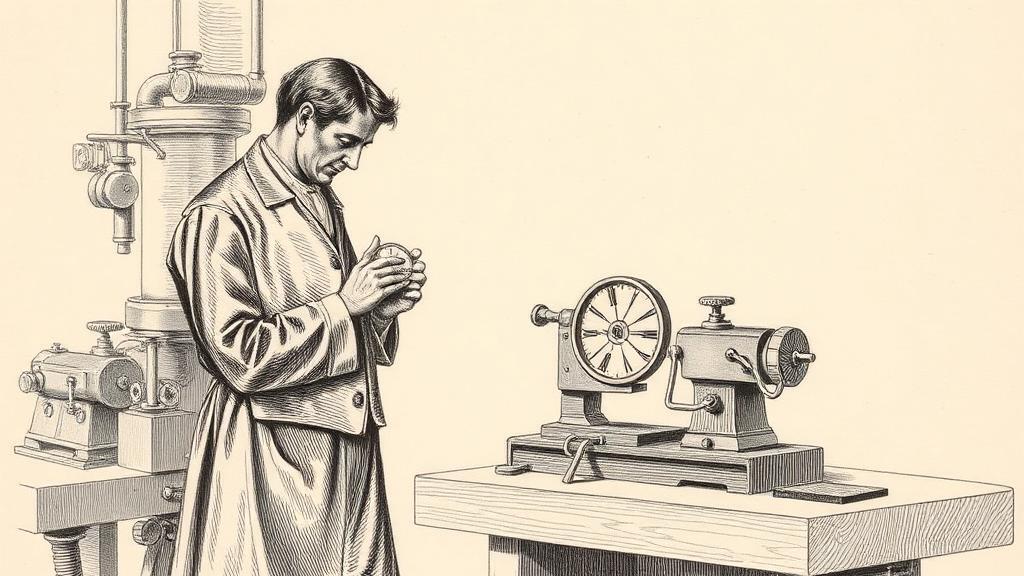
The Waltham watch factory, or how time stopped being a luxury
In 1854, a brick mill on the Charles River in Waltham, Massachusetts opened with roughly 90 workers and one ambition: to make a pocket watch the way the Springfield Armory made a musket. Most of those workers had never touched a watch movement before. By the end of the first week, they had assembled thirty.
The man behind that ambition was Aaron Lufkin Dennison, a Maine-born watch repairman who had spent years turning over a single observation. At the Springfield Armory he had watched machinists assemble rifles from identical, interchangeable parts — any lock fit any stock, no hand-fitting required. Nobody had tried this with something as intricate as a watch. Dennison believed they could. He assembled partners — clockmaker Edward Howard, manufacturer David Davis, and Boston merchant Samuel Curtis, who supplied $20,000 — and founded the American Horologe Company in Roxbury in 1850. The crucial tool, borrowed directly from the armory method, was the master gauge: every component measured against a reference part rather than against its neighbor. A mainspring made on Tuesday had to seat a barrel made on Friday without any adjustment at all.
Before Waltham, a pocket watch cost roughly half a year’s wages for a factory worker, because it was, in effect, a custom object. Swiss and English craftsmen hand-fitted each movement, one at a time; a skilled finisher might complete eight watches in a year. The new system cut that cost and cut it again. It also nearly destroyed itself in the attempt. The Panic of 1857 wiped the Boston Watch Company — the firm’s third name — out of existence; it sold at auction. New owner Royal Robbins kept the machinery and the methods, reconstituted the firm as the American Watch Company, and found himself, six years later, supplying the Union Army.
The “William Ellery” model — a seven-jewel movement priced at $13 — is the pivot on which the story turns. By 1864 it represented nearly half of Waltham’s annual output (Wikipedia). Soldiers who had never owned a watch carried one in their breast pocket, all of them running to the same time, because they were all, in every practical sense, the same watch. The Charles River Museum of Industry and Innovation records that by the 1880s the factory had grown to over 2,400 workers delivering nearly 2,200 movements a day — a scale that drew Swiss watchmakers across the Atlantic to study the methods, and later Henry Ford, who visited to examine the assembly line before designing his own.
What Waltham settled was who got to know the time. The railroads, which needed synchronized schedules to prevent single-track collisions, adopted the factory-made pocket watch as their standard through the 1870s and 1880s. The specifications that emerged — shock resistance, temperature compensation, seventeen or more jewels — set the baseline for the entire global industry. Time, in the sense of knowing the exact minute wherever you happened to be standing, became a condition of ordinary working life rather than a privilege of the counting house.
Dennison himself left in 1862 and eventually made his way to England, where he finished his career making movements for other manufacturers. The factory in Waltham ran until 1957, producing roughly 40 million watches across those years. The system he adapted from the armory is still the reason a watchmaker’s bench looks like a machine shop, not a sculptor’s studio.
Sources
- Waltham Watch Company — Wikipedia — founding history, company name changes, the William Ellery Civil War model, Dennison’s departure, and total production figures.
- Charles River Museum of Industry and Innovation: Of Trenches and Timepieces — factory scale, workforce growth to 2,400, the 2,200-movements-per-day rate in the 1880s, and Henry Ford’s study of Waltham’s assembly methods.
- American System of Watch Manufacturing — Wikipedia — the master-gauge methodology adapted from Springfield Armory firearms production; Dennison credited as the architect of American mass-production watchmaking.