The year computing fit in a pocket
In January 2007, Steve Ballmer — CEO of Microsoft, whose Windows then ran on roughly 90 percent of the world’s personal computers — was shown a photograph of Apple’s new iPhone on CNBC and laughed. “Five hundred dollars, fully subsidized, with a plan,” he said. “I said that is the most expensive phone in the world and it doesn’t appeal to business customers because it doesn’t have a keyboard. There’s no chance that the iPhone is going to get any significant market share. No chance” (Fortune). He was looking at a phone. He was missing a computer.
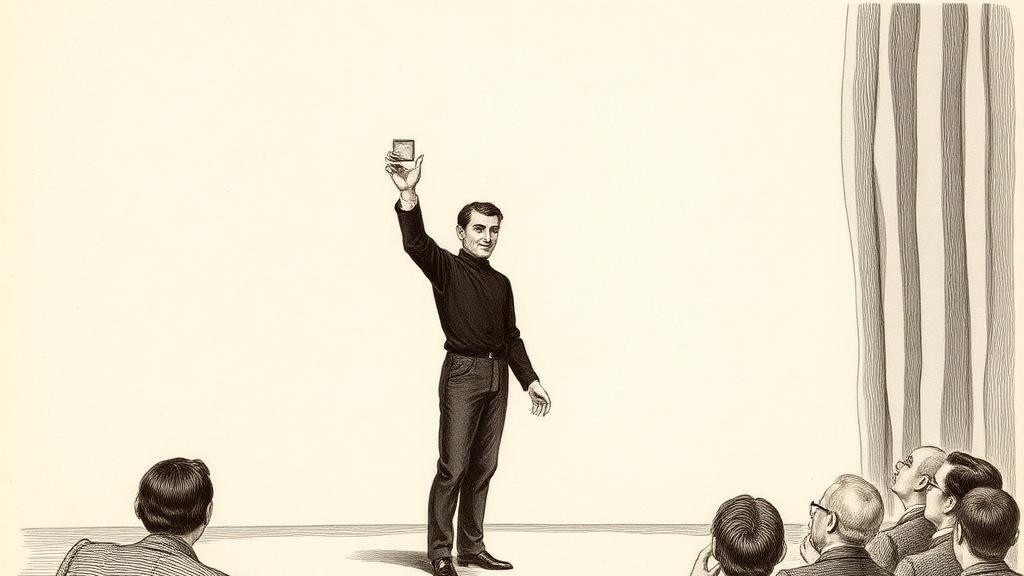
Steve Jobs unveiled the device on January 9, 2007, at Macworld Expo in San Francisco’s Moscone Center, describing it as three things at once: an iPod, a phone, and an internet communicator. The crowd grasped what he meant — one device, not three. What was harder to see was what kind of device.
The iPhone was not a phone with computer features appended. It ran a version of Mac OS X — descended from NeXT’s NEXTSTEP, the operating system Jobs had brought back to Apple in 1997, which in turn descended from BSD Unix — rebuilt entirely for a finger rather than a mouse.
Building it had taken thirty months and an estimated $150 million. The project, codenamed Purple, assembled roughly 1,000 engineers and designers under Tony Fadell on hardware, Scott Forstall on software, and Jony Ive on design. The phone went on sale June 29, 2007, at $499 with a two-year AT&T contract; Apple sold one million in seventy-four days (Wikipedia).
The computing establishment watched with misplaced equanimity. Jim Balsillie of Research In Motion, whose BlackBerry was then the dominant business-communication device in North America, called the iPhone “kind of one more entrant into an already very busy space.” Nokia, the world’s leading handset maker, circulated an internal analysis concluding the high price would contain the damage (Computer History Museum). Ballmer, as noted, laughed.
What none of them had fully priced in was the browser. The original iPhone shipped with no App Store, no third-party software, no 3G radio. What it shipped with was Safari — a complete web browser rendering real HTML, not the stripped-down WAP portals that had passed for mobile internet until that morning. When the App Store opened in July 2008, it handed developers a platform with GPS, a camera, and a microphone, already in a pocket — often the pocket of someone who had never owned a desktop computer.
By 2017, Apple alone had sold 1.2 billion iPhones (Computer History Museum), and every other major manufacturer had adopted the touchscreen template. The machine that had filled a room in 1945, occupied a desk by 1985, and sat in a shirt pocket by 2007 was not three different inventions. It was one, steadily reaching for something smaller.
Sources
- iPhone (1st generation) — Wikipedia — Project Purple development, OS lineage from Mac OS X through NeXT to BSD Unix, team leads, $150M cost estimate, launch date and pricing, first-million timeline.
- Happy 10th Birthday, iPhone! — Computer History Museum — the iPhone as a computing platform shift, Nokia and BlackBerry responses, app ecosystem growth, 1.2 billion units figure.
- Steve Ballmer on the iPhone — Fortune — Ballmer’s January 2007 CNBC remarks, context on Microsoft’s slow response to the mobile era.