The nucleus as clock: thorium-229 and the end of atomic timekeeping's monopoly
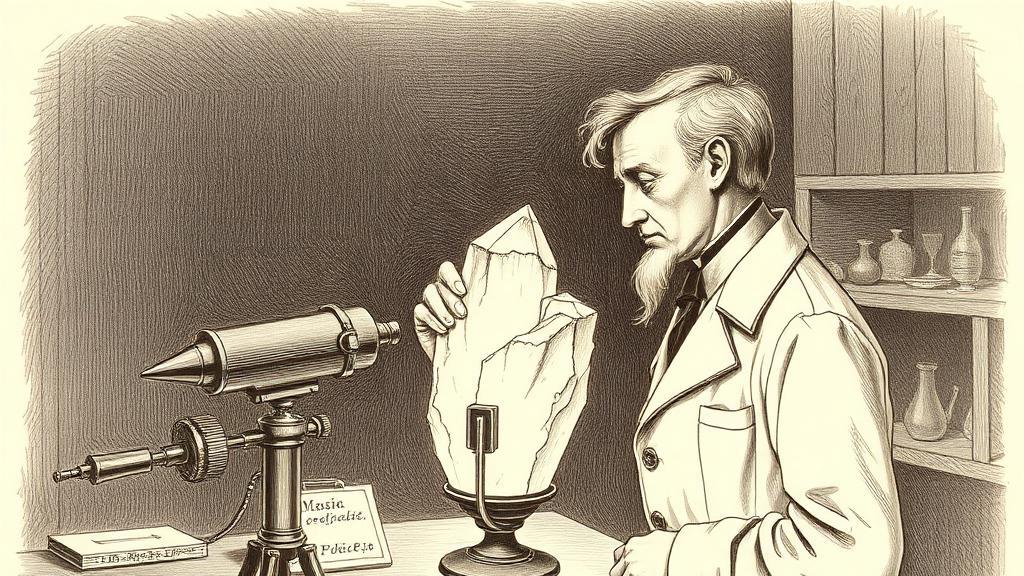
At 3:42 in the morning on May 23, 2024, a graduate student named Chuankun Zhang was watching a laser and a computer screen in a laboratory in Boulder, Colorado, when the signal appeared. The laser — tuned to 148.4 nanometers, deep in the vacuum ultraviolet, a range so energetic it is absorbed by ordinary air — was striking thorium-229 atoms embedded in a calcium fluoride crystal. The crystal began to glow. Zhang called his labmates out of bed. They confirmed the result and, at 9:30 a.m., opened a bottle of champagne. Jun Ye, their principal investigator and one of the world’s foremost clockmakers, later said tears flooded his eyes. They had done what physicists had been chasing for two decades: induced a thorium nucleus to tick (Quanta Magazine).
To understand why this mattered, it helps to understand what a modern atomic clock actually measures. A cesium clock — the standard since Louis Essen built the first at the National Physical Laboratory in 1955 — counts cycles of radiation emitted when a cesium electron jumps between two energy states. It is extraordinarily precise, but it is exposed: electromagnetic fields, temperature gradients, vibration, and neighboring atoms all nudge electrons and introduce error.
An atomic nucleus is not exposed. It sits deep inside its electron cloud, shielded from almost all environmental noise. Nuclear energy transitions, however, typically require gamma rays with millions of electron-volts to trigger — not the kind of energy you can produce with a laboratory laser. Thorium-229 is the exception. A peculiar near-cancellation between its electromagnetic and strong nuclear forces leaves it with an excited state reachable at less than 10 electron-volts, in the vacuum ultraviolet range where lasers, though difficult, are buildable. It is the only nucleus in the entire periodic table with this property. The physicist Victor Flambaum called it “a freak of nature,” and he meant it as a compliment (Quanta Magazine).
The concept was proposed in 2003 by Ekkehard Peik and Christian Tamm at Germany’s Physikalisch-Technische Bundesanstalt in Braunschweig (Science News). For twenty years it stayed theoretical, frustrated by the challenge of producing vacuum ultraviolet lasers precise enough to interrogate so narrow a target. Ye’s group at JILA solved the frequency measurement problem in May 2024, achieving precision of one part in a trillion — millions of times sharper than earlier attempts. Independent groups in Germany and California confirmed the result within four months.
Measuring a frequency and building a clock are different things, though. A clock needs a feedback loop: something that continuously reads the oscillator’s signal and corrects the driving laser to stay locked to it. In June 2026, two teams delivered that — independently, within weeks of each other. Shiqian Ding’s group at Tsinghua University in Beijing and Thorsten Schumm’s team at TU Wien in Vienna each embedded thorium-229 in calcium fluoride crystals and implemented running feedback loops (phys.org). Both achieved fractional frequency instability approaching one part in ten trillion over a day of operation — the equivalent of drifting by one second in three million years. Neither clock yet surpasses the best optical atomic clocks in raw timekeeping precision, but both already outperform atomic clocks in dark matter detection experiments, because the nuclear transition is sensitive to physical effects that electron orbitals simply cannot reach.
That sensitivity is the real prize. The thorium nucleus responds to variations in the strong nuclear force and the fundamental constants underlying it. Run a nuclear clock beside an atomic clock long enough, and any drift between them would be evidence that the laws of physics are not quite as invariant as they appear — a question physicists have wanted to probe since Paul Dirac speculated about it in 1937. For most of that time, the instrument to look did not exist.
It does now. From a shadow on sand to a nucleus ticking sixty-eight trillion times per second, the pursuit has always been the same: find something in the universe that holds still, and use it to catch everything else in motion.
Sources
- Quanta Magazine: The First Nuclear Clock Will Test if Fundamental Constants Change — JILA breakthrough, 3:42 a.m. anecdote, Jun Ye’s account, one part in a trillion precision, Flambaum quote
- phys.org: Nuclear clocks tick for the first time — Tsinghua (Ding) and Vienna (Schumm) teams, June 2026 working clocks, precision figures, dark matter detection applications
- Science News: Clocks made from an atomic nucleus just ticked on for the first time — Peik and Tamm 2003 proposal, feedback loop requirement, comparison to atomic clocks