Dead on arrival: how the VOC broke Yemen's coffee monopoly
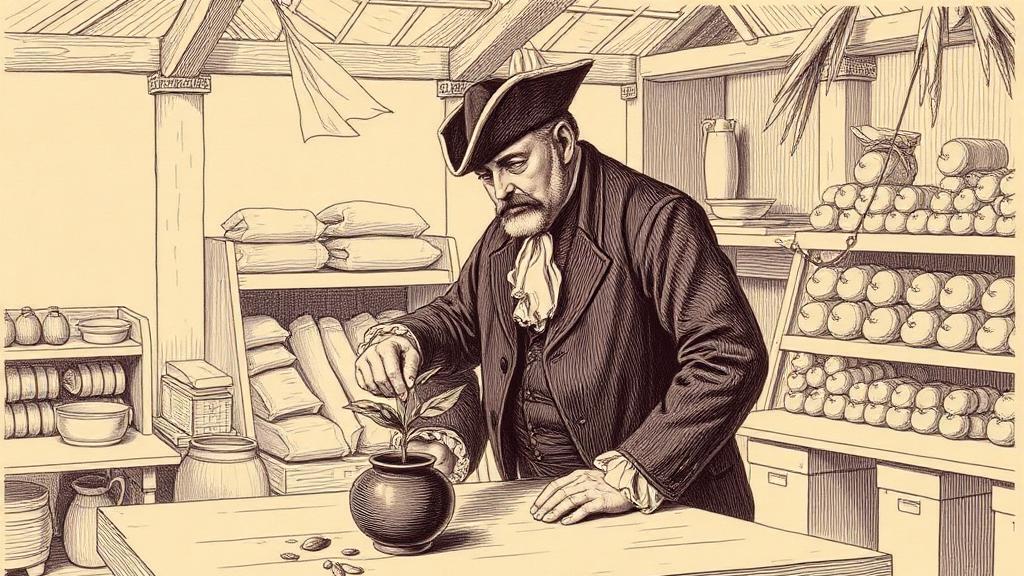
When the Dutch East India Company’s ships returned from Mocha in the 1680s, the coffee was always dead on arrival. The Yemeni monopoly was not merely commercial — it was botanical. Every bean shipped from the port had been scalded or roasted to prevent germination; for nearly two centuries, Arabia had kept the living plant from crossing its borders, and no European merchant had managed to change that with any lasting effect. Nicolaas Witsen, burgomaster of Amsterdam and a VOC governing director, decided to route around the problem.
He found his opening on the Malabar Coast of India, where a Sufi pilgrim named Baba Budan had planted a small grove of Yemeni cuttings two decades earlier. In 1696, Witsen instructed Adrian Van Ommen, the VOC commander at Malabar, to ship seedlings from Kananur across the Indian Ocean to Java (Ukers, All About Coffee, 1922). Governor-General Willem van Outshoorn planted them on the Kedawoeng estate, near Batavia. That year’s floods destroyed every one.
Witsen ordered a second shipment. In 1699, Henricus Zwaardecroon imported cuttings from Malabar and established them more carefully. They rooted. In Ukers’s own summary, these became “the progenitors of all the coffees of the Dutch East Indies.” By 1707, the VOC’s governor was meeting with West Java’s regents, pressing them to plant coffee in the volcanic highlands above Cianjur, where cooler nights and mineral soil suited arabica better than Batavia’s steaming coastal plain. Only the regent of Cianjur agreed at first. Within two decades, the Company simply made it a requirement.
In 1711, the first export left Java for Amsterdam: 894 pounds of green coffee beans, fetching prices at auction that astonished the trading rooms. Within a generation, the Dutch East Indies supplied enough to satisfy most of Europe’s demand. “Java” became the continent’s generic word for coffee — a geographic shorthand that outlasted the VOC by two centuries.
Then there was the plant sent home in 1706. VOC officials shipped a live specimen from Java to Amsterdam’s Hortus Botanicus, where it was installed in a hothouse and studied. In 1714, Amsterdam gifted a cutting to King Louis XIV, who placed it in the Jardin des Plantes in Paris. Six years later, a French naval officer named Gabriel de Clieu carried a seedling from that plant across the Atlantic to Martinique. From Martinique, arabica spread to the Caribbean, to Brazil, to Colombia, to Guatemala. The ancestor of almost every coffee tree in the Western Hemisphere spent eight years in a Dutch greenhouse because Nicolaas Witsen had been frustrated that Yemen wouldn’t sell him live seeds.
The VOC did not survive to see the full extent of what it had started. The company collapsed in 1799 under its own debt, and Java’s plantations passed to the colonial Dutch government, which tightened the compulsory cultivation system considerably. The coffee kept moving, regardless — already loose in the world, already in a hundred gardens, already crossing new oceans on ships the VOC had never built.
Sources
- Chapter 2: History of Coffee Propagation — Ukers, All About Coffee (1922) — Witsen’s initiative, Van Ommen’s 1696 shipment from Kananur, Zwaardecroon’s 1699 success, and the VOC’s spread across the Dutch East Indies.
- Coffee in Indonesia: A Timeline — KOPKOPI — The Kedawoeng estate, the 1711 first export of 894 pounds to Amsterdam, and the 1707 negotiations with West Java’s regents.
- Coffee’s History Blooms at Hortus Botanicus — Sprudge — The 1706 live specimen sent from Java to Amsterdam’s Hortus Botanicus and its path to Louis XIV and then the Western Hemisphere.