Newton's guinea, or how a mathematician's arithmetic error invented the gold standard
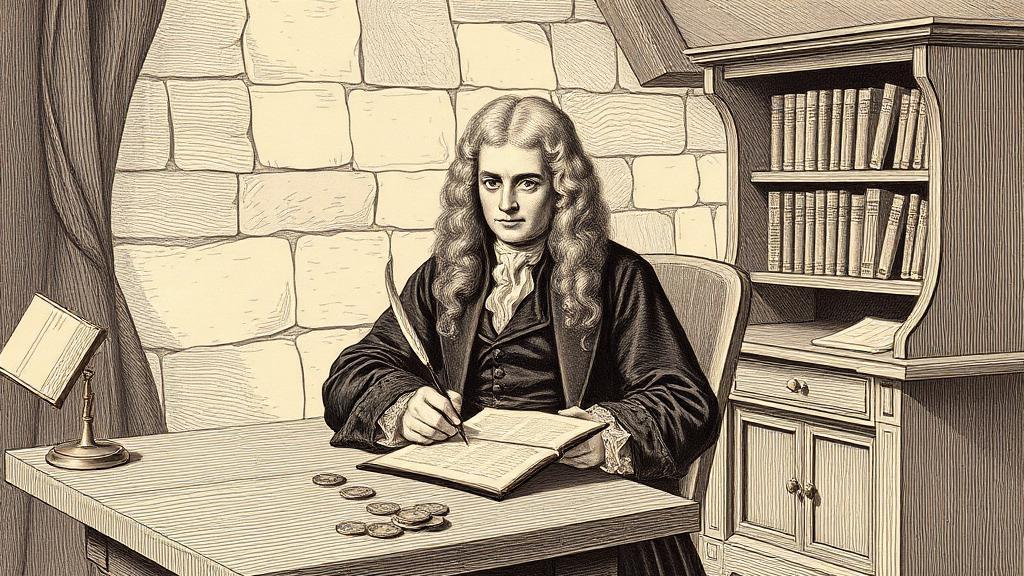
On September 21, 1717, Isaac Newton — seventy-four years old, eighteen years into his tenure as Master of the Royal Mint, still writing in the precise algebraic hand that had once mapped the heavens — completed a memorandum that he was certain would fix England’s silver problem. British silver coins had been melting away for years, spirited out of pockets and into crucibles, then shipped to the Continent where the metal fetched more by weight than by face value. The culprit, Newton diagnosed, was a price that had gone wrong. The gold guinea was valued at twenty-one shillings and sixpence, and the international silver market had climbed far enough that swapping silver coins for gold guineas and selling the gold abroad returned a tidy profit. Reduce the guinea to twenty-one shillings flat, he advised, and the arbitrage would stop.
On December 20, a Royal Proclamation enacted his recommendation precisely.
Newton had been at the Mint since 1696, when the government pressed him into service during the Great Recoinage — the frantic project to replace two centuries of clipped and hammered silver coinage with freshly minted, machine-struck coins. The role suited him better than anyone expected. He applied the same methodical precision to currency that he had applied to optics: receiving weekly reports on metal prices from Amsterdam, reorganising the presses to strike coins at nearly one per second, personally prosecuting counterfeiters with a tenacity that surprised people who knew him only as a theorist. William Chaloner — a coiner who had publicly boasted he could run the Mint better than Newton — was hanged at Tyburn in 1699 after Newton built a case against him over months, in disguise, across the taverns of London.
The silver problem did not obey the same logic as orbital mechanics. After December 1717, silver coins kept disappearing. Gresham’s Law is indifferent to the identity of the mathematician who set the rate: when official exchange values diverge from market values, the undervalued metal exits circulation — exported, melted, hoarded — while the overvalued metal stays in pockets. Newton’s revised guinea was still priced a shade too high for the global silver market to tolerate. Over the following decades, gold coins became England’s working currency by default, not by decree. Nobody issued a proclamation ending bimetallism. It ended because a ratio was six pence off.
Three years later, Newton lost approximately £20,000 in the South Sea Bubble — a sum large enough to embarrass him into public silence on the matter. He had calculated the orbit of every planet in the solar system with sufficient precision to predict their positions a century in advance. He could not quite calibrate the price ratio between two metals against the reactions of a continent of merchants. The Mint’s weekly price reports from Amsterdam had not been enough.
Britain made the arrangement official in the next century. The Coinage Act of 1816 formally established gold as the sole legal tender standard; the Bank of England resumed full convertibility in 1821 after the Napoleonic suspension. Other countries watched. By 1880 most of the industrialised world — Germany, the United States, Japan — had followed England onto gold. During the classical gold-standard era from 1880 to 1914, inflation in gold-standard countries averaged just 0.1 percent a year.
The whole architecture — a century of price stability, the template for international finance, the system that would eventually require a world war to dismantle — rested on a memorandum Newton wrote to fix a minor inconvenience, and a proclamation that got it nearly right.
Sources
- Newton at the Mint — University of Oxford — Newton’s career at the Mint from 1696, his methods, the Chaloner prosecution, his role in fixing the guinea price.
- Gold Standard — Library of Economics and Liberty — Newton’s 1717 overvaluation of gold, Britain’s de facto then formal gold standard, the 0.1% inflation figure during the classical period.
- Gresham’s Law — Wikipedia — The mechanism by which overvalued money drives undervalued money out of circulation, applied to the silver exodus of 1717–1820.