The quartz clock and the wobbling Earth
The clock that caught the Earth wobbling was not, strictly speaking, built to be a clock. In 1927, at Bell Telephone Laboratories in New York, Warren Alvin Marrison was trying to measure the vibration frequency of a quartz crystal — and the only way to do it was to count the vibrations. At 50,000 cycles per second, that was not straightforward.
Marrison had grown up in Inverary, Ontario, trained as a radio engineer in the Royal Flying Corps during the First World War, and arrived at Bell Labs in 1925 by way of Western Electric. His assignment was practical: the expanding American telephone network needed precise electrical frequency standards. Radio broadcasters were legally required to hold their signals within 50 Hz of their licensed frequency; telephone exchanges had to stay synchronized across thousands of miles of copper. The best precision pendulum clocks of the era drifted by several seconds a day — adequate for catching a train, inadequate for calibrating a national communications network.
Quartz offered a solution. Pierre and Jacques Curie had shown in 1880 that certain crystals generate an electrical charge when compressed, and that the reverse holds too: apply a voltage and the crystal vibrates. A quartz crystal in an electrical circuit oscillates at a frequency determined by its physical dimensions, and it locks to that frequency with exceptional stability. Marrison’s crystal ran at 50,000 cycles per second.
The problem was displaying that frequency. No instrument in 1927 could count 50,000 oscillations per second and render a readable output. So Marrison and his colleague Joseph Horton designed a frequency-divider circuit — a cascade of vacuum tubes that halved the signal, halved it again, and again, until the output was slow enough to drive a small synchronous motor. The motor turned a set of clock hands. When they looked at what they had built, Marrison wrote later that the whole exercise had “incidentally produced the first quartz crystal clock.” The patent — U.S. No. 1,788,533 — was filed in 1928.
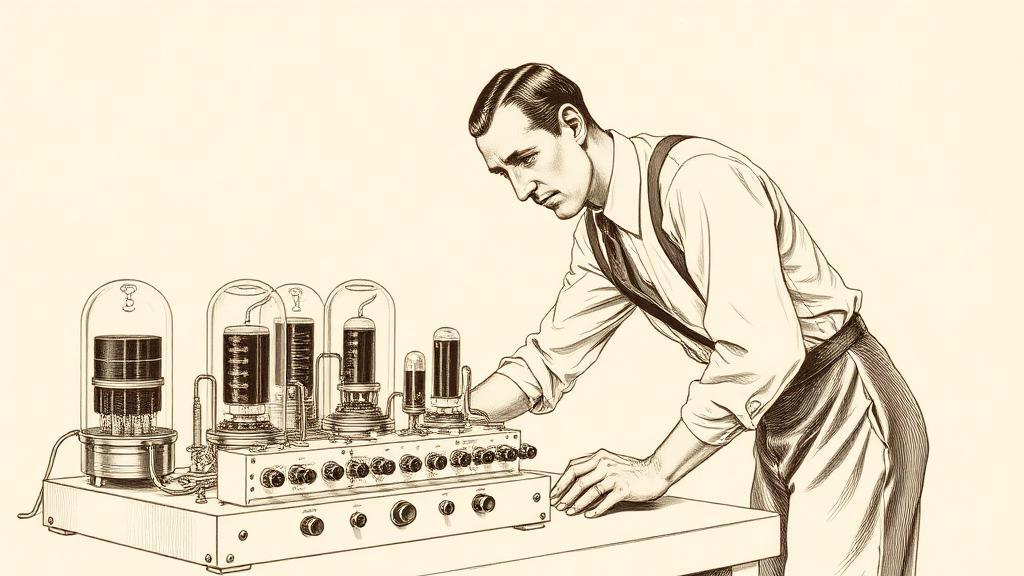
The apparatus filled a workbench: tubes, coils, dividers, motor, hands. Its accuracy was approximately 0.2 seconds per day — an order of magnitude better than the best pendulum clocks. Telephone engineers were satisfied. Astronomers were about to be unsettled.
By 1932, quartz clocks had grown precise enough to detect something no previous instrument could resolve: the Earth’s rotation is irregular. The planet speeds up, slows down, wobbles in tiny unpredictable amounts driven by atmospheric pressure, ocean tides, and the sloshing of the liquid outer core. Every standard of time since the ancient Egyptians had been anchored to the length of a day — which meant every previous clock had been measuring itself against a reference that was, in very small but measurable ways, drifting. The quartz clock was the first instrument sensitive enough to see it. A machine built to synchronize telephone calls had invalidated the Earth as a primary time reference.
That discovery did not resolve quietly. It set timekeepers on a thirty-year search for something more stable than a planet — a search that ended in 1955 when Louis Essen at the National Physical Laboratory built the first caesium atomic clock. The quartz crystal is still inside nearly every timepiece manufactured today. But the second it measures is now defined by something the Egyptians would have found incomprehensible: the vibration frequency of a caesium atom.
Sources
- Warren Marrison — National Inventors Hall of Fame — biographical details, Bell Labs career, “incidentally produced” quote, U.S. Patent No. 1,788,533
- Quartz clock — Wikipedia — technical workings, accuracy figures, and the 1932 discovery of Earth’s rotational irregularity
- Piezoelectricity — Wikipedia — the Curie brothers’ 1880 discovery and its mechanism