The midsole grown from light
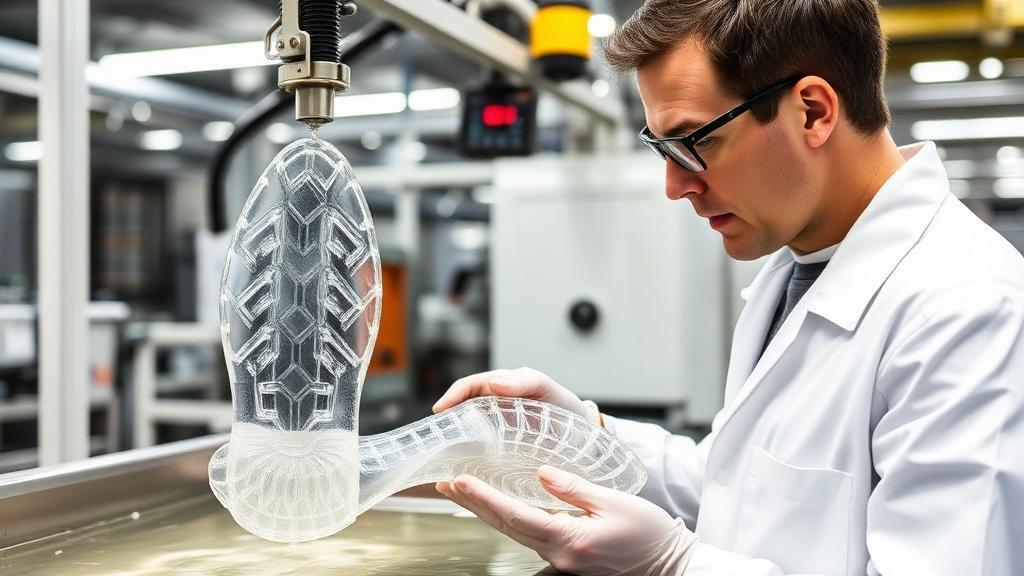
In a factory in Germany in April 2017, a running shoe midsole rose from a bath of liquid resin in about twenty minutes. There was no injection mold. There was no machined cavity. The sole grew from nothing — a lattice of 20,000 precisely placed struts — drawn upward by synchronized pulses of ultraviolet light.
The shoe was the Adidas Futurecraft 4D, announced April 7, 2017, and it was the product of a partnership between Adidas and a Silicon Valley startup called Carbon. Carbon’s co-founder and CEO, chemist Joseph DeSimone, had spent years developing Digital Light Synthesis — DLS — a process that used a bath of UV-curable liquid resin and a programmable light engine to grow dense polymer structures from the bottom up. Where conventional 3D printers extruded melted filament in rough approximations, DLS cured each cross-section in sequence and delivered manufacturing-grade precision. What had taken ninety minutes on earlier additive machines took twenty under DLS.
The Futurecraft 4D midsole solved something injection molding had never managed: a single piece that behaved differently in different places. Conventional foam got one density. You shaped it to handle the competing demands of heel cushioning, midfoot stability, and forefoot propulsion — but you could not tune the material itself. With a printed lattice, Adidas and Carbon could vary stiffness and energy return zone by zone, using data drawn from seventeen years of running research and more than five million simulated lattice variations. The material — a proprietary elastomeric resin called EPU 41 — went through over 150 formulations before Adidas accepted it. Eric Liedtke, the Adidas executive who championed the project, joined Carbon’s board of directors. It was that kind of partnership.
The first 300 pairs were distributed quietly to friends and family in April 2017, with no price and no public sale. Five thousand pairs followed in the autumn. Demand did what demand does when scarcity meets novelty: pairs appeared on the secondary market at prices above $20,000. The shoe’s manufacturing cost bore no relationship to those numbers. The premium was purely historical — a bet on the footnote.
Adidas announced a target of 100,000 pairs by the end of 2018. Time magazine named the Futurecraft 4D one of its best inventions that year. By then, the broader industry had noticed. Nike, New Balance, and several smaller startups had begun their own additive-manufacturing programs. The question the Futurecraft 4D had posed — what happens when the internal geometry of a midsole becomes as engineerable as its outer shape — was no longer Adidas’s question alone.
Every midsole that came before, foam or air or cork, was shaped from the outside. The Futurecraft 4D was the first to be designed from within.
Sources
- Adidas Unveils Futurecraft 4D — Carbon Press Release — April 7, 2017 announcement date, Eric Liedtke and Joseph DeSimone roles, Digital Light Synthesis technology overview.
- The Perfect Fit: Carbon and Adidas Collaborate — Carbon Case Study — EPU 41 material development (150+ formulations), lattice design iterations, the engineering problem DLS solved in midsole manufacturing.
- The History of Adidas 4D — Adidas Blog — Timeline of 4D development, the initial 300 pairs, retail launch details, secondary-market prices, Time magazine recognition.