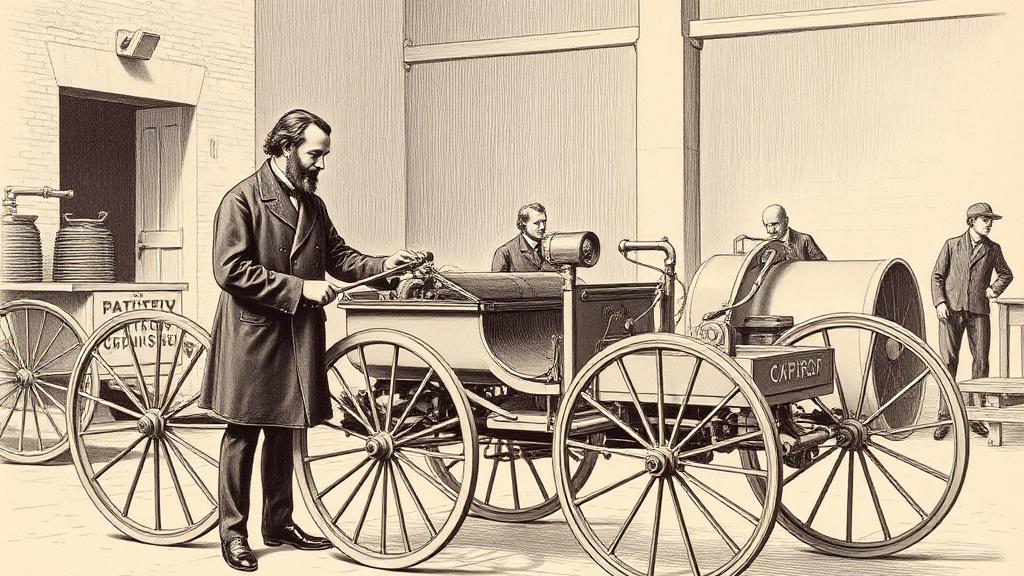
Benz Patent-Motorwagen: a wall in Mannheim and the birth certificate of the automobile
Somewhere in the factory yard of the Benz & Cie. Rheinische Gasmotoren-Fabrik in Mannheim, in the spring of 1885, Karl Benz pointed his three-wheeled machine at open space and opened the throttle. The engine — a single-cylinder four-stroke unit the size of a moderate piece of luggage — produced approximately two-thirds of one horsepower. The vehicle rolled forward. Then it hit a wall.
The crash was, in retrospect, an appropriate beginning. Benz was not adapting a steam boiler or a coal-gas industrial engine; he had designed everything from scratch for a single purpose: to move a vehicle down a road. The patent he filed on January 29, 1886, described it as a “vehicle powered by a gas engine” and was granted the number DRP 37435. The National Motor Museum calls that document the automobile’s birth certificate — the founding document of the car.
What Benz built was not like Lenoir’s Hippomobile, which was a stationary gas engine bolted to a three-wheeled frame. Every system was purpose-designed: a tubular steel frame, wire-spoked wheels with solid rubber tyres, a differential for the rear axle, and a chain-and-belt transmission. The 954 cc engine sat horizontally at the rear, ran on a petroleum fraction called ligroin — sold by pharmacies as a cleaning solvent — and idled at roughly 250 revolutions per minute. At full throttle it reached about 16 kilometres per hour. The whole machine weighed 270 kilograms. A new one cost 3,000 marks.
The first usable tests on public roads happened in early summer 1886, mostly at night, so Benz could work through the frequent failures without drawing a crowd. The Neue Badische Landeszeitung reported on June 4, 1886, that Benz had driven the improved second model around Mannheim in daylight; the paper noted that “the vehicle is set in motion or stopped at will, by directing the belt.” The Mannheim public was, by most accounts, puzzled.
A problem remained invisible in the early reports. The Patent-Motorwagen needed ligroin, and ligroin came from pharmacies, in bottles. There were no garages, no spare parts, no mechanics who knew what a differential was. When Bertha Benz drove the Model III from Mannheim to Pforzheim in August 1888 — 106 kilometres, the first long-distance automobile journey — she cleared a blocked fuel line with a hatpin and repaired a failed ignition with a strip of her garter. The infrastructure would take a generation to catch up with the machine.
About 25 Patent-Motorwagens were built between 1886 and 1893, most of them sold in France, where the bicycle dealer Émile Roger had become Benz’s first agent. Lenoir had shown that a combustion engine could move a vehicle; Benz showed it could be manufactured, sold, repaired, and driven again. That difference — from demonstration to commodity — is the one that turned a wall in Mannheim into an industry.
Sources
- Benz Patent-Motorwagen — Wikipedia — patent date and number, engine specifications (954cc, 0.68 hp, 250 rpm), top speed, weight, production numbers, ligroin fuel, wall-crash incident, first newspaper report.
- Benz Motorwagen — National Motor Museum — patent as “birth certificate of the automobile,” first commercial sale, Émile Roger as first agent.