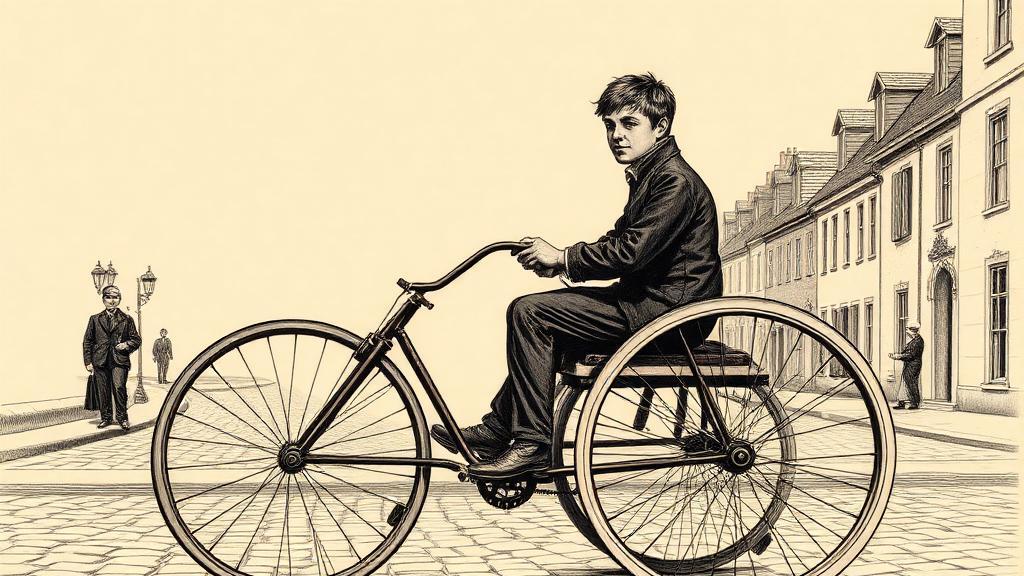
The Daimler Reitwagen
On 18 November 1885, a 17-year-old named Paul Daimler climbed onto a wooden-framed machine behind his father’s workshop in Cannstatt — a suburb of Stuttgart that looks, even today, nothing like the birthplace of modern transport — and rode it approximately eight miles to the town of Untertürkheim. Partway through the journey, his seat caught fire.
This was not, strictly speaking, a surprise. The machine’s hot-tube ignition sat directly beneath the saddle, and the Reitwagen — German for “riding car” — was already an experiment operating right at the edge of what its designers understood. What made it historic was everything else: a gasoline engine, two wheels, a rider. It was the first motorcycle.
Gottlieb Daimler and Wilhelm Maybach had been working toward this since 1882. Daimler, then 48, had broken with the Gasmotoren-Fabrik Deutz, the Otto engine company where he had spent years as technical director, and set up a workshop in his garden shed in Cannstatt with Maybach, his longtime collaborator. Their stated aim was to build a small, light, fast gasoline engine that could power anything — a boat, a carriage, a railway car — and they needed something to put it in first. The bicycle frame was the obvious choice: cheap, available, human-scaled. Patent DE 34926, filed 3 April 1885, covered the engine they called the Standuhr — the “grandfather clock engine,” for its tall, narrow profile. Patent DE 36423, filed 29 August 1885, covered the vehicle itself.
The resulting machine weighed 90 kilograms and had a top speed of 11 kilometres per hour. Two main wheels ran on wooden rims with iron treads; a pair of spring-loaded outrigger wheels, one on each side, prevented it from falling over — the equivalent of training wheels on a machine its inventors were not entirely sure would behave. The engine displaced 264 cc, produced 0.5 horsepower at 600 rpm, and was mounted in the wooden beam frame on rubber blocks to reduce vibration. The brake operated by pulling a cord. There were no gears.
Paul Daimler rode it anyway. After the outward leg — seat fire and all — he returned to Cannstatt. Contemporary accounts note that Gottlieb subsequently had the saddle modified. No record survives of whether either of them discussed the fire.
What the Reitwagen did not become is as revealing as what it was. Gottlieb Daimler, once satisfied the engine worked, turned immediately to four-wheeled vehicles. He had never really been interested in the motorcycle as such; the two-wheeler was a test rig, a convenient body for a still-maturing engine. Within a year he was fitting the same engine to a carriage, and the automobile was on its way. The Reitwagen itself was lost when a fire swept the Cannstatt workshop in 1903. What survives are replicas — in Stuttgart, Munich, and Tokyo — and the concept itself, which refused to stay a footnote.
The motorcycle business was left to others: to the Hildebrand & Wolfmüller partnership that would put the first production motorcycle on sale in Munich in 1894, to the Americans who would industrialize it at the turn of the century, and to generations of engineers who kept refining the thing Daimler built and immediately set aside. Every gasoline motorcycle engine since traces a direct line back to a garden shed in Cannstatt, and to a teenager who rode home with a smouldering seat and, apparently, not much to say about it.
Sources
- Daimler Reitwagen — Wikipedia — patent dates and numbers, technical specifications, first ride date and distance, fate of the original machine and museum replica locations.
- 1885: A Teenager Undertakes the First Trial Run — Transportation History — details of the November 18 first ride, the seat fire incident, and Daimler and Maybach’s collaboration in the Cannstatt garden shed.