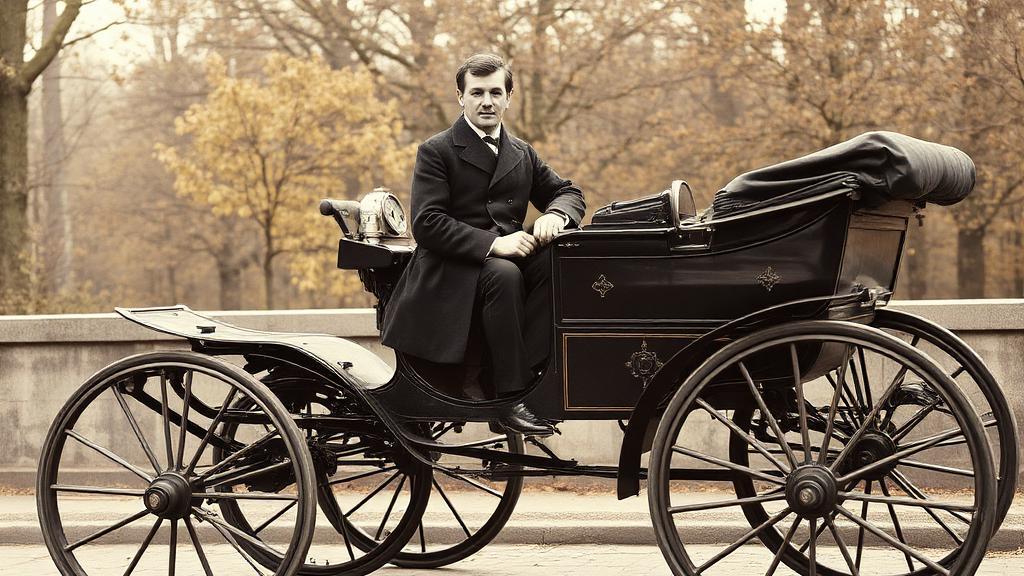
Daimler's motor carriage: the first four-wheeled petrol vehicle, Bad Cannstatt, 1886
The coachbuilder’s paperwork said birthday present. Gottlieb Daimler had placed the order with Stuttgart firm Wilhelm Wimpff & Sohn on 8 March 1886 — an open, four-wheeled Americaine touring carriage, a gift for his wife Emma. The carriage arrived at 13 Taubenheimstrasse in Bad Cannstatt after dark on 28 August, carried through the back gate to avoid the neighbours. Inside the property, waiting to be fitted to it, was an engine that ran five times faster than anything on the market.
Daimler, fifty-one years old that year, had left his previous employer — Gasmotorenfabrik Deutz, where he had worked alongside the engine inventor Nikolaus Otto — under acrimonious circumstances in 1880. He brought with him a severance of 112,000 gold marks and his chief engineer, Wilhelm Maybach. In Bad Cannstatt, they converted a garden greenhouse into a private workshop and spent four years building the engine Deutz had been too conservative to attempt.
The result was the Standuhr — the grandfather clock. Daimler named it himself: the upright single cylinder, with its tall housing and overhung flywheel, resembled a floor-standing parlour clock. The resemblance ended there. Contemporary gas engines turned at 120 to 180 revolutions per minute; the Standuhr turned at 600. The faster an engine, the lighter it could be for a given power output — and a light engine was one you could mount on a vehicle. By April 1885 they had filed German Patent DRP 34926 and were ready for the next step.
Maybach installed the 462 cc, 1.1-horsepower engine in the body of Emma’s Americaine and drove it from Bad Cannstatt toward Untertürkheim, one autumn day in 1886, covering roughly 3 km before turning back. Top speed: 16 km/h. The horse was not involved.
Meanwhile, the gardener at Taubenheimstrasse had been hearing metallic knocking from the greenhouse for months — strange smells, rhythmic pounding, two secretive men working at odd hours. His considered assessment: the tenants were making counterfeit coins. He went to the police. Officers obtained a key, let themselves in, and found engine parts, machinist’s tools, and the prototype of the modern internal combustion engine. No coins. They left Daimler and Maybach to continue undisturbed, and the workshop at Bad Cannstatt still stands today, maintained as a memorial by the Mercedes-Benz Group.
Daimler’s approach — engine first, vehicle second — was the reason the Standuhr spread so quickly. Panhard et Levassor of France licensed the design in 1887 and sold a sub-license to Armand Peugeot; the engine’s descendants were powering cars across Europe before the decade was out. In 1888, a modified version lifted an airship 4 km over Bad Cannstatt, fifteen years before the Wright Brothers. The company Daimler founded eventually merged, in 1926, with the firm Karl Benz had been building 100 km away in Mannheim during those same months of 1886 — the two men having, by all accounts, never met.
The crank turned 600 revolutions a minute behind a locked greenhouse door in Bad Cannstatt. It had considerably further to go than the carriage it was sitting in.
Sources
- Daimler Motorized Carriage — Wikipedia — carriage delivery date, engine specs, Maybach test drive, comparison with Benz Patent-Motorwagen.
- Gottlieb Daimler Memorial — Mercedes-Benz Group — the Bad Cannstatt workshop, the counterfeiting incident, the site’s surviving structure.
- Standuhr engine — History of Information — engine rpm and speed-to-weight significance, Daimler-Deutz background.