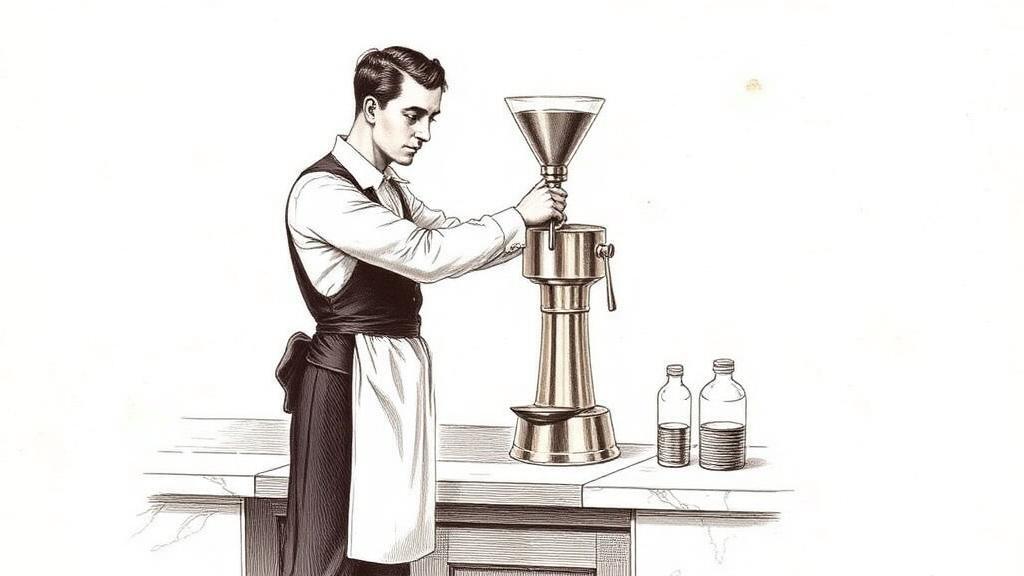
Bezzera's portafilter and the machine that gave espresso its name
On 19 December 1901, a Milanese manufacturer named Luigi Bezzera filed papers with the Italian patent office for a new kind of steam-pressure coffee machine. His application was specific: the device had multiple brewing groups — individual portafilter heads that could press a single shot directly into a cup, on demand. The patent was granted the following June as Italian no. 153/94, 61707. Bezzera took the document and went back to his workshop. He had no plan for what came next.
Bezzera had looked at the batch-brewing machines already appearing in a handful of Italian bars and spotted their flaw: they made coffee in quantity, and coffee made in quantity turns stale. His portafilter solved this by reducing the unit to a single extraction — water pressed through tamped grounds in seconds, poured immediately. Multiple heads on a single boiler meant a busy counter could run several orders at once. It was a genuine engineering insight. What Bezzera lacked was money to scale it and any idea how to sell it.
Desiderio Pavoni bought the patent in 1903. Pavoni was also an engineer, but a commercial one: well-capitalized and attentive to what Milan’s café trade was waiting for. He added a pressure release valve — before which, opening the brewhead at the wrong moment sent a jet of steam at the barista — and invented a wand for frothing milk. Then he set up a workshop on Via Parini in Milan and started making one machine per day.
La Pavoni was formally established in 1905. Its flagship, the Ideale, stood brass-fitted behind café counters: a vertical boiler held at a constant 1.5 bars of pressure, capable of 150 cups per hour. It ran on gas or electricity, and it looked exactly like something a serious establishment should own. Pavoni sold them by hand, one at a time, across Italy.
The word came at the 1906 Milan World’s Fair. Bezzera and Pavoni displayed the machine together under the label “Bezzera L. Caffè Espresso” — the first recorded use of espresso for coffee prepared this way. The Italian pulls in two directions: esprimere, to press out, and the older sense of express as prepared specifically for the person in front of you. Both meanings fit exactly. Milan’s fair-goers tried the cup. The word did not require a second introduction.
What Bezzera and Pavoni had done, between them, was lift espresso out of one Turinese hotel’s private experiment and put it on a counter anyone could approach. The portafilter configuration they refined on Via Parini became the canonical espresso machine shape — the template every competitor spent the next century copying or improving. The crema and the nine-bar extraction were still forty years out, waiting for Achille Gaggia’s spring-loaded piston. But the cup, the bar, and the name were already there.
Bezzera founded his own company afterward; his great-grandson Luca still runs it. Pavoni’s firm outlasted him by decades, still producing machines in Milan. Between them, they had handed the world a ritual it hadn’t known it was missing.
Sources
- Luigi Bezzera — Wikipedia — patent filing date (19 December 1901), patent no. 153/94, 61707, portafilter innovation, 1906 Milan Fair as first recorded use of “espresso,” Luca Bezzera.
- The Long History of the Espresso Machine — Smithsonian Magazine — Pavoni’s purchase of the patent in 1903, pressure release valve and steam wand, Bezzera’s lack of marketing capacity.
- La Pavoni — company history — Via Parini workshop, founding 1905, the Ideale and the filter holder as core innovations.