Springfield, 1901: the birth of Indian Motorcycle
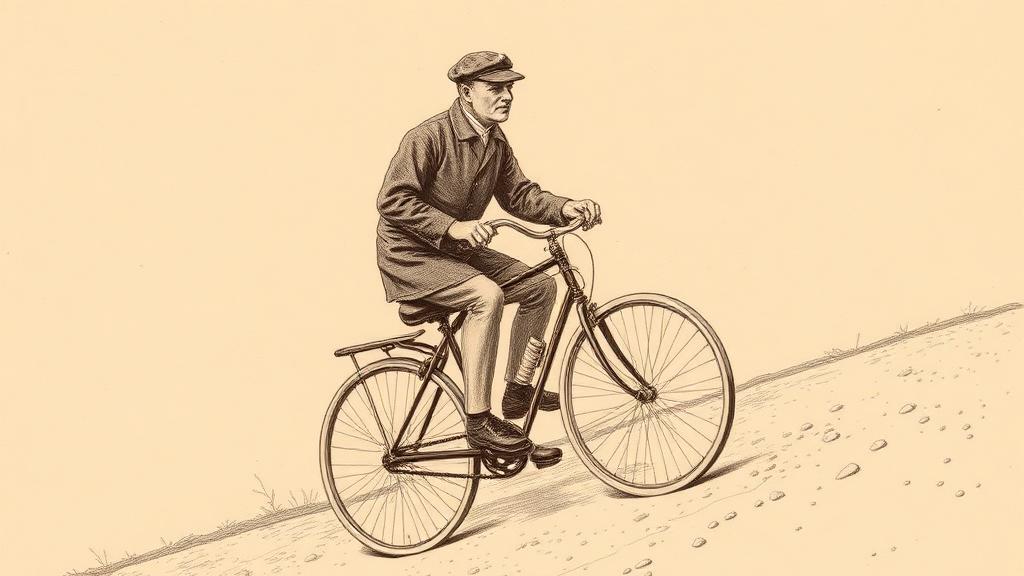
Cross Street in Springfield, Massachusetts rises at a 19-percent grade, and on the afternoon of Saturday, June 1, 1901, it was lined with four to five hundred people who had come to watch a bicycle run uphill under its own power. Oscar Hedstrom — a Swedish-born machinist who had spent months building this machine in a borrowed workshop in Middletown, Connecticut — pointed it at the loose gravel and climbed with power to spare.
The company behind the machine would come to be called the Indian Motocycle Company — one r, a spelling that appeared on early letterheads and stayed. But in the crowd’s eyes that afternoon, it was simply the machine George Hendee had commissioned and Carl Oscar Hedstrom had built, and it worked.
George Mallory Hendee arrived at motorcycles through a bicycle racing career. Between 1882 and 1886 he held the National Amateur High Wheel Championship, and his speed record from 1886 stood unbroken for six years. By 1898 he had pivoted to manufacturing, incorporated the Hendee Manufacturing Company in Springfield, and named his bicycle line “Indian” on the grounds that the name would sell better in export markets. The brand existed before the motorcycle did.
Hedstrom was different in almost every way. Born in Lönneberga, Sweden, in 1871, he came to Brooklyn at age nine, apprenticed at an engineering workshop in the Bronx at sixteen, and by his late twenties was building motorized “pacers” — tandem bikes fitted with small engines used to help competitive cyclists hold racing speed in track events. Hendee saw the pacers, reached the obvious conclusion, and in early 1901 they signed a partnership.
Hedstrom leased space at the Worcester Cycle Manufacturing Company in Middletown, completed the first prototype by May 25, and brought it north to Springfield. The machine displaced roughly 15 cubic inches and made 1.75 horsepower. What was less modest was the engineering: a concentric-float carburetor Hedstrom had designed and cast himself, and the engine mounted as a seat-post substitute so it became a structural part of the frame rather than a bolt-on afterthought. It weighed 130 pounds and topped 30 miles per hour.
About 143 machines shipped in 1902. Annual production crossed 500 by 1903 and peaked at 32,000 in 1913, making Indian the world’s largest motorcycle manufacturer at its height. Along the way, in 1911, the Indian factory team swept the top three positions at the Isle of Man Tourist Trophy — taking first, second, and third before a crowd that had expected a British result.
Hedstrom resigned in 1913, worn down by disputes over stock manipulation among the company’s investors. Hendee stepped away in 1916. The name outlasted both of them by decades.
In 1903, two years after Cross Street, a group of mechanics in Milwaukee incorporated a competing company. The American motorcycle industry had found its shape on a 19-percent grade of loose gravel in Springfield, on a Saturday afternoon in the first summer of the new century.
Sources
- Indian Motorcycle — Wikipedia — founding date, production figures, 1911 Isle of Man TT result, origin of the “Indian” name.
- The Indian Motocycle Is Born — The Vintagent — Cross Street demonstration details, crowd size, grade, early production figures.
- Oscar Hedstrom — Wikipedia — Hedstrom’s biography, Swedish origins, Bronx apprenticeship, concentric carburetor design, 1913 resignation.
- The Early History of Indian, Part 1: George M. Hendee — The Vintagent — Hendee’s racing career, championship years, 1898 founding of Hendee Manufacturing Company.