Paris–Rouen, 1894: the race that decided what a car should be
On the morning of 22 July 1894, twenty-one machines assembled at the Porte Maillot on the western edge of Paris. Some ran on petrol, some on steam. One, if the entry paperwork was to be believed, ran on gravity. The question their organisers had set for them — covering 126 kilometres to Rouen through the Seine valley — was less about who could go fastest and more about whether the automobile was worth taking seriously at all.
The man who had convened this spectacle was Pierre Giffard, editor of Le Petit Journal, then one of France’s most widely read newspapers. That spring, Giffard had offered a prize for vehicles that could travel from Paris to Rouen under their own power, and 102 entries arrived along with the ten-franc registration fee. The committee culled the field through a qualifying trial on 18 July, admitting only twenty-one. The criteria for winning were explicit: the vehicle had to be “safe to use, easy to operate, and not too expensive to run.” Giffard was selling newspapers and persuading a sceptical public, not staging a race.
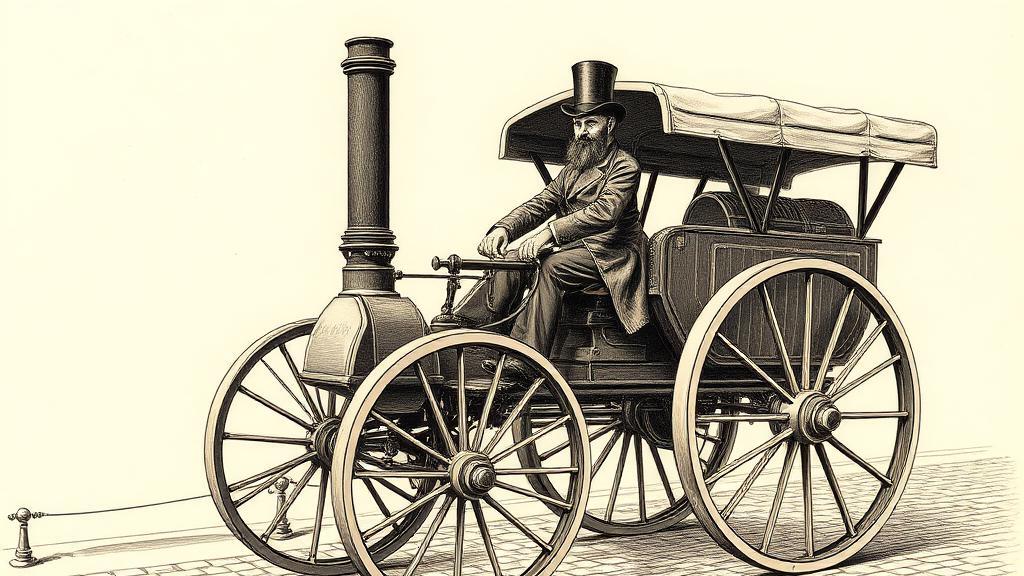
Only four of the twenty-one starters failed to finish. Every one of the thirteen petrol-engined vehicles completed the route. Count Jules-Albert de Dion, co-founder of De Dion-Bouton, arrived in Rouen first: his 20-horsepower steam tractor had covered the distance in 6 hours and 48 minutes, at an average of just over 17 kilometres per hour. He was met at the finish with whatever the French equivalent of mild approval looked like in 1894.
Then the judges disqualified him.
De Dion’s steam tractor required a stoker — a second man to tend the boiler — which the committee ruled a violation of the “easy to operate” criterion. A machine that required a crew was not yet a car. The 5,000-franc first prize went jointly to Panhard & Levassor and Peugeot, both running petrol engines derived from Daimler’s design. De Dion received a consolation 2,000 francs. The man who had covered the ground fastest lost on a point of principle that turned out to be rather important.
That principle mattered more than the prize money. Petrol required no fire-tender, no boiler, no stoker — just a driver, a can of fuel, and something approaching a road. The Paris–Rouen trial demonstrated, across 126 kilometres and in public, that the internal-combustion engine was not one option among many but the practical option. Within months, the Automobile Club de France was founded on the strength of the event. In 1895, Émile Levassor drove from Paris to Bordeaux and back — 1,178 kilometres — in 48 hours and 48 minutes, alone in a Panhard, and won.
The automobile had answered the question asked of it on those summer roads. For the next hundred years, the answer was petrol — one driver, one engine, one tank.
Sources
- Paris–Rouen (motor race) — Wikipedia — entry count, qualifying process, route distance, finishers, De Dion’s time and disqualification, prize amounts, formation of the Automobile Club de France, Paris–Bordeaux–Paris 1895.
- The 1894 Paris-Rouen Trial — Goodwood Road & Racing — Giffard’s motivation, judging criteria, the “safe, easy, affordable” framework, De Dion disqualification details.