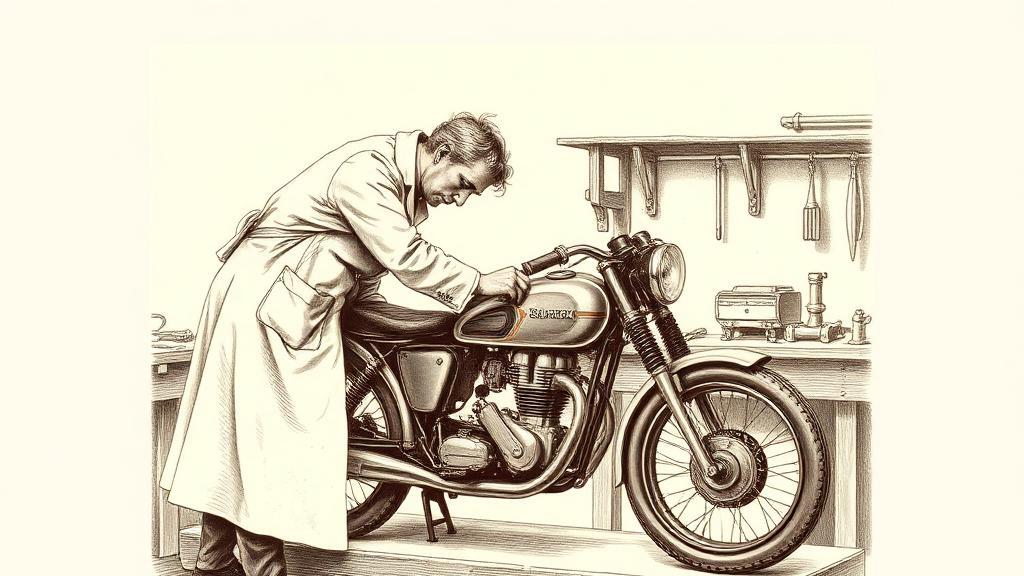
The Rolls-Royce of motorcycles, delivered with proof
The certificate that accompanied every Brough Superior SS100 from the workshop on Haydn Road in Nottingham said the same thing to every buyer: the machine you just paid £170 for — roughly a working man’s annual wage — had been timed above one hundred miles per hour on a measured quarter-mile. If it hadn’t cleared that mark, it went back to the bench. This was 1924. Almost no road vehicle of any type could reach three figures. George Brough’s guarantee was not advertising. It was a standard he held himself to, in writing, until the last of them left the workshop sixteen years later.
The SS100 launched in late 1924 and appeared in the 1925 catalog as “an exact replica of the Brough Superior ridden by H. le Vack when capturing 9 world’s records.” It was built on a plain premise: source the best British components — a 998cc JAP V-twin from J.A. Prestwich Industries, a gearbox from Sturmey-Archer — and hand-assemble them in Nottingham to a standard that would embarrass most factories. Each bike was fitted individually. Handlebars adjusted for the owner’s reach. Controls set for the owner’s hand. No two SS100s were identical.
Brooklands was the testing ground. Every machine was timed there before shipping. The standard model was certified at 100 mph; the Pendine variant — a works-spec race kit named for the speed-record sands in Wales — carried a guarantee of 110. By 1940, when the factory converted to war work and production stopped, 383 had been built in total — 281 with the original JAP engine, 102 with a later Matchless unit. That is a small number for a machine so widely remembered.
The “Rolls-Royce of motorcycles” label arrived not from Brough’s marketing team but from a 1923 road test by journalist H.D. Teague, who reached for the highest compliment available. Rolls-Royce was initially displeased. Then a company executive toured the Nottingham workshop, found craftsmen in white coats and an obsessive attention to fit and finish that Rolls-Royce recognised as its own register, and quietly authorized the comparison. It may be the only time a luxury carmaker has formally endorsed a motorcycle as its equal.
T.E. Lawrence — Lawrence of Arabia, by then retired to a cottage in Dorset under the name T.E. Shaw — owned seven Brough Superiors and named each one George, after the builder. When he died in May 1935, it was from head injuries sustained when his SS100, registration GW 2275, swerved to avoid two boys on bicycles near Bovington Camp. Neurosurgeon Hugh Cairns attended him at the Bovington military hospital and, struck by what he saw, spent the following years researching motorcycle head injuries. His published work became the scientific foundation for mandatory crash helmet adoption across Europe. Lawrence was not trying to set any record that morning. He was simply riding home.
The SS100 established a threshold the motorcycle industry had not previously thought to enforce: a verified, documented top speed as a minimum deliverable, not an aspiration. Performance became a contract. Every performance specification sheet in the century that followed traces a line back to those Brooklands timing slips.
Three hundred and eighty-three machines is not a large run. But the standard Brough wrote into those certificates turned out to be worth considerably more than the number of certificates he signed.
Sources
- Brough Superior SS100 — Wikipedia — production numbers (383 total, 281 JAP / 102 Matchless), T.E. Lawrence GW 2275 crash, Brooklands testing.
- A Brief History of the Mighty Brough Superior SS100 — Silodrome — 1925 catalog launch text, Rolls-Royce authorization, bespoke manufacturing details.
- 1927 Brough Superior SS100 Pendine — National Motorcycle Museum — Pendine variant 110 mph guarantee, factory sourcing philosophy.