Schlage's bored lock, or how thirty dollars changed the front door
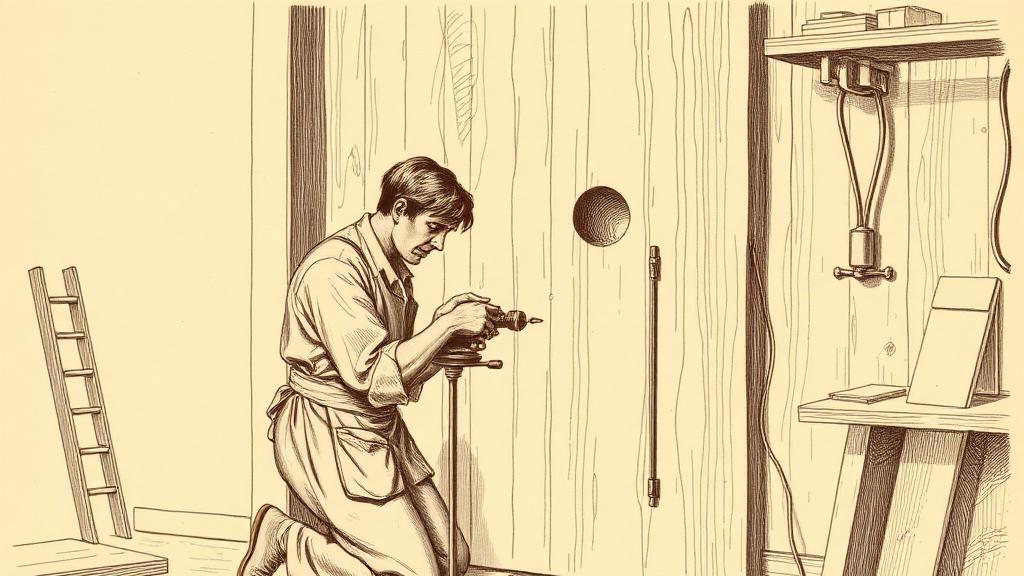
In 1920, Walter Schlage set up a workbench in a rented shop in San Francisco’s financial district and began drilling test holes in doors. Not a complicated act, but the hole was the point: he was drilling where craftsmen had been chiseling for centuries, and he intended to make the chisel unnecessary.
Schlage had come to San Francisco by way of Jena, Germany, where in the 1890s he had apprenticed at Carl Zeiss Optical Works — the workshop that produced the finest microscope lenses in Europe. He arrived in the United States around 1900, took an engineering post at Western Electric, and spent his evenings designing lock mechanisms nobody had asked him to build. His first patent, filed in 1909, was for a door lock that also controlled the room’s lights — a domestic automation concept a hundred years ahead of the market. It went nowhere commercially.
He left Western Electric in 1920 and incorporated the Schlage Manufacturing Company in San Francisco with three investors — C.P. Griffin, J. Thomkins, and J.H. Morgan — on thirty dollars in startup capital. The problem he had decided to solve was the mortise lock.
The mortise lock derived its name from the mortise cavity a carpenter had to cut into a door’s edge before any hardware could go in: a deep rectangular pocket requiring specialized tools and skilled hands. It was locksmith work, which meant it assumed a locksmith. Schlage’s conviction was that decent door security should not require one.
U.S. Patent 1,456,041, issued May 22, 1923, described the answer: a single cylindrical housing containing the knob, spindle, and latch retractor assembled as one unit, installed through two perpendicular holes — a 2⅛-inch face bore through the door’s surface and a smaller edge bore into the side. No chiseling. No mortise. Push a button in the center of the exterior knob to lock it; turn the interior knob in either direction to release the latch. You could always exit. Entry required the key.
The mechanism had one acknowledged limitation: it handled latch function only, not deadbolt. That trade-off — simplicity in exchange for one function per unit — is precisely why the separate deadbolt became a fixture of American residential construction. The two together did everything the mortise had done alone, at a fraction of the installation cost.
By 1925, the Schlage workshop had grown from six employees to a hundred, running two shifts and producing nearly twenty thousand cylindrical locks each month. The 1920s housing boom was underway, and residential developers needed door hardware that a carpenter could install in minutes, without a locksmith in the room. The bored cylindrical lock was what American housing had needed, and hadn’t known to ask for.
Schlage died in 1946. By 1974, when Ingersoll Rand acquired the company, it employed 1,600 workers and was the largest manufacturer in San Francisco. The lock it made was in the door of almost every American house built in the intervening three decades.
The holes are still the same size. Contractors drilling residential doors today specify a 2⅛-inch face bore — the dimension Schlage fixed in the 1920s — because across a century of housing booms, smart-lock revolutions, and corporate acquisitions, nobody has found a reason to change the hole.
Sources
- Walter Schlage — Wikipedia — Life dates, Carl Zeiss apprenticeship, Western Electric career, 1909 light-control patent, company founding, Ingersoll Rand acquisition and 1,600 employee figure.
- Schlage Lock Company — Encyclopedia.com — Investor names, $30 startup capital, growth from 6 to 100 employees, 20,000 units/month production figure.
- Bored Cylindrical Lock — Wikipedia — Patent US 1,456,041 (May 22, 1923), 2⅛-inch face bore specification, comparison to mortise lock, trade-off with deadbolt function.
- Walter Reinhold Schlage — Golden Age of Manufacturing Hall of Fame — Carl Zeiss Optical Works apprenticeship, 1909 light-control patent origin story, 1940 Modern Pioneer Award.