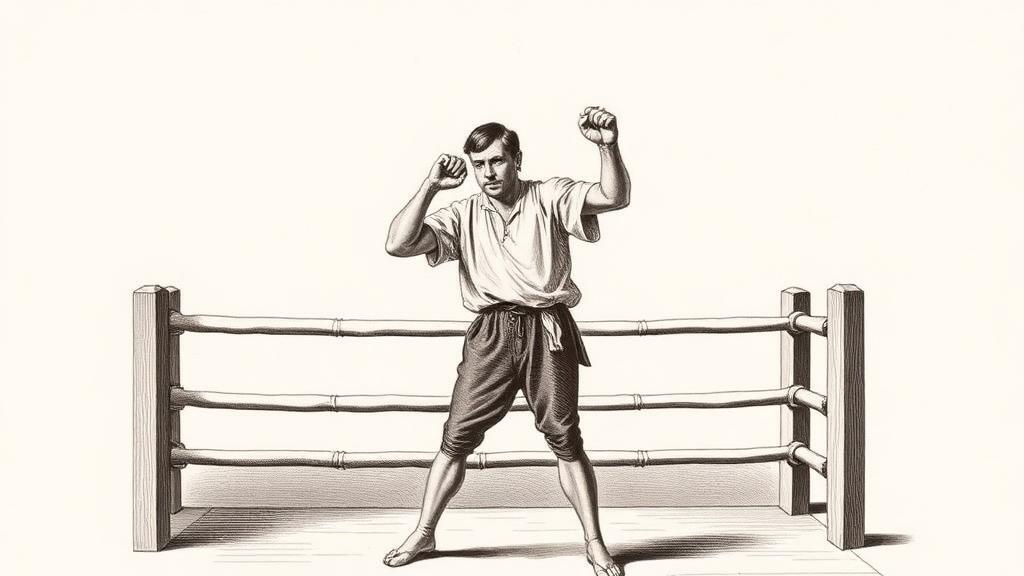
Broughton's Rules: the day boxing acquired a conscience
On 17 February 1741, a coachman named George Stevenson climbed into a fairground booth on Tottenham Court Road and fought Jack Broughton, the reigning champion of English prizefighting, for roughly forty minutes. Stevenson hit faster, witnesses noted — but one of Broughton’s blows told for three of Stevenson’s. Near the end, Broughton pinned him against the ropes and struck him above the heart, breaking several ribs. A few days later, Stevenson was dead.
Broughton was already the best fighter in England — a former Thames waterman who had won the Doggett’s Coat and Badge rowing race in 1730, then turned to prizefighting, where his reach and power had made him effectively unbeatable. What the Stevenson match gave him, alongside the championship, was a problem he could not punch his way out of: how do you run a sport that keeps killing people?
His answer came two years later. On 13 March 1743, Broughton opened an amphitheatre on Oxford Road in London, backed by the Duke of Cumberland. On 16 August 1743, he posted seven rules on its walls — the first formal code for boxing in the history of the sport.
The rules were spare, as founding documents often are. They defined a round as lasting until a man went down, with a thirty-second interval before he had to face his opponent at the centre mark or be declared beaten. No hitting a man on the ground. No seizing “by the ham, the breeches, or any part below the waist.” A two-judge dispute system, with a third-party arbiter for deadlocks. No bell, no weight classes, no gloves required — just seven clauses that told two men where the line was.
Broughton also introduced what he called mufflers for training — padded gloves stuffed with lambswool or horsehair, available to gentlemen who visited his later Haymarket boxing school without wanting to rearrange their faces in the process. Henry Fielding found the invention ludicrous enough to lampoon in The History of Tom Jones in 1749. The professional boxing world mostly agreed — mufflers stayed in the gymnasium for the next century, until the Marquess of Queensberry made padded gloves mandatory in the 1860s. The concept, though, was Broughton’s.
Broughton had one more drama left. In 1750, he lost his title — and reportedly cost the Duke of Cumberland a substantial wager — when a journeyman named Jack Slack caught him with a punch that left him temporarily unable to see. He never fought professionally again, and was eventually buried in Westminster Abbey, which is not the typical destination for a retired fairground brawler.
His rules lasted until 1838, when the London Prize Ring Rules superseded them — using Broughton’s framework as the foundation. Pierce Egan, the great chronicler of English boxing, called him the “Father of the English School of Boxing.” The title fits. What Broughton did in 1743 was not quite invent a sport — prizefighting had existed for decades — but he drew the line between a sport and a brawl: the line being, specifically, that you do not hit a man when he is on the ground.
That line is still there.
Sources
- Broughton Rules — Wikipedia — The seven rules in full, context of the amphitheatre, replacement by the London Prize Ring Rules in 1838.
- Jack Broughton — Wikipedia — Biography, Doggett’s Coat and Badge, Westminster Abbey burial, Pierce Egan’s assessment.
- This man’s death inspired the first rules of boxing — The History Blog — Details of the 17 February 1741 Broughton–Stevenson bout and the death that motivated the rules.
- Boxing History — British Boxing Board of Control — Broughton’s rules and their lineage through the London Prize Ring Rules to the Queensberry Rules.