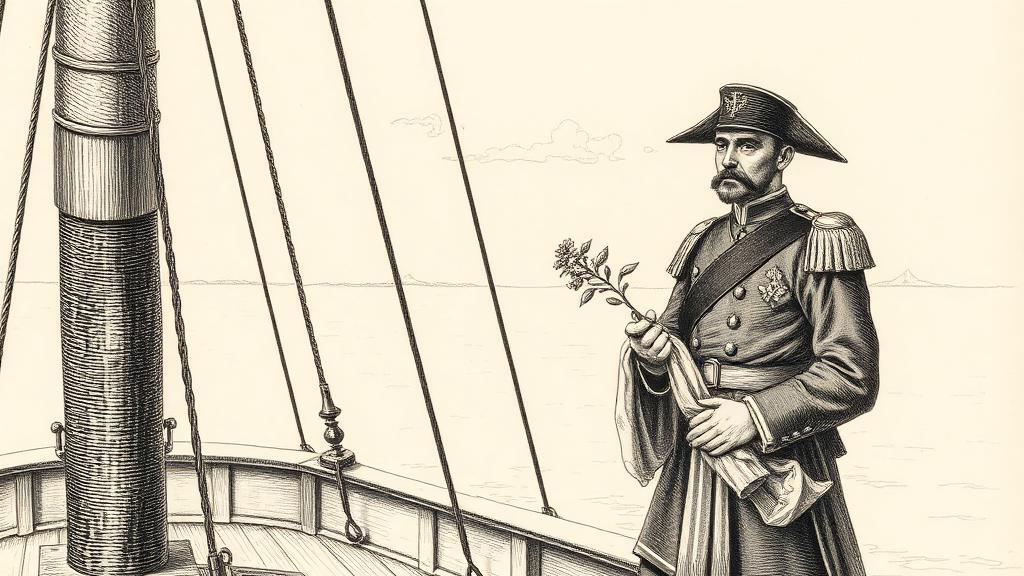
The sergeant major and the five coffee plants
On February 20, 1727, Sergeant Major Francisco de Melo Palheta sailed out of Belém at the mouth of the Amazon with five large ships, four smaller boats, and more than two hundred soldiers. His orders, signed by Governor João da Maia da Gama, were to monitor French activities along the Oyapock River and enforce Portugal’s territorial claim under the Treaty of Utrecht. He was fifty-seven years old, a veteran of Amazonian frontier campaigns, and — on the return voyage — he would be carrying something considerably more consequential than treaty papers: five coffee plants and a pouch of seeds.
Brazil had no coffee in 1727. The French did. Their plantations in Martinique, established just seven years earlier when Gabriel de Clieu coaxed a single surviving plant across the Atlantic, had begun producing Coffea arabica on a commercial scale. French Guiana, Palheta’s destination, had its own coffee groves, and France had no intention of sharing. The governor of Cayenne refused all export of seeds or cuttings — the standard arrangement for a monopoly anyone intended to keep.
What happened next exists in two versions. The story that has circulated for three hundred years involves the governor’s wife, a farewell banquet, and a bouquet of flowers slipped to Palheta at the door — the stems concealing, among the blossoms, several ripe coffee berries. The story has been repeated so often it has acquired a name: Madame D’Orvilliers. It has also attracted scrutiny. In 1727, Palheta was fifty-seven and the governor’s wife approximately fifty with four children. The mechanism was almost certainly more prosaic: later accounts note that Palheta “purchased the coffee in Cayenne” without disclosing his sources — a transaction requiring neither romance nor a bouquet, but some combination of money, discretion, and the goodwill a man commanding two hundred soldiers tends to generate in a small colonial port.
He returned to Belém with five plants and thousands of seeds. He gave most of them to the city council for distribution to local farmers and kept the rest for himself, planting them on his land near Vigia, in Pará. The French monopoly, which had survived the entire Atlantic, did not survive one Portuguese sergeant major from the Amazon frontier.
Coffee moved south through Brazil as if the soil had been waiting. By 1770, plantations had reached Rio de Janeiro. By the 1830s, Brazil was producing thirty percent of the world’s supply. By the 1840s, forty percent. The market dominance was so complete that Brazilian prices became a global benchmark, and the fate of the world’s morning cup was effectively settled somewhere between São Paulo and Minas Gerais.
Five plants from Cayenne, pressed into the clay of Pará, built all of it.
Sources
- Francisco de Melo Palheta: Brazil’s coffee pioneer — CoffeeFactz — Palheta’s rank and age, the February 20, 1727 appointment by Governor da Gama, the fleet of five ships and 200 soldiers, the Madame D’Orvilliers legend and its historical critique, the purchase in Cayenne, five plants and seeds distributed in Belém and planted in Vigia, Pará.
- Coffee production in Brazil — Wikipedia — 1727 planting in Pará as founding event; spread to Rio de Janeiro by 1770; 30% of world production by 1830s, 40% by 1840s.
- The rich history of coffee in Brazil — Orange Brown Imports — the 1727 seeds as the founding stock of Brazil’s coffee industry; the trajectory from Pará through the colony and into global dominance.