Gabriel de Clieu's water ration
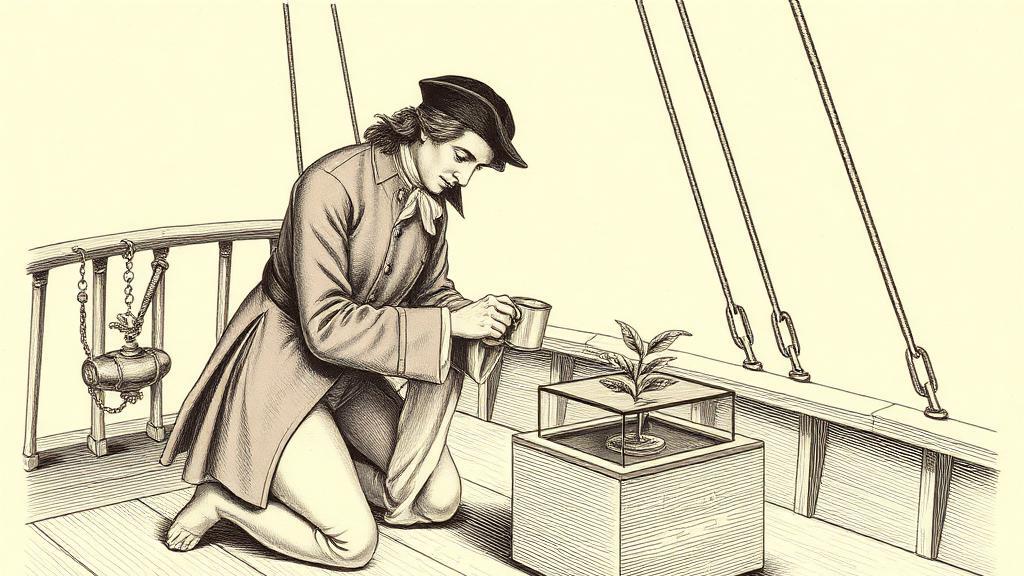
In 1723, somewhere in the mid-Atlantic doldrums, a French naval officer stood in the heat and poured a small measure of water. His own daily ration. He handed half of it to a plant no larger than a slip of a pink carnation, sealed under glass in a wooden box on the ship’s deck. The plant had already survived a saboteur, a Tunisian corsair, and a storm. The officer, Gabriel-Mathieu de Clieu, decided it was going to survive the calm as well.
De Clieu was born in Dieppe around 1687, a Norman who had risen through the French navy to infantry captain in Martinique. On home leave in Paris, he visited the Jardin royal des plantes, where a single coffee tree — descended from a Dutch specimen gifted to Louis XIV in 1714 — sat in a heated greenhouse, protected from the public and exceedingly well-watered. Wikipedia Whether he persuaded the royal physician to release a cutting, or charmed “a lady of quality” into slipping him one (both stories appear in the historical record), he emerged from Paris with three small seedlings and a glass-topped box designed to keep them warm on the crossing.
The ship left from Nantes. The account de Clieu later published in the Année littéraire in 1774 reads like an adventure novel with good sourcing: a fellow passenger “basely jealous of the joy I was about to taste through being of service to my country” grabbed at the plant and tore off a branch. A Tunisian corsair gave chase and the ship barely escaped. A storm threatened to capsize everything. Then came the worst: weeks of windless calm that drained the water casks, and a ration so thin that de Clieu shared his own measure with the surviving seedling for more than a month. Ukers, All About Coffee Two of the three plants were already dead. The third was barely alive.
It lived. De Clieu planted it on his estate at Prêcheur, on the northwestern coast of Martinique, where the volcanic soil and tropical humidity suited it perfectly. The first harvest came in 1726. Within fifty years the island counted 18.8 million coffee trees — every one descended from a cutting that a man had kept alive by going thirsty. Coffee Review From Martinique the trees spread to Guadeloupe, Saint-Domingue, and eventually across the American mainland, to Brazil, Colombia, Guatemala, and beyond.
De Clieu lived to 88, becoming governor of Guadeloupe, and was eventually presented to Louis XV as the officer “to whom the colonies and commerce generally are indebted for the cultivation of coffee.” He wrote up his account only in the final year of his life — which perhaps explains its novelistic confidence. Whether or not every storm and every spy is exactly as he remembered it, the basic fact holds: one plant crossed the Atlantic alive.
The curious postscript is that de Clieu was not, strictly speaking, first. Coffee had already reached Saint-Domingue in 1715 and Surinam in 1718. What he gave Martinique was not the New World’s debut but its definitive root stock — and, arguably, its founding myth.
Every cup of Brazilian, Colombian, or Costa Rican coffee you have ever drunk is, in some sense, a thank-you note to a man who poured his water ration the wrong way.
Sources
- Gabriel de Clieu — Wikipedia — biography, acquisition of the seedlings from the Jardin royal des plantes, and the voyage narrative.
- Chapter 2: History of Coffee Propagation — All About Coffee (Ukers, 1922) — de Clieu’s own account of the voyage, the water-sharing, and the arrival in Martinique.
- From Europe to the Caribbean — Coffee Review — the 18.8 million trees figure, regional spread, and historical context.