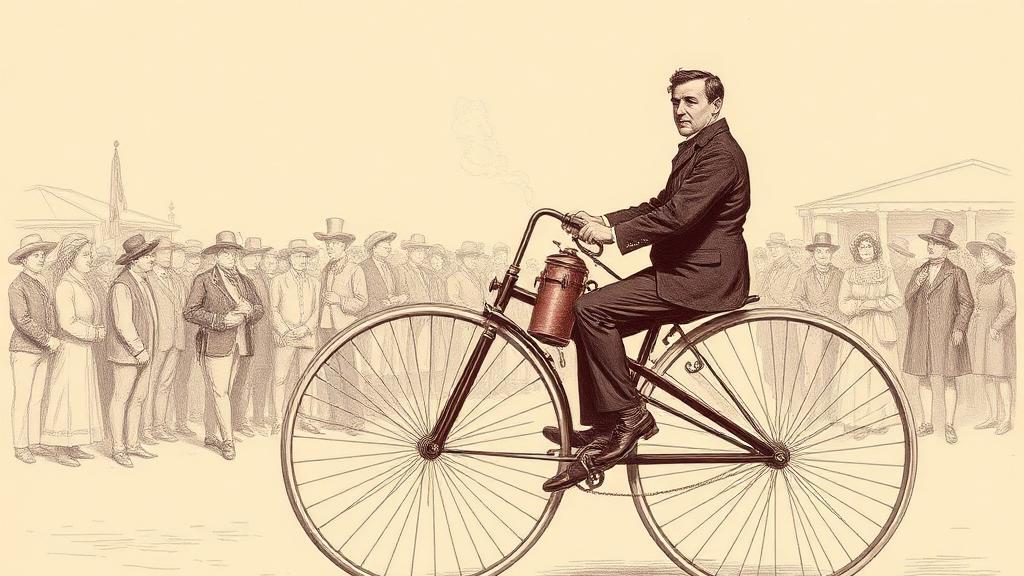
Lucius Copeland's steam motorcycle
Dust hangs over the fairgrounds of an Arizona territorial fair in 1884 when a man mounts a peculiar high-wheel bicycle — peculiar because its large drive wheel sits at the rear, not the front — and rides away from the crowd under a small cloud of kerosene steam. His name is Lucius Day Copeland. His machine covers a mile in four minutes. In a workshop eleven time zones away, Gottlieb Daimler is working on the patent that will make the whole exercise obsolete.
Copeland had been at this since 1881. Working in Phoenix, he designed a compact steam boiler small enough to mount on a standard Columbia penny-farthing bicycle and pushed it to 12 miles per hour — modest, but proof that a small engine, properly built, could fit a bicycle frame and move it. For the 1884 fair he switched to an American Star high-wheeler, a machine that put the large drive wheel at the rear to prevent the rider from being thrown headfirst over the handlebars, which was something of an occupational hazard with ordinary penny-farthings.
The 1884 machine ran a kerosene-fired boiler mounted around the steering column — roughly 100 pounds of hardware generating about a quarter horsepower at 80 pounds per square inch (Bonhams, lot 135). A single leather belt drove the rear wheel. Top speed was around 15 miles per hour, and the boiler held enough water for an hour of running. By the standards of what came before — Roper’s charcoal-fired behemoth, Perreaux’s locomotive boiler strapped to a velocipede — this was compact, portable, and fast.
In 1887, Copeland moved east, established the Northrop Manufacturing Company in Camden, New Jersey, and put the same engine into a three-wheeled vehicle he named the Phaeton Moto-Cycle, deploying the hyphenated term in an American commercial context years before European manufacturers would attempt it. He demonstrated range by driving one 120 miles to Atlantic City and back. About 200 Phaeton steamers were built before he retired in 1891 (Wikipedia) — a genuine commercial run, not a demonstration.
What Copeland could not have known was that the timing had already gone against him. In August 1885 — eleven months after his Arizona demonstration — Daimler and Maybach filed patent DRP 36,423 in Bad Cannstatt for a gasoline-powered two-wheeler. Paul Daimler, Gottlieb’s teenage son, rode it six miles the following November. The Reitwagen started faster, weighed less, and required nothing heavier than a tank of petroleum before breakfast. The case for steam on two wheels closed almost exactly when Copeland made it.
The original Copeland engine survived, resurfacing decades later at the Arizona Museum in Phoenix. In 2002, Peter Gagan, a past president of the Antique Motorcycle Club of America, tracked it down, paired it with an authenticated 1884 Star high-wheeler, and built a working replica (Bonhams, lot 135). The machine runs. Gagan, a lifelong motorcyclist, has declined to ride it. He cites the high-perch design — a reasonable position, given the era it belongs to.
The word moto-cycle, however, turned out to belong to no particular fuel.
Sources
- Copeland steam bicycle — Wikipedia — 1881 Columbia penny-farthing experiment, 1884 Star bicycle demonstration, Northrop Manufacturing Co.
- 1884 Copeland Steam Cycle, Bonhams auction lot 135 — physical provenance and reconstruction by Peter Gagan, quarter-horsepower engine, 80 psi boiler pressure.
- Lucius Copeland — Wikipedia — Phaeton Moto-Cycle, 200 units produced, 120-mile Atlantic City demonstration, retirement 1891.