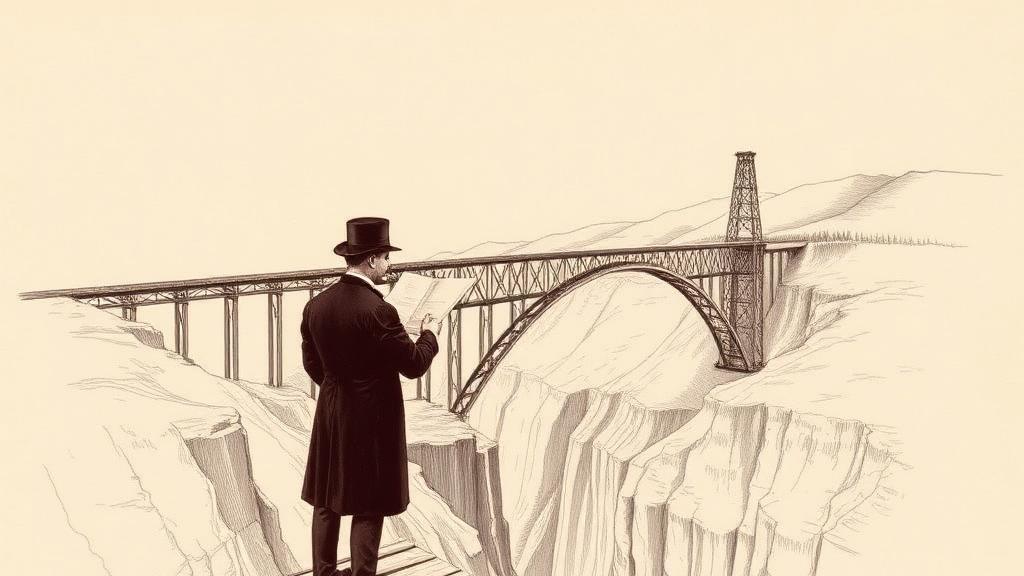
The Garabit Viaduct, or the bridge that proved the Tower
On 26 April 1884, two curved iron arms reached across a river gorge in the Massif Central and touched. The keystone was driven home 122 metres above the Truyère — higher than the towers of Notre-Dame — and with that closing the Garabit Viaduct became the tallest bridge on earth. Its engineer, Gustave Eiffel, was already thinking about the next one.
The project began not with Eiffel but with Léon Boyer, a public works engineer born in 1851 who spent the brutal winter of 1878 in a mountain gorge that the standard route planners had written off as uncrossable. Boyer designed the single-arch crossing; the state, bypassing competitive tendering, awarded the contract to Eiffel & Cie on the strength of its Maria Pia railway bridge over the Douro in Porto — a span that had held the world’s longest arch until Garabit surpassed it. Boyer lived to see trains cross his gorge when the viaduct first opened in November 1885, then sailed for Panama to oversee canal construction. He died of yellow fever in 1886, three years before the tower that Garabit made possible.
Eiffel built the 165-metre arch by cantilevering outward from both valley walls at once, each iron half advancing section by section on temporary timber supports while cables held it back to the masonry piers. For months the two halves hung over the gorge, closing the gap millimetre by millimetre. His structural engineer Maurice Koechlin calculated wind loads and thermal expansion — the mountain gusts through the Massif Central are not gentle — and every component was prefabricated at Eiffel’s workshops before being shipped south and bolted together at altitude. The finished span used 678,768 rivets and weighed 3,169 tonnes. More than four hundred French and Italian workers drove those rivets by hand, suspended over a canyon where, on 15 March 1884, one man fell from a service gantry and did not get up.
The proof came in 1885: the first locomotive, a 75-tonne engine, crept across the deck. Eiffel had predicted the arch would deflect eight millimetres under that load. It deflected eight millimetres. Not approximately — exactly.
That precision was what made the next project possible. The system Koechlin and Eiffel had proved at Garabit — iron components fabricated off-site to tight tolerances, shipped to a remote location, and assembled at altitude with no remedial adjustment — was the same system they applied to a 300-metre tower for the 1889 Paris Exposition Universelle. Same rivet technique, same prefabricated logic, same demand for millimetre accuracy at height. Garabit was the experiment. The Tower was the result.
The viaduct still carries a single-track railway line through remote Cantal, unremarked by most of the five million people who visit the Tower it enabled every year. Boyer is a footnote in the engineering histories, a careful man who spent a winter measuring a gorge so that a bridge could be built that changed what bridges — and towers — could be.
Sources
- Garabit viaduct — Wikipedia — construction timeline, dimensions (122 m height, 165 m arch span, 565 m total length), arch completion April 1884, opening November 1885.
- The Garabit Viaduct — Eiffel Tower official site — connection to the Tower project, rivet technique as direct predecessor, Eiffel’s reputation built at Garabit.
- Viaduc de Garabit — Historical France — Boyer’s 1878 winter survey, workforce of 400+, 678,768 rivets, Boyer’s death of yellow fever in Panama 1886, worker death 15 March 1884, 8 mm deflection under load.