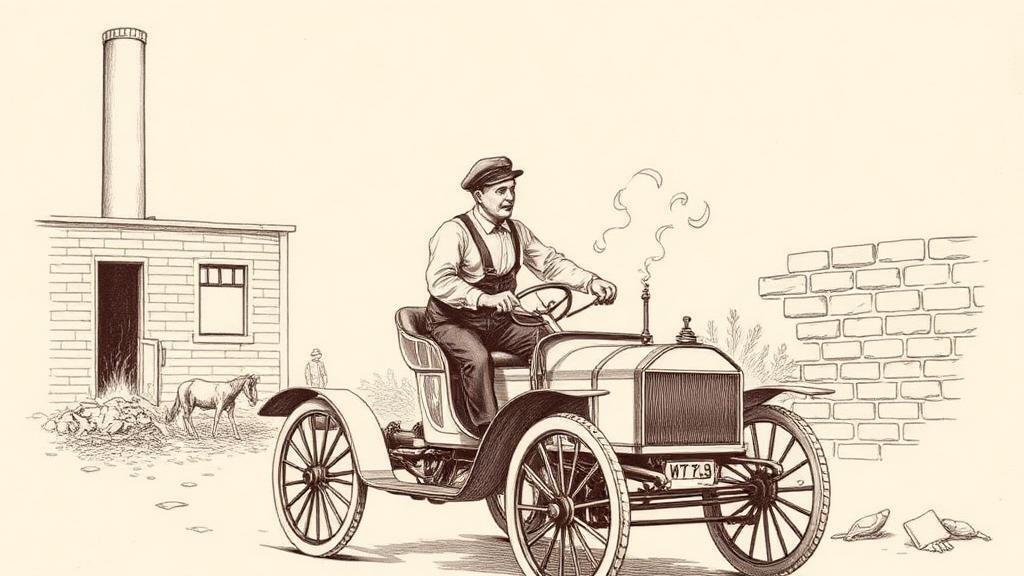
The Curved Dash Oldsmobile: America's first mass-produced car
On the morning of March 9, 1901, the Olds Motor Works factory in Detroit burned to the ground. Workers managed to roll a single prototype out the door before the building collapsed — a light, tiller-steered runabout barely bigger than a pony cart, priced at $650 and designed for people who had never owned a car. That prototype, the Curved Dash Oldsmobile, became the first mass-produced automobile in American history.
Ransom Eli Olds had been building vehicles since 1897, when he founded Olds Motor Works in Lansing, Michigan, later relocating to Detroit. By 1901 he had developed eleven distinct models. The fire erased ten of them. The one survivor was already a hit: Olds had taken more than 300 advance orders for the Curved Dash before the blaze, a detail his biographer later noted when the “rescued from the flames” story began circulating (Studebaker National Museum). The runabout didn’t need the origin myth.
The car was deliberately unimpressive. One horizontal cylinder, water-cooled, producing 4.5 horsepower; tiller steering; chain drive; a top speed of roughly 20 miles per hour (Wikipedia). It weighed about 700 pounds and seated two passengers side by side. The curved front fender gave it its name. At $650 — below the going rate for most automobiles of the period — it was engineered to be affordable, not astonishing.
After the fire, Olds rebuilt in Lansing and faced an urgent supply problem: where do you get 400 cars’ worth of parts when your factory just burned down? His solution would reshape American manufacturing. He contracted the engine to Leland & Faulconer, a precision machining firm in Detroit, and contracted the gearbox to two brothers named John and Horace Dodge, who had recently sold their bicycle business and were looking for work. Bodies and interiors went to separate suppliers. Olds assembled the pieces. The Curved Dash became the first automobile built through a network of specialized subcontractors — a structure the entire American auto industry would adopt (The Henry Ford).
In 1902, production leaped to 2,500 units. By 1903 and 1904, the Curved Dash was the best-selling car in America, with over 5,000 rolling out of Lansing annually. By the time production ended in 1907, more than 19,000 had been built. The car even acquired its own song: “In My Merry Oldsmobile,” published in 1905, became a genuine popular hit — the first time an automobile brand name was embedded in the era’s sheet-music culture.
The supply network Olds assembled outlasted the car itself. Henry Leland, who had honed his precision manufacturing on the Olds engine contract, took that expertise into Cadillac in 1902. The Dodge brothers parlayed their Olds and later Ford transmission work into Dodge Brothers Company, launching their first car in 1914. Ransom Olds had not just built a vehicle; he had seeded an industry.
Henry Ford would adopt the same subcontractor model a few years later, then accelerate it into something the world had never seen. The supply chain, it turned out, was the product.
Sources
- Oldsmobile Curved Dash — Wikipedia — factory fire story, year-by-year production numbers, technical specifications, and popular-culture impact.
- The Curved Dash Oldsmobile — The Henry Ford — subcontractor system, production method, and context within early American automotive manufacturing.
- Putting America on Wheels — Studebaker National Museum — the 300 pre-fire advance orders, the fire’s contested role in model selection, and the rebuild in Lansing.