Deep Blue beats Kasparov: the night the clock ran out on chess as a hard problem
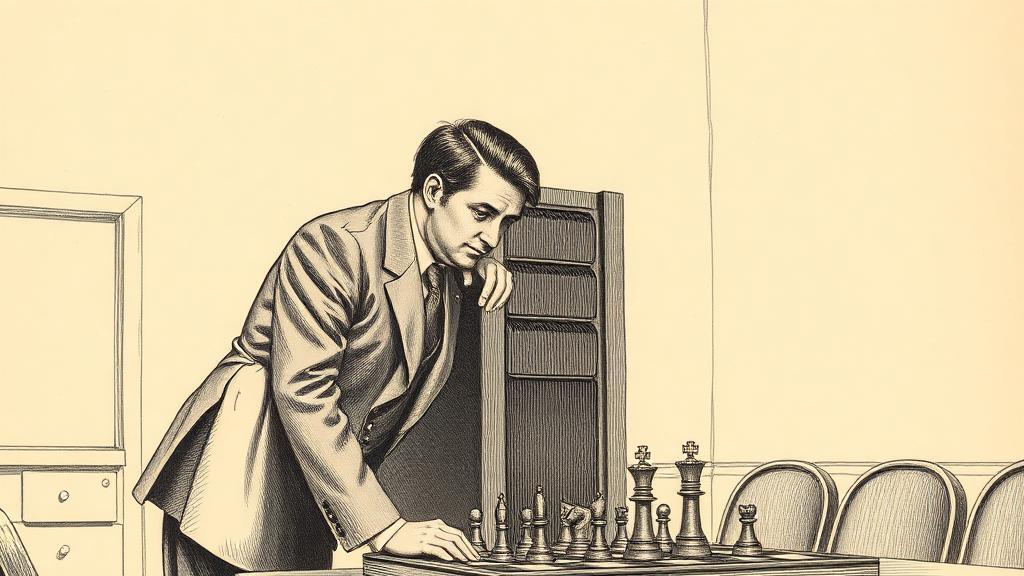
On May 11, 1997, Garry Kasparov played nineteen moves of the Caro-Kann Defense in a Midtown Manhattan conference room and resigned. The game lasted less than an hour. Kasparov had been world chess champion for twelve consecutive years; the opponent he walked away from without a handshake was a refrigerator-sized IBM supercomputer running on 480 custom chess chips.
The machine was called Deep Blue, and the final score — 3½ to 2½ over six games played between May 3 and May 11 in New York — made it the first computer to defeat the reigning world champion in a match under standard tournament conditions.
Deep Blue’s lineage ran back to 1985, when Feng-hsiung Hsu, a Carnegie Mellon graduate student, built a chess chip he called ChipTest. By 1988 the project had become Deep Thought — named partly for the computer in Douglas Adams’s Hitchhiker’s Guide to the Galaxy — and had reached grandmaster level. In 1989, Kasparov played Deep Thought in a public exhibition and won both games without difficulty. When Hsu joined IBM Research that same year, the machine was renamed Deep Blue, a quiet nod to IBM’s own nickname, Big Blue, and serious funding followed.
The 1997 version could evaluate 200 million chess positions per second, typically searching six to eight moves ahead and twenty or more in sharp tactical positions. Its opening library contained summaries of 700,000 grandmaster games. Four grandmasters — Joel Benjamin, Miguel Illescas, John Fedorowicz, and Nick de Firmian — had spent months tuning its evaluation function, which eventually comprised some 8,000 specialized rules for different position types.
The moment that haunted Kasparov was not the final defeat but a single move in Game 2. Deep Blue’s 37th move — a bishop retreat to e4 — was, Kasparov said afterward, “too sophisticated for a computer.” He was convinced a human had intervened and accused IBM publicly. IBM denied it and released the game logs; subsequent analysis confirmed the move was ordinary machine output from a position Kasparov had probably misread. But Kasparov had already decided something unnatural was happening, and the suspicion unmoored him. He arrived for the final game underprepared in the opening and was off the board in nineteen moves, without a word.
What the match settled was not that computers could think. Deep Blue did not think. It enumerated: given enough positions evaluated fast enough across enough parallel chips, the best move tends to surface. The achievement was that chess — long considered the canonical benchmark of human strategic intelligence, the proving ground that had held AI researchers’ ambitions for forty years — could be cracked by this method. Once cracked, the benchmark was retired.
That forced the field toward harder problems. Researchers who had assumed chess would last decades pointed instead at Go, language, protein folding — domains where the search space is too vast for enumeration and the rules are not cleanly written down. Deep Blue demonstrated the method on chess. Its real legacy was marking precisely where the method ran out.
Deep Blue never learned from a game it played. What came after it would.
Sources
- Deep Blue versus Garry Kasparov — Wikipedia — match results, game-by-game details, the Game 2 bishop-move controversy, and Kasparov’s public accusations.
- Deep Blue (chess computer) — Wikipedia — development history from ChipTest (1985) through Deep Thought to Deep Blue at IBM, hardware specs, the 8,000-rule evaluation function.
- How IBM’s Deep Blue Beat World Champion Garry Kasparov — IEEE Spectrum — engineering team (Feng-hsiung Hsu, Murray Campbell), grandmaster advisors, the two-tower hardware architecture, 200M positions/second figure.